Thursday, 21 April 2016

The Deer Hunter


A brief non-mothy entry today. I spent the morning reconnoitring the last stages of the route for our local Beating of the Bounds (leaving Holy Cross church, Shipton-on-Cherwell, at 11am on May Day, Sunday 1 May, if you're anywhere near. I can supply more details through Comments).

Cameraman spotted. I'm off

There were only brief spells of weak sunshine and I didn't see any butterflies, nor did I set up any moths. But the local woodland down by the river Cherwell was full of deer and here are some pictures which I managed to snatch. Deer are quick to scram, very prudently, but I developed a technique of pretending that I hadn't seen them, slowly unzipping my camera case and raising the camera as unobtrusively as possible. And then...click!


The scuts are a fine sight when the deer flee, bobbing up and down as they go

The results aren't brilliant and were mostly taken with the zoom well out. Luckily the camera has a built-in anti-wobble mechanism and I hope the pictures given an idea of the excitement of such large animals living wild on our doorstep - and many, many other UK doorsteps; deer were just as common where we lived on the edge of Leeds.

Wading through oilseed rape on last year's Beating of the Bounds

Tuesday, 19 April 2016

Sunny days...

...are here again, hooray! And with them, the sap rising in the trees and plants, not to mention young lovers such as this pair of Small Tortoiseshells.


Actually 'young' may be a misnomer judging by the frayed state of the edge of the top insect's right hindwing. I suspect that this is a couple of oldies tempted out of hibernation and reliving the giddy days of their youth last autumn and late summer.


P and I followed them along a field edge on a reconnaissance for our second Beating of the Bounds walk which is due here on May Day. Also out enjoying the sun was a Peacock and a squadron of Brimstones, the latter based appropriately on the periphery of 'London' Oxford (aka Kidlington) Airport.

The moth trap initially appeared to be a fly trap, above, but on closer inspection proved to have a small but good selection of predictable arrivals for this time of the year. Here they are, below:

Common Quaker (I think)
Hebrew Character

Common Quaker

Powdered Quaker

Clouded Drab (I think)

Monday, 18 April 2016

Shivery nights; fur coats helpful


The weather has turned glorious by day but remains chilly o'nights and that means that the real riches of Spring moths are yet to come. This is not unusual, and in previous years I have often delayed lighting the lamp until the very end of the month - which this year will mark the third anniversary of our move from Leeds. Time flies.


In spite of the cold, the regular modest snoozers in the eggboxes - Common Quakers and Hebrew Characters - were nonetheless joined last night by a nice pair of Brindled Beauties, shown in their fur coats above, and a completely zonked Pale Pinion, below.
Well, the famous surgeon Lord Moynihan had chubby fingers too - indeed they are commemorated by a cast of his hands at Leeds General Infirmary. Alas, I don't suppose I will ever get my wedding ring off, though symbolically that is nice.
Meanwhile, my Emperor Moth eggs remain quiescent. But that suits me at the moment as life is busy in other fields. Grandchildren, Beating the Bounds on Mayday, et al.

Saturday, 16 April 2016

Brrrr! And Eeeek!


Here's looking at you, pal. In spite of snow this morning, the lamp attracted a decent number of moths last night including this Early Thorn, above and below, which must present an intimidating prospect to other insects. Its fine antennae complement its unusual habit, which I noted the other day, of folding its wings vertically like a butterfly.


This particular specimen is on the drab side for the species, which can come with tasteful orange shades, especially amongst the second brood which hatches from larvae produced by this Spring generation and emerges in late summer.This moth will have hatched recently after spending the winter as a chrysalis. I imagine it is less than impressed by the weather with which its young adult life has been blessed.


There is a scarce, dull greyish variant of the main species (Selenia dentaria) known as form harrisoni, but I don't think this one of those. I must check on who Harrison was and report back. Nice to immortalised in a modest way by a rare moth.


Also among the eggboxes, a Hebrew Character (above) and a meeting house-ful of Common Quakers, a couple of them shown below.


Tuesday, 12 April 2016

Powdered and pale


Powdered Quaker

Catches in the trap continue to be modest on these cold and damp nights. Yesterday evening our house and neighbours were shrouded in a spooky mist, the sort which brings to mind murders and escaped convicts on the marshes. Such conditions also bring with them an eerie hush.

Common Quaker

The lamp shone bravely, though, and attracted three caddis fly plus an assortment of predictable moths: Common Quakers, Hebrew Characters and a Brindled Beauty. But there was also the pretty Powdered Quaker, above. Its name defies the simple traditions of the Society of Friends who have never been big on make-up. But it's a very pretty moth, I think they'd agree.

Pale Pinion

A Pale Pinion came for the second time this year, below. An interesting feature of this moth is that it emerges in the Autumn, overwinters in a hiding place under loose bark or in stone wall crevices, and then re-emerges in the Spring when it mates. It has two completely different diets, thank to this life cycle. In the Autumn it sups from over-ripe blackberries and ivy flowers. At this time of the year, it dines off catkins.

And again, from the side

Monday, 11 April 2016

Just pretending


One of the ways to tell a  butterfly from a moth (apart from browsing my handy guide  by clicking on the tab above), is to note the way that insects hold their wings.  Almost all butterflies clasp them together vertically above their bodies; almost all moths fold them back horizontally.

However, there are exceptions, as with almost every rule. Last night I was visited by one of them, the Early Thorn, a Spring moth which imitates the butterfly wing position when at rest.  It is not like a butterfly in any other way, with its dumpy body, feathery antennae and jinking, rather frenzied manner of flight. It can be on the wing from late February, so mine is rather a late Early Thorn. It's the first to come calling this year.

There were also several Common Quakers, Hebrew Characters and March moth (again, a little out of synch) in the eggboxes, some of which were damp after heavy overnight rain. Mr and Mrs Robinson's simple but wonderfully effective rainshield did its work, however, and my expensive mercury vapour bulb didn't blow.

Perched on another eggbox was the lovely Brindled Beauty below. A real tabby cat of a moth.

Sunday, 10 April 2016

Daisy Hawkeye


Today's picture comes thanks to a sharp-eyed friend of mine called Daisy, who comes to church with her younger brother (lowering the average age of our friendly gang by a considerable number of years).

She nipped up to me just before proceedings started and said: "There's a Small Tortoiseshell up on that window". Sure enough there was, above a graphic scene of the disciples weathering the storm on the Sea of Galilee. Well identified, Daisy, and thanks also to my fellow-coppicer at Weaveley Furze, Martin Knops, who whipped out his 'phone and snapped the insect.

Just before leaving, I spotted a flicker out of the corner of my eye and realised that it was the shadow of the butterfly which had moved to another window, a clear one without stained glass, in its instinctive efforts to reach the light. There is much potential symbolism in this episode; you can imagine Alan Bennett's vicar saying: "I sometimes think that we are all Small Tortoisehells seeking a way out of darkness." And needless to say, the appearance indoors of butterflies like this on warm Spring days has led to various stories handed down from the past.

In theatres, for instance, a butterfly fluttering about at a premiere is held to be a good omen - handily, because it is more than likely that one of the two main hibernating species in the UK, the Small Tortoiseshell and the Peacock, will have found the huge, cosy folds of a theatre's curtain a good place to tuck away.

Daisy was responsible for passing on news last year of a very interesting moth found in a nearby village where she and her friends were playing out. It was the Convolvulus Hawk, the second largest moth found in the UK after the Death's Head Hawk. More here and on my own encounter with this relative rarity here.

Thursday, 7 April 2016

A much-travelled Empress


 I am delighted to report more excitements on the Imperial front after the double hatching in the Palace nursery (actually a Tupperware box) reported in my last post.


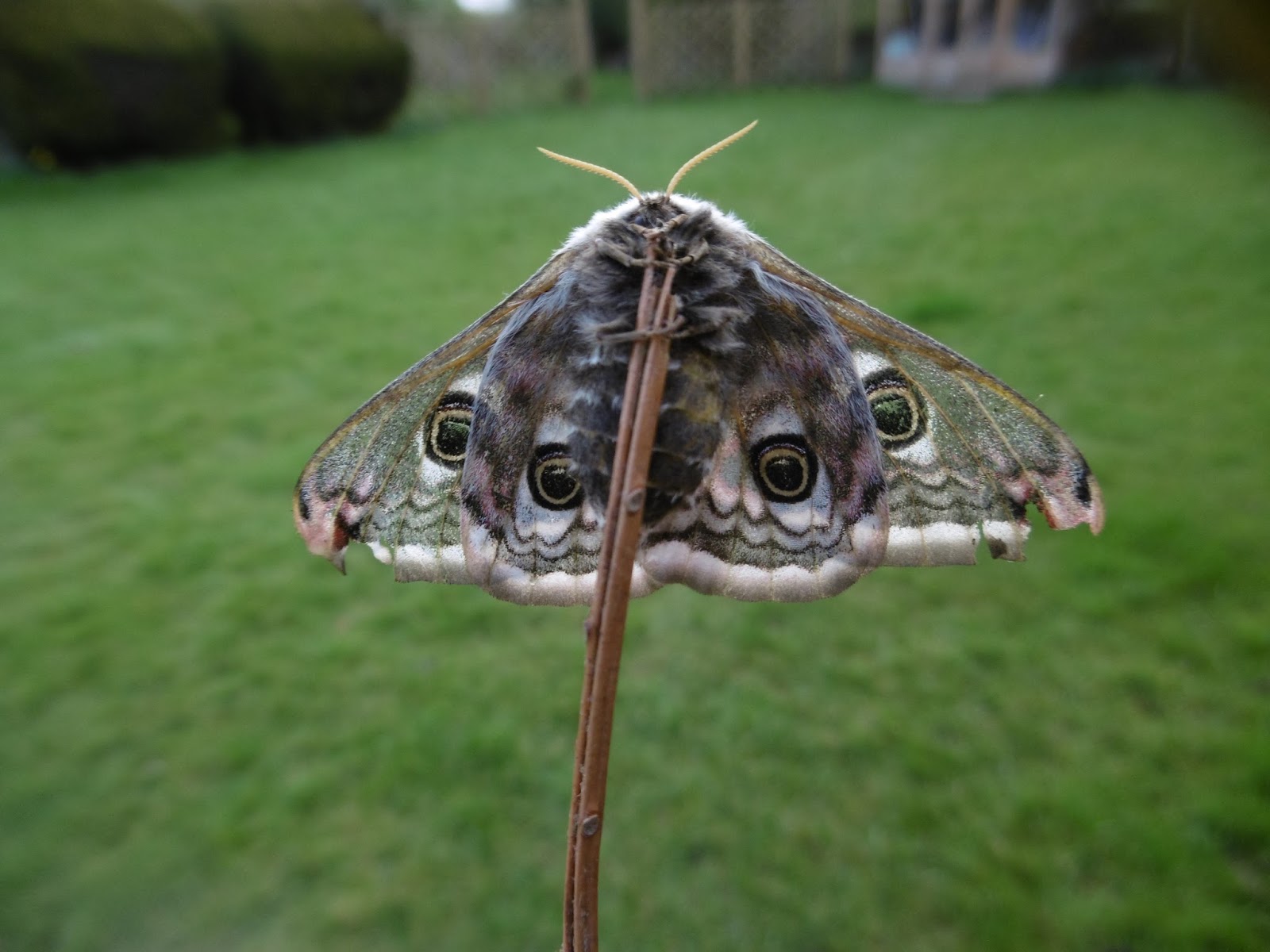
Penny and I duly took the two beautiful moths to the grandchildren in east London, where the male put up with its hosts only briefly before spiralling away into a bright blue sky. The female, however, flew only as far as the family's garden fence where she stayed all day, presumably releasing her pheromones in the hope of attracting suitors. That's the granddaughter's finger, above, showing them the way.


Emperors have this habit, apparently attracting males from up to three miles away. It's part of an extraordinarily strong breeding urge in a species whose adult moths do not eat or sup nectar and consequently live only for a few weeks - and that after spending a summer as a growing caterpillar and then up to three, or even four years in a cocoon. Nature's ways, eh.

The Empress' vigil was unrewarded, sadly, although she clung to her post through drizzle, heavy showers and even a violent hailstorm as the weather put on a vintage British Spring display. So come evening, we popped her back in the cocoon box and took her home. Not many Emperor moths can claim to have travelled 140-odd miles in their first two days of life.


I released her again this morning and she is now waiting patiently on a garden wall and I will check occasionally to see if her Prince has arrived. But meanwhile, I made an exciting discovery back in the Tupperware, in the course of trying to find out (unsuccessfully) which of my four cocoons were the ones from which the two moths had hatched.


On a hawthorn twig supporting one of the cocoons was this cluster of fresh eggs, below. Are they unfertilised? Or did the two moths get together during several hours of sharing their modest home? As they come from the same brood, will this affect fertilisation and growth? Many questions, whose answers will in due course, I hope, unfold.


Tuesday, 5 April 2016

Two years later...


Exciting news: two children of the magnificent female Emperor moth which visited the trap in early May 2014 have finally hatched. As recorded in various posts since the original arrival, the beautiful Empress laid a clutch of eggs on an eggbox - appropriately - and I managed to rear the 25 caterpillars until they formed cocoons.

A solitary male hatched last year but the others slumbered on, until earlier today when I checked their Tupperware home before heading off down to London to see the grandchildren. I brought the box into the house last week in the hope that warmer temperatures might encourage a hatch; I'd initially given the remaining cocoons up for lost, but Dave Wilton of the marvellous Upper Thames Moths blog urged me to be patient. Emperors often spend two whole years in pupation, he advised. Some have spent four years slumbering in their cocoons.

He was right. To my delight, when I checked this afternoon, there was a newly-hatched male in the box. I was in rather a rush because of getting other things ready for our London trip, but luckily I gave the box a thorough look. And there, tucked behind some sprigs of hawthorn (one of the species' many foodplants) was a lovely female too. What excellent things to show our little granddaughter, who has just been given a brother, four days ago.

Thus the moths are now in east London where I hope they make a life. We released both in the garden soon after arriving from Oxford. It's a remarkable life cycle, the Emperor Moth's. The adults don't feed and live only a few weeks during which their sole ambition is to mate. And yet they can spend over two years in the egg-caterpillar-pupa stages, just to prepare for this.


Monday, 4 April 2016

Alley moth


There is an understandable feeling among many of us that wildlife enjoys green fields and rolling hills as much as we humans do. This is not always the case. Some of the most unpromising landscapes in the country are home to a rich variety of animal and plant species. Take this alley in Walthamstow in outer east London which is where I found today's moth.

Tarmac, high walls and not particularly interesting vegetation. But it was enough to attract this littles crap of a micro-mothwhich fluttered in front of the buggy as Penny and I took our granddaughter for an expedition. I think that it's a Light Brown Apple moth, Epiphyas postvittana, which first made it to Britain from its native Cornwall in 1936. It has never looked back and is now found in most of England and Wales, a lot of Scotland and a fair part of Ireland. Please let me know if you disagree.

Our own little one was satisfied with it, after previous encounters with ladybirds, flies and a centipede on the short walk from home. I didn't know about the Australian connection at the time but will tell her when we meet again tomorrow.


Friday, 1 April 2016

Birth day moths


My mind is more on our day-old grandson than the moths, but I put the trap out last night nonetheless, to see if anything memorable might come to mark his arrival in the world. My moths have a very good record in this regard; I remember in particular a fabulous Large Emerald arriving to mark our younger son's birthday ten years ago or so. It was the first I had ever seen.


Last night was not on that scale, but it was very nice to find the handsome Pale Pinion, above, asleep in the eggboxes along with five Hebrew Characters - first pic below - and a Small Quaker - last pic. The latter is as pretty as a newborn babe, even if its colouring is the usual modest assortment of browns and greys which we associate with the Quaker family of moths. Caramel-y, perhaps, if one is looking for an appropriate link to human Quakers and their fine reputation - Rowntree, Cadbury, Fry - for making chocolate.


Have you been April Fooled? I was. Yesterday, we set up a fine pair of plump partridges, one of which spent ages on our roof ridge making distraught calls for its friend. This morning, Penny told me that there was a parrot on our neighbours' birdfeeder. And I believed her.
Wednesday, 30 March 2016

Can I have a moth on my finger, please?


Almost a month has gone by since I last set the moth trap, but I couldn't resist the question which forms the headline to today's post. Penny and my little granddaughter came for Easter with her Mum and Dad and they were preceded by an email saying: "Emily is keen to see the moths." When they arrived, she duly popped the question.


The moths obliged, most winningly in the form of the Oak Beauty, above, which agreed to be transferred from my pudgy finger to Emily's delicate one before waking up and fluttering off, initially into a spider's web. Extricating it from this was a lesson in the effectiveness of the fibre's sticky, binding nature. I am not especially keen on spiders but their spinning is a marvel of the natural world, like the silk produced by moths for cocoons.


My retirement hobby of guerrilla knitting has made me extra interested in this subject, coupled with a Yorkshire background which has given me a lifelong interest in wool. I admit that I was bored almost to death and, so far as I can recall, actually to tears by a youthful, two-hour tour of the Wool Industry Research laboratories in Leeds. But I have enjoyed learning much since, including the close co-operation between Leeds University scientists on the trail of DNA in the 1930s and local hairdressers specialising in perms, a treatment which alters the DNA-related structure of hair (please forgive my amateur handling of scientific terms, but you can read more about this fascinating episode here).


Back to the moths. The eggboxes, and in due course Emily's finger, also played host to a Common Quaker, a Crambid micro moth which I must check out later and what I think is a Dark Chestnut, shown in order in today's pics.  Update: No, it's a Clouded Drab - very many thanks for speedy advice from Ben Sale in Comments. Further update: I have now checked on my supposed Crambid and realised that it's actually a macro - the March Moth, which has come at an appropriate time of the year, unlike some other species named after months (eg the August Thorn and December Moth) which have a habit of arriving early or late. The March Moth is one of a number of UK moths whose females are flightless and spend their lives scuttling up and down tree trunks. Let's hope that evolution eventually gets them a better deal.