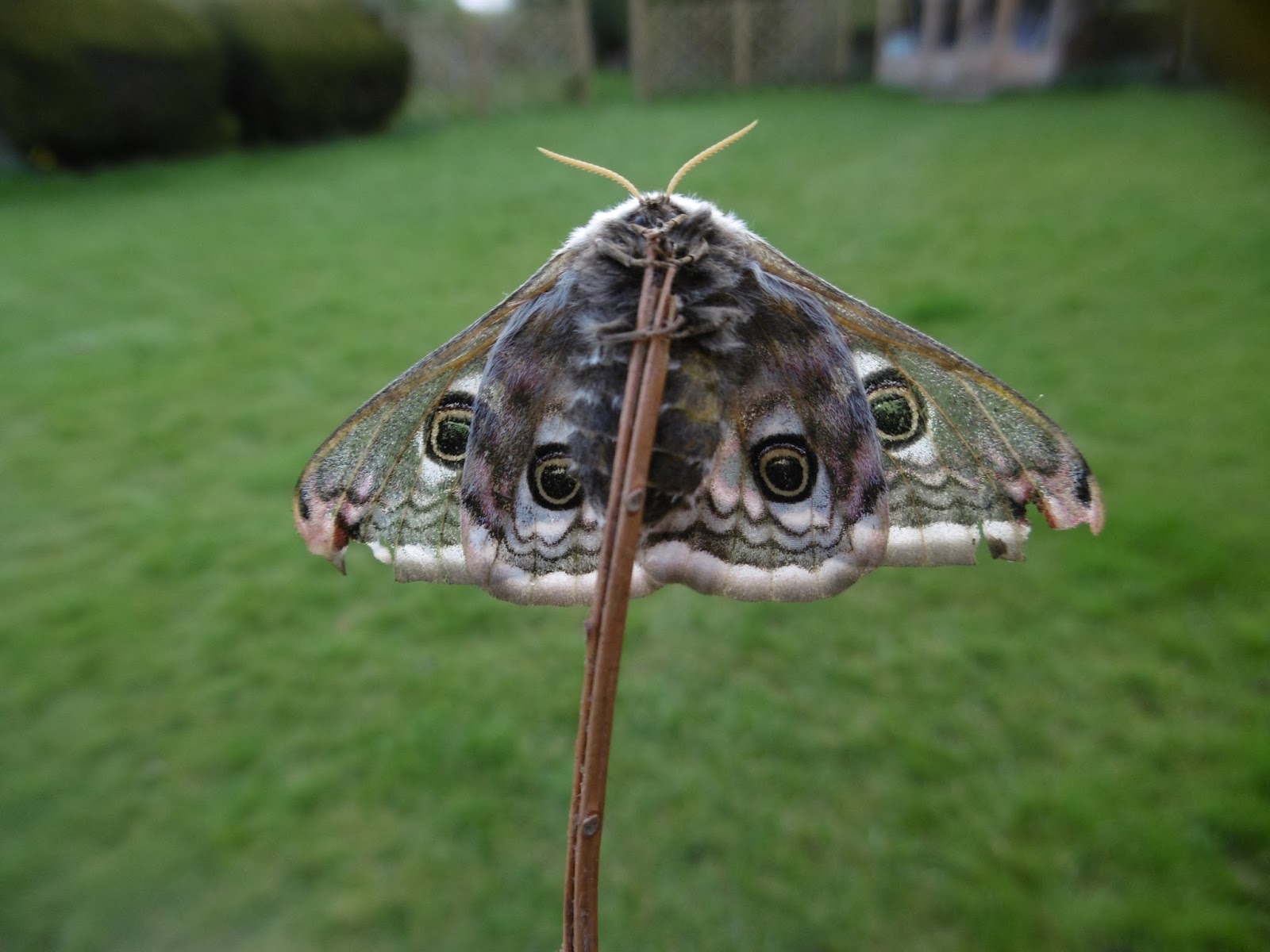
I am delighted to report more excitements on the Imperial front after the double hatching in the Palace nursery (actually a Tupperware box) reported in my last post.

Penny and I duly took the two beautiful moths to the grandchildren in east London, where the male put up with its hosts only briefly before spiralling away into a bright blue sky. The female, however, flew only as far as the family's garden fence where she stayed all day, presumably releasing her pheromones in the hope of attracting suitors. That's the granddaughter's finger, above, showing them the way.

Emperors have this habit, apparently attracting males from up to three miles away. It's part of an extraordinarily strong breeding urge in a species whose adult moths do not eat or sup nectar and consequently live only for a few weeks - and that after spending a summer as a growing caterpillar and then up to three, or even four years in a cocoon. Nature's ways, eh.
The Empress' vigil was unrewarded, sadly, although she clung to her post through drizzle, heavy showers and even a violent hailstorm as the weather put on a vintage British Spring display. So come evening, we popped her back in the cocoon box and took her home. Not many Emperor moths can claim to have travelled 140-odd miles in their first two days of life.

I released her again this morning and she is now waiting patiently on a garden wall and I will check occasionally to see if her Prince has arrived. But meanwhile, I made an exciting discovery back in the Tupperware, in the course of trying to find out (unsuccessfully) which of my four cocoons were the ones from which the two moths had hatched.


On a hawthorn twig supporting one of the cocoons was this cluster of fresh eggs, below. Are they unfertilised? Or did the two moths get together during several hours of sharing their modest home? As they come from the same brood, will this affect fertilisation and growth? Many questions, whose answers will in due course, I hope, unfold.