Tuesday, 19 July 2011

Whispering sweet mothings


There should be plenty of Riband Waves here next year, judging by this contented pair which spent at least two hours in blissful union on the side of my shed. Their passion seems to have made them oblivious to moths' usual use of camouflage although the fact that they remained motionless preserved them from the many passing birds. We have a whole family of long-tailed tits in the garden, fledged this year, who give every appearance of enjoying life. They zoom around in a gang like teenagers, showing off their flying skills and twittering all the time (just like so many people these days...)


Sex isn't specially on my mind, but there is something priapic about this little chap - a pug? - who was dozing not far from the Riband Waves. I've speculated before about this curious way that some moths hold up their tails and this time I Googled. I found a Yahoo thread headed Why do moths stick their butts in the air? which has interesting info about the insects possibly (a) releasing pheremones to attract the opposite sex; and (b) emitting ultrasound 'whispers' to the same end. This led in turn to another fascinating internet page which contains the memorable lines:

Males of the Asian corn borer moth (Crambidae) were recently shown to whisper extremely low-intensity ultrasonic courtship songs close to females.

Never let anyone tell you that moths are boring - even corn-boring ones. And here's an enticing moth's-eye picture of the approach to my light trap just to round things off.

Monday, 18 July 2011

Interlude with a volcano

I was going to write about mating moths this morning after an intimate discovery on the side of my garden shed. But I was reading online last night about the latest Indonesian volcanic eruption and I suddenly thought: 'Mount Lokon? That rings a bell.'


Indeed it does. Here it is in December 1985 when I was standing at the bottom trying to work out a way to the top. The smudgy zigzag to the right of the peak looked promising; it was a rare day of sunshine in usually humid, cloudy Sulawesi (formerly Celebes); and the whole scene was pleasantly reminiscent of Blencathra or somewhere like that.

In the event, what appeared from a distance to be springy turf was head-high elephant grass whose leaves have edges so sharp that you're sliced before you know it. The five of us (on an expedition organised by the Royal Entomological Society, which is at least a link with moths) soon looked like members of a flagellants' club. Worse was to come. The summit seemed a humdrum place with several empty bottles of Bintang (Star) beer dumped by previous visitors, but the descent was a nasty reminder that volcanoes need treating carefully. We were puzzled by the apparent absence of a crater but soon found ourselves unable to see anything more than 20 yards away as we climbed down into a thick, hot and sulphurous world of steam.


The climb became a slither, but luckily the eerie canopy lifted in time for us to see that too much more sliding on the rust-coloured scree would take us - woosh, plop! - over the rim of the crater into bubbling, boiling water to add flavouring to what looked un-nervingly like pea soup. I can genuinely say that the colours in my very amateurish watercolour are more true to life than the muddy effort of my then inadequate camera. We returned to base camp in the Dumoga-Bone rain forest wiser and more cautious than we were before.

Sunday, 17 July 2011

Hello to the Lobed


A new moth this morning and one I'm glad to see because I've noticed its picture in my moth Bible in the past and thought: well, that's one even I couldn't get wrong. It has an idiosyncratic pattern of pallid colour shaped like an egg-timer or Marilyn Monroe, although in the latter case the comparison ends there. Mind you, this one seems to have two small security staff scurrying about. I can't tell you how many little flies like that come to the trap at the moment. I don't know why the Double Lobed hasn't been here before as it's apparently common. However, the book lays it on thick about how much it likes damp places and Leeds definitely qualifies in that respect at the moment.


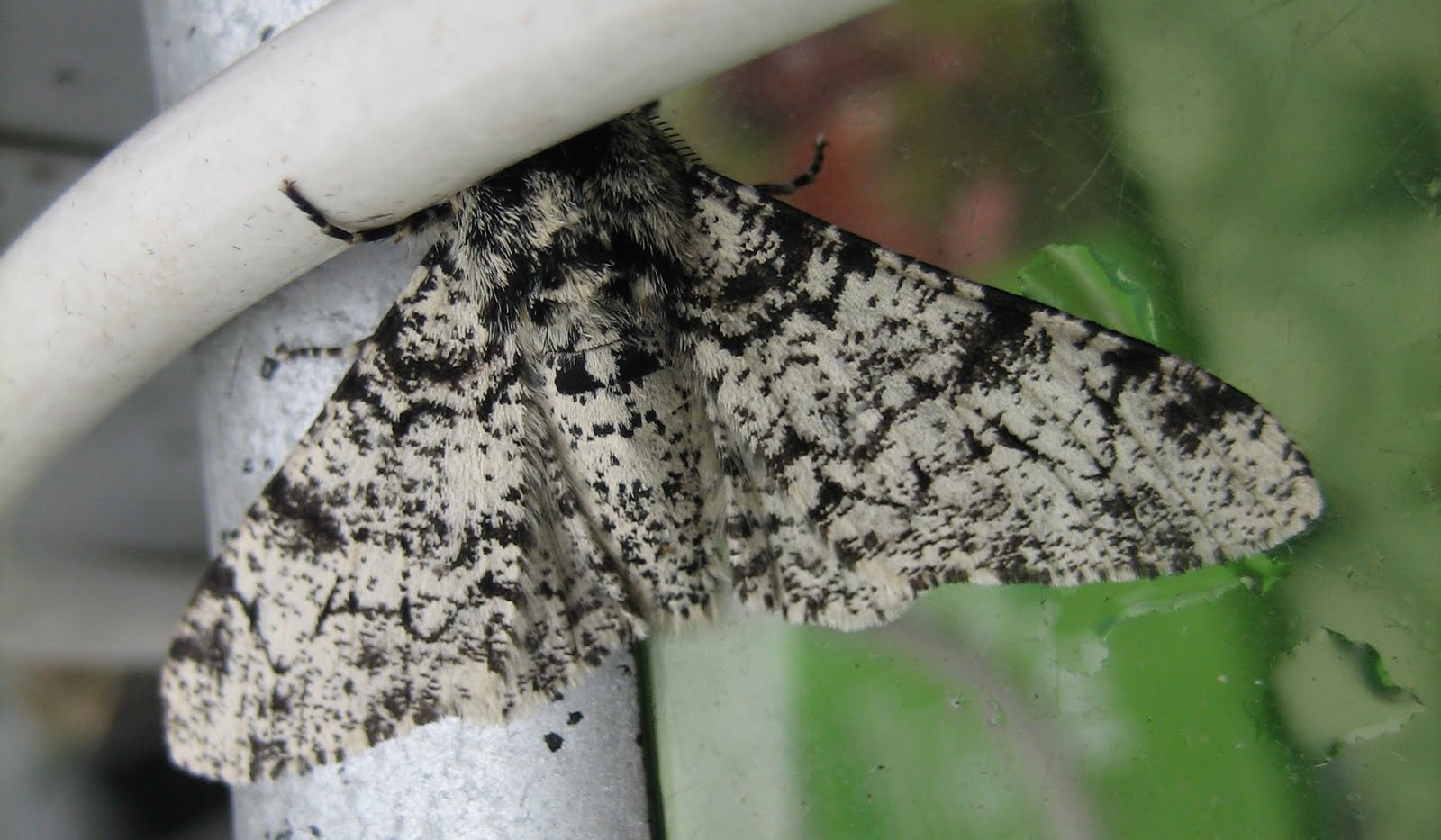
I've posted a lot about the Peppered Moth in the past and you can spend all day Googling about its special place in Darwinian theory and all the counter-attacks of the Creationists. I have better things to do, embarking on Day Two of majestic birthday celebrations for Penny, but here are a couple of pics cos it's such a lovely creature. A propos the Darwinian side of things, melanistic specimens are getting rarer and rarer these days. I've not had one here for at least two years.

Friday, 15 July 2011

Where's the moth?


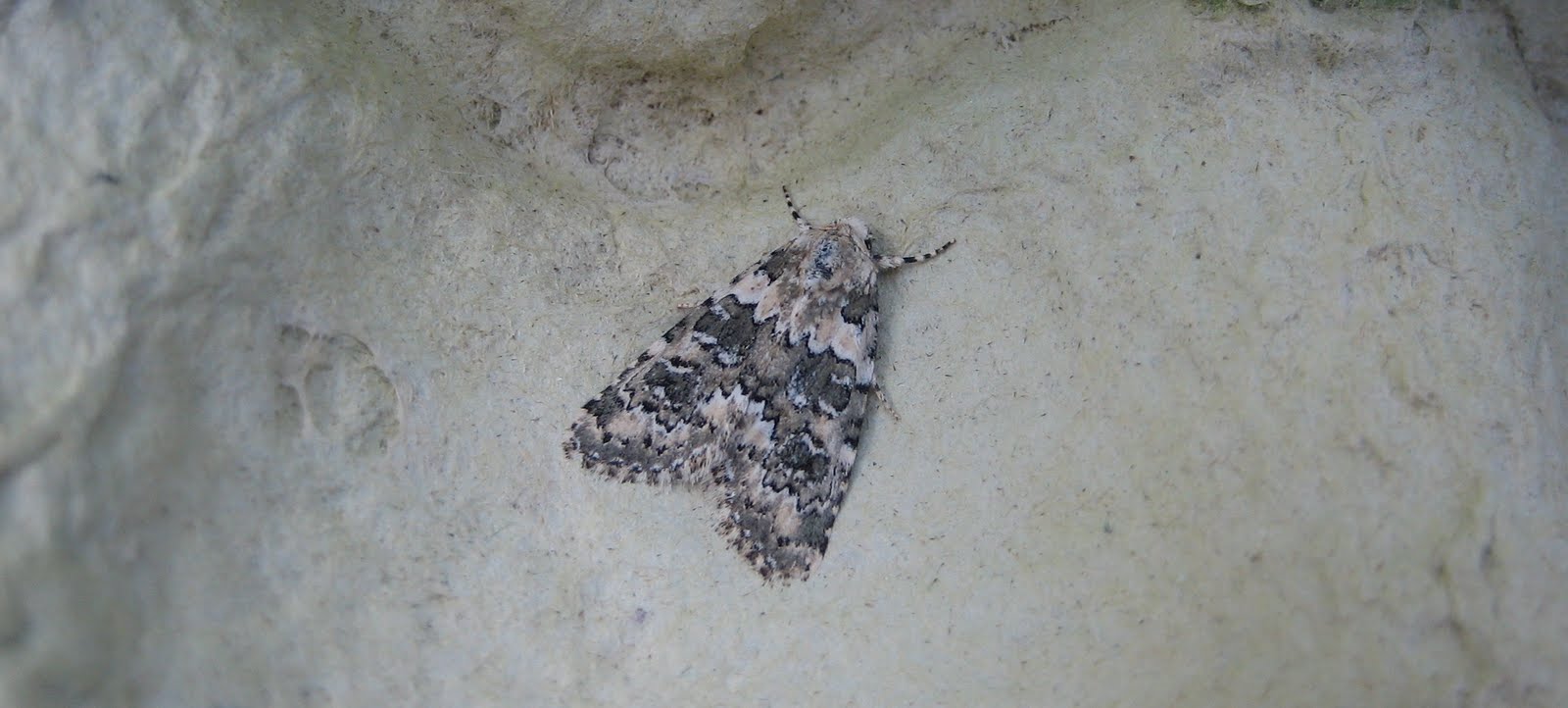
Moths are masters of camouflage and here is a Marbled Beauty to give us a lesson. Now you see it - below. Now you don't, or hardly - above. It's also a moth with a fondness for old buildings according to the experts; presumably plenty of crumbling plaster and flaking window frames can help it to hide.


This morning's other little star is this beautiful Tortrix moth, a micro which deserves the term as my special Penny Wainwright Pencil Scale shows. After much Google-imaging, I am pretty sure that it is Acleris forsskaleana whose surname intrigued me, so I clicked and Wiki-ed on.


It's worth reading the entry on Pehr Forsskal, whose name was given to the moth by Linnaeus himself, who also Christened a plant after the young Finn because it was similarly tenacious and stubborn. Forskkal seems to have been an all-round good egg, writing a Treatise on Civil Liberty which the Swedish authorities promptly suppressed. Here's a Wiki-pic of him looking tenacious but nice. What on earth would the moth make of all this?

Thursday, 14 July 2011

A flag for Mothland


If there were a country called Mothland, maybe this could be its flag. I always enjoy pictures where moths seem to be reading the instructions and advertisements on the eggboxes. This morning, the happy coincidence of an eggbox (complete with Angle Shades moth), red towel and grass looks like the banner of a freshly emerged nation. Here's the latest, for example: the flag of South Sudan.


The Angle Shades has a particularly sophisticated version of the shuttle-shaped marking common on the wings of many moths. Here's another example which visited last night: the Shuttle-shaped Dart with its neat little needle's eye. It reminds me of a clergyman. The eggbox seems to be imitating an advert for 'Jaws'.

Wednesday, 13 July 2011

Tawny and Dots

The headline today sounds like one of those TV police duos such as Starsky and Hutch. Actually, it's a couple of nice but unassuming moths. One of them is new here - provided that I have identified it correctly, which regular readers will know is a big 'provided'.


Here it is and I think it's a Tawny-barred Angle, although I wondered for quite a while if it might be a melanistic or dark form of that familiar regular, the Riband Wave. This led me to a fascinating website thread by birdwatchers which you can read here, all about moths' internal genitalia and including a photograph of a Gatekeeper butterfly apparently trying to mate with a Painted Lady.

That sounds like something out of fiction, too. Mind you, the Painted Lady always has done; even as a child I used to wonder if it was slightly disreputable. Here's the second half of today's pair, meanwhile: the Straw Dot, below. A nice little moth which apparently has recently become scarcer in the north of England. So a special welcome.

Monday, 11 July 2011

Beautiful visitor


The Swallow-tailed moth. What else can I say? Very familiar but very beautiful, and for once my camera hasn't picked up any reflected glow from the black of the trap bowl. If you know nothing about moths, you may have come across this one. It is drawn to lighted windows on summer nights, as well as to traps like mine.


The Brown China-mark is another lovely moth and Sherlock Holmes would make one deduction about my garden from its presence. "Drag the pond, Watson," he might say, as the pair of them search for the body of one of the fiendish Moriarty's victims. "The pond? My dear Holmes, how can you tell that there is a pond?" "Elementary, Watson. If there is a Brown China-mark moth, there will most certainly be a pond. Its caterpillars feed exclusively on aquatic plants.'

Update: just how good a detective would M.Wainwright really be, though? See comments...

Sunday, 10 July 2011

Little and large


Big, small and in-between in the trap this morning. At the big end, this Poplar Hawk is in very good condition, and interesting proof of how long generations can last. The first one this year arrived as long ago as 26th May and its generation has been recorded as late as early August, with a second one sometimes hatching in August and September in southern England. But emergence from the chrysalis will be staggered within the period, like London buses, and I'm sure that this one can only have hatched recently. I'm glad to have caught its maroon blotches and also the weird way it slides its underwings forward beneath the forewings. When fully 'sheathed', they stick right out in front.

In the middle range, here's a boldly-patterned Dark Arches, left, and our variable friend the Mottled Beauty, below right. Both species have been visiting for at least a month but, again, these two look very fresh.

And finally, that familiar micro with its sort-of specs pattern, which completes a trio of long-lasting species. Examples have also been arriving since May. For once, I managed to find something to give scale and show how titsy it is. On my first study of the eggboxes, I missed it altogether. It pays to have a second look.

Saturday, 9 July 2011

Not a lot about moths

I usually spend time here bewailing my inability to identify small brown and/or grey moths. There'll be another example in a mo. But first, here's some triumphant identifying of human beings, including myself when young. Even though we're grey too, or at least black and white.

I think I mentioned some time back that a flurry of nostalgia among my old university pals has led to much emailing of photos, mostly of elderly gents (we were all boys in 1968; the girls had to climb in), but including the original of the blurred one I use in the little blog corner about who I am (or was).

This coincided with one of the regular outbreaks of 'Oxbridge mafia' charges at The Guardian which always get some readers excited about a supposedly contraband list of members, including my innocent self. There's no secret about any of it. For better or worse, I was at Merton College, Oxford, in the good old revolutionary days and here we all are: my fresh-faced year in 1968.


I'm the saucy one three from the left in the front row, looking as though I'm enjoying a private joke with a moth. But more interesting is the guy with the Beatle cut two rows back from me, two from the right. That's Sir Alec Jeffreys who has done more good than the rest of us put together, through his work on DNA fingerprinting. The chunky guy to his left is Chris Laidlaw, then a New Zealand All-Black who I see from his Wikipedia entry is keeping the spirit of '68 alive, huzza.

When we all exchanged emails with pics of us as old giffers, Sir Alec apologised that his had the curious catchline 'stamp' - left over from an initiative by the Royal Mail which sadly apparently has to wait until he is in Heaven. Personally, I say: 'We demand a commemorative stamp for Sir Alec Jeffreys now!' And now, before I go and have my breakfast, here is yet another mystery moth, below. Does anyone know what it is? A Snout of some kind? A Fantail type? And does it really have a green sheen, or is it picking that up from the eggbox? I just clicked on it to enlarge it, btw, and notice that half of its left-hand antenna is missing. Poor thing. Update: Ah-ha, Gotcha! See Comments.

Friday, 8 July 2011

Head-on view

It was a bit of an exciting day yesterday, what with the News of the World imploding. I was down in London at the Guardian's head office when the news broke and it was one of those moments which won't fade quickly from my memory. Actually my own role in events was characteristic; I had was just sitting back contentedly after finishing a story about...moths. It's linked here, and you may be interested in joining the great Horse Chestnut - Save Our Conkers survey.


Meanwhile the lights have come on again all over the world, as Vera Lynn sang; at least they have in my garden. Above is a quizzy creature for you. Recognise it? It's actually a common but very beautiful visitor as shown - don't look now - at the bottom of this post. Moths' faces are extraordinary, but this is what a flower would see, if it had eyes.


Meanwhile here is a tiny visitor which makes big headlines. The pip-sized Spindle Ermine is the moth which can weave those dramatic but harmless canopies of silk which occasionally take over whole lines of trees, parked cars etc and prompt Doomsday articles in, well, papers such as the News of the World. Talking of Doomsday, I came home late last night to find that there had been a major fall of hail. In July! But it's actually keeping very warm.

Oh and here's the quiz answer. The good old Burnished Brass:

Thursday, 7 July 2011

Mmmmmm.....

On Tuesday I was jealous of my American friends Sarah, Greg and family and their Luna moth. Today my envy is closer to home, with this picture from Kay Easton, a neighbour just up the hill here. She kindly sent me this picture of a visitor to her garden - very kindly, as work is still stopping me from trapping at the mo.


I spent ages taking pictures of these in Paxos last year and reproduce my famous (to me) 'miracle' photo of one below with its Heavenly sunbeam. But they're everywhere in the Greek Islands and altogether much rarer here. The last time I saw one in the UK was in Manorbier, near Tenby, when I was ten.


They do keep coming, though. I've been checking my ancient record books and the lists for Yorkshire compiled by George Porritt between 1883 and 1922 record instances from Barnsley to York, while describing the moth as 'very uncertain in appearance' apart from a scorching annus mirabilis in 1865. The excellent journal Atropos meanwhile shows that 27 were trapped at Spurn Point last year, one of the ring of coastal monitoring stations which I described in the Observer article the other day. Check out Atropos' great website, with its 'Live Flight Arrivals' icon - for moths not EasyJet planes.

Hoping Kay's lovely moth comes my way - though not to the trap. It's another of the daytime flyers.

Tuesday, 5 July 2011

Peek-a-Boo

Sorry I'm so late today; things have been busy. For the same reason I didn't switch the trap on last night although it was balmy weather. Tonight, maybe...though we've just had a very welcome sprinkling of rain. Things are getting to look a bit parched - it's interesting how quickly that happens.


Anyway, here are a couple of pals from last time the light was on. The Dark Arches above is saying in moth language, I am sure, "Leave me alone. Don't you know what time it is?" The Small Fanfoot below just looks so nice that I wanted to share it with the world. It's how I imagine Jane Eyre.


Finally, another quiz time, although this one is probably only for my kindly American pals unless there's someone very knowledgeable elsewhere in the world. My friend the excellent painter Sarah Meredith was dozing away the other night in the muggy weather they're having in upper New York state (where everywhere has familiar names such as Delhi and Cairo but they're all pronounced differently, eg Del-Hi and Kay-Ro). Then she heard a flutter or possibly a scrabbling and peering out into the darkness, beyond her eminent husband Greg's foot, she saw this beast on their window screen.

"

It was half the size of my palm - the biggest moth I've seen here since a Luna when we moved in," she emails. A Luna! Oh lucky America! Well, I've no doubt that it's a hawk moth of some kind, but does any Sphingidae expert know which one?

Monday, 4 July 2011

I wouldn't if I was you

I've been too busy to trap this weekend, though I watched some moths last night over a candlelit glass of wine outside in the gloaming. Yes, England really can be like this. So here's a picture I took on Friday of a bold Light Emerald about to go abseiling. It survived the experience and fluttered away.

In case you ever wondered, here's another picture from Friday showing what a moth trap looks like - to a human. The eyesight of moths is still the subject of much study but they seem to see a sort of kaleidoscope of images. You can imagine what a great big shining light, much too bright for we humans to stare at directly, does to a delicate system such as that.


And now it's quiz time. Does anyone know what lives in here, above? Spiders, I suspect. Or maybe insect larvae. I didn't think it right to disturb them, but please tell me if you recognise the architectural style.

And finally, right, all sorts of moths are venturing out into the sunlight when you brush past bushes. Here's one of those extraordinary T-shaped micros with the pleasantly human-sounding name of Emmelina mondactyla - Emma Singlewing. It has to unroll its wings like a Venetian blind before scooting away.

Sunday, 3 July 2011

A blaze of unexpected colour - shield your eyes...


Yippee! This is more like it! I have dutifully brought you a series of small and interesting moths the last few days, but I have secretly been yearning for colour. Here it is! We're having a family bramble-bash/gardening marathon this weekend at my late Mum's garden, ready for a fun commemoration of her life later this month. The sun's blazing and the butterfleis are out - I'm glad to say; there haven't been as many so far in this warm spell as I'd have expected. I think it's coincided with a time when one brood is almost over and the next one not quite hatched.


AND the moths were out too. The two top pictures are a day-flying Six Spot Burnet which enjoys the sunshine as much as any butterfly and has an equal dislike of the dark. After posing on the thistle for a while, it whirred off like some bizarre helicopter until I found it again on the grass blade. The flight method is strange indeed but colourful, as the red hindwings are particularly prominent if blurred by rapid flapping. I'll try to catch one in motion with the camera today.


My bramble-bashing also disturbed lots of the pretty creature in the third picture - Yellow Shells which are sort-of day-flying in that they doze lightly in hedges and are only too pleased to take a little flight if disturbed. And the butterflies were out too: Tortoiseshell, Comma, the first Red Admiral I've seen this season, assorted Whites and this Meadow Brown (right - and look at its wing 'struts' like an old biplane's) and Ringlet (above, swoon). The last two were the only ones which settled long enough for my ageing photographic methods. They have mothy brown colours, but aren't they lovely? I still remember my excitement when I first caught a Ringlet in the old netting days. Probably around 1958... So here's another one - and below that, a couple of Meadow Browns getting ready to make sure that next year sees a good lot too.


Saturday, 2 July 2011

Thumbnail sketch


"Ah, the pugs!" said a more experienced mothing friend not long ago. "Wait 'til you get to the pugs. You'll love them." Well, I'm not waiting, but the pugs are. For my love, I mean. I think the presumed leisure of retirement will be the only way to kindle passion, when there's time to sort out these tiny creatures which to my notoriously unforensic eye, all look alike. And there are about 50 of them, all classified as macro moths in spite of their diminutive size.


At least this one has various distinctions, especially that lovely russet colour, like a warm brick in the current sunshine. So I'm risking my tattered reputation to say that it is a Double-striped Pug (you can make out the double stripes too, just, slanting down the wings.) Meanwhile here is a micro on my thumb, to show how small they are. Mind you, it's not got to grow much to outdo a pug.

Sorry, I do bite my nails. Always have, always will. It's the only safe way. So-called 'nail' scissors tend to cut to the quick and I can't understand how to use those clipper things.

Friday, 1 July 2011

Minimalism


Tiny moth, tiny post. I tried the trap in a very shady area last night and the catch fell spectacularly. There were half-a-dozen Light Emeralds, three Mottled Beauties, a clutch of Hebrew Characters, Dark Arches et al. But the only novelty which caught my interest was this little chap on my dressing gown. So far I have Googled 'tortrix, micro moth, dotted and chequered' in various combinations without success. But as Che Guevara always said: 'La lutta continua. Hasta la vittoria siempre.' Or words to that effect.

Update: Yay! The mighty Ben Sale has done the business already. It's Lozotaenia forsterana, which doesn't seem to have an English name. So I hereby Christen it the Chequered Tortrix.