Tuesday, 27 April 2010

Orange and green

The sun has come out and so have the butterflies. The nights remain cold, and the moths are staying in. That seems to be the situation at the moment, with only a smattering of Early Greys, Drabs and Quakers dozing in the egg boxes of a morning. Hence a bit of a gap since I last posted, and I've also been away - down on the Malvern Hills from which today's exciting and complicated photos come.

Chris Thomond and I were on the British Camp making the latest of our Britain's Best Views extravaganza of films for the Guardian website and we diverted to West Malvern to do a bit on the water; they have the wonderful Hayslad gusher there - pure Malvern Water streaming free from a double-headed brass pipe. A non-stop succession of people called by with jerrycans while we were there, some from as far away as Birmingham and one topping up his car battery with the (naturally distilled) stuff.Opposite the gusher there was a pretty clump of that lovely Spring flower which I call Milkmaids - aka Lady's Smock or Cuckoo Flower, and we filmed this to go with some bluebells as typical of the abundant flora and fauna of the hills. Don't let anyone tell you that Britain's wildflowers are a thing of the past. They are everywhere. And while Chris filmed away, I wisely observed: "Milkmaids are excellent because they attract Orange Tip butterflies..."

And Lo! Into the scene fluttered a newly-hatched male OT, which then led us a merry dance as the main picture shows (plus the massively blown-up detail here in the small one, just above, left). It was like the badgers in the Fast Show. We got film of it in the end, though, and here's my own pic of it, fortuitously with its proboscis busying away, like a child sticking their tongue out in a school photograph.
This all happened on Monday but it's Tuesday now and there's another male Orange Tip fluttering daintily round our garden here in Leeds. Only the males have the orange, but both sexes are graced with the wonderful delicate greeny-grey patterning on their hind underwings which you can just see in the pic.

Wednesday, 21 April 2010

Quiet spell

We've just celebrated Tamil New Year with our excellent in-laws. A green woodpecker hopped around their garden in Dorridge, south of Birmingham, which has to be a good omen. I tried to photograph it but failed completely. Ditto my efforts to stalk the first Orange Tip of 2010 back here at home. It was like the badger spotter in The Fast Show; whenever I looked out of the window, the Orange Tip was there; by the time I got outside with my camera, it wasn't. Luckily Radha, mum to our lovely daughter-in-law Abi, has stepped in and sent me this photo of a Peacock which she took with her mobile phone.

Also, as divine punishment for my teasing Steve Thorpe over his nine moths, I got just ONE in the trap the night before last, a solitary Hebrew Character. It was freezing cold which I suspect has sent all sensible moths to re-hibernate for a spell. Lean times. But it doesn't matter. Summer is on the way.

Here's today's brilliant Jessiebug from Borneo. I think (and hope) that's it's old skin, rather than a mate who's been cannibalised.

Monday, 19 April 2010

Rookery nook


Rain stopped trapping last night, but Nature is exuberantly busy elsewhere in the garden. And indeed the house. We came into the kitchen to find a crow (no it's a jackdaw - see Steve Thorpe's helpful comment) had come down the chimney, somehow avoided death in our fake flame gas fire, and got into the usual state of panic on the windowsill. We eventually ushered it out of the back door with cooing noises and a broom. Much as I like birds, I wish the crows (sorry, jackdaws) wouldn't nest on top of our chimneys. I pot at them ineffectively with my sons' old BB gun; but maybe the horrors experienced by this one bird may put them off, if it has the means to describe or at least communicate the nature of its awful time.

Meanwhile, our customary ladybrid infestation continues apace. This red-on-black one had chosen a dangerously intimate place to explore. I'll leave you to guess what the porcelain background portends. Ladybirds are everywhere in our house overwinter; lift a window and ye shall find them, unjam a door and they are there. Aphids beware!

Finally a bit of beast from Jessie in Borneo. I've still not had time to start identifying the Jessmoths, but would that the UK had some like this. (Steve helps here too - it looks as though it's an Indonesian Moon Moth - many thanks S!)

Sunday, 18 April 2010

Time for tea


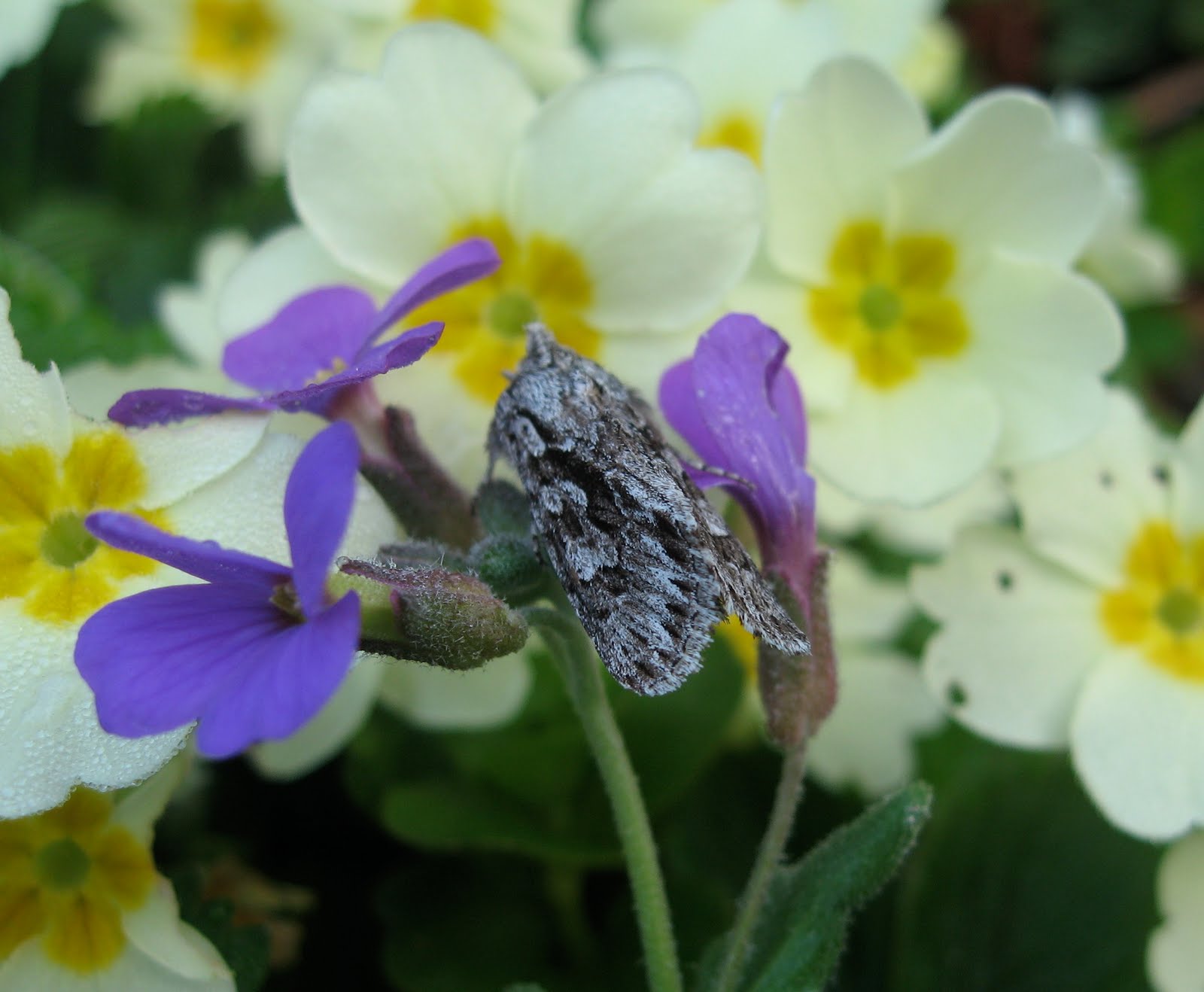
I've been exchanging comments with Steve Thorpe of Derbyshire about the Early Grey - he had an impressive five of them in his trap the other day. I've had one visiting regularly this week - a welcome change from the current mixture of Friends' meeting house (17 assorted Quaker moths last night) and synagogue (nine Hebrew Characters) which the trap resembles. I say 'welcome' because the Early Grey stands out, partly for its subtle colouring and partly for its posture. It settles with its front legs stretched firmly out in front of it, in their woolly fell-walking socks. When I first encountered it - last week - I thought that it was an early Tussock moth; they have exactly the same habit, like a sheepdog waiting for instructions.

Early Greys are very docile. To spice up the current grey/brown arrivals, I'm cheating a bit by carefully tempting them on to bright Spring flowers. Pugs won't do this; they zig-zag off in nervous fits. But the Early Grey came quietly, and indeed the species is known for resting openly during the day on tree bark or lichened rock, safe in its subtle camouflage. My final reason for liking it is that we mix Earl Grey with ordinary tea to make our morning brew, and very nice it is. 'Early' sounds like the sort of endearment Lady Grey might have used for her eminent husband, but I don't know whether she did. Here's a picture of our Earl Grey tea packet, along with a weird product I bought in Soho's Chinatown but have yet to try.

Jessie's contribution today (below) rather shows that, however much we hype the patterns, socks and Beatle-y haircut of the Early Grey, Borneo's moths beat us every time. I will try to identify Jess's moths soon. I've got a massive book on exotic ones somewhere, and of course there's Google.

Saturday, 17 April 2010

The spice of life


Another night, another Satellite. And if you compare this one with its much darker relation several posts below, you can see how much variety there can be within a species. This is the bane of already dodgy identifiers such as myself, but adds interest to each moth. Look, even the little moon and its satellites are different from the other one's: orange this time, compared with creamy white. I've been reading a bit more about the Satellite and discovered that although it over-winters as an adult, it only becomes active in milder weather. I know people like that. I guess these two survived the ice and snow by crawling into a nook and staying wisely put.

Meanwhile, another Jessie-photo too. She only realised after checking this lovely pic she took of a bright butterfly in Borneo, that just beside it (above and to the right with the little brown 'eyes') was a 'leaf' butterfly as well. Brilliant camouflage!

Friday, 16 April 2010

Thank you, Jessie!

There were many fewer moths in the trap last night; two dozen Quakers, Drabs and Hebrew Characters compared with over 50 on average this week. So that's my contribution to data on the first volcano day, Ash Friday (if I can add to the huge outpouring of Icelandic puns and jests). It may have been the cold, of course, but one possible field worth checking is the effect, if any, of the ash cloud on moths and the moon. There was only the slenderest of sickles last night - thank you Woodlands junior school in Kent which has an excellent Moon Site online (www.woodlands-junior.kent.sch.uk/time/moon/#2) - and conceivably the ash rendered it invisible. Linking moths and the moon is not lunacy. Authorities as eminent as Prof Edmund Ford, who went up in an RAF balloon in quest of knowledge on the topic, have speculated that there may be a connection with moth navigation, and disorientation by light traps.


Today's picture is far away from this, albeit not as far as the moon. My niece Jessie has been in Borneo on a break from the iniquitous world of TV whose indie companies treat young researchers as underpaid slaves with no prospect of the commitment which I've enjoyed in my lucky life from employers. She promised to photograph butterflies, moths and bugs with her much greater skill and steadier hands than mine. Here's the first of a series, a strange little bird-like creature in a rumpled wedding gown on the hairy hand of one of Jessie's mates. I wonder if it had just hatched.

Oh, forgot to say earlier that I've relearned how to put links on the blog and have added those of Phil, Ben, Matt and other kindly experts whose own accounts are much worth reading.

Thursday, 15 April 2010

Sooty


I realise I may be testing the patience of those longing for vivid moths, but this humble arrival (above) isn't completely uninteresting. It looks like an early victim of the Icelandic volcano ash which is causing chaos to human flights. I wonder if collated moth trap information will show any difference over the next few days, as the ash drifts down to ground level (assuming that that is what it will do). I don't need warning about volcanic ash as an invisible enemy of machinery. We wrecked a nice camera simply by taking it up Vesuvius. You should have heard the camera shop man in Leeds, eloquent on the fiendish effects of the particles. Anyway, I think this is a Narrow-winged Pug, one of a tribe created by God specially to exasperate moth identifiers. Ben and Co will put me right if it isn't. The pair in the long thin picture look to me like Brindled Pugs, largely because this moth flies in March/April while most Pugs don't hatch until June or thereabouts. It's hard to photograph moths which insist on staying in the trap's black bowl. The darkness does something beyond my understanding to the camera's intake of light, even with digital's extra cleverness.
Incidentally, I was up on the Roman Wall recently and the way the Narrow-winged Pug's eggbox has curled and jutted reminds me of the stretch at Cuddy Crags. Strange, how the mind works.

Wednesday, 14 April 2010

Nice distinctions

Those mystified by moth enthusiasm may have their doubts increased by today's offering. Here are some of the trap's first arrivals - among 53 slumbering away - and I can't say that any of them are likely to draw new recruits to the study. Be forbearing though, and have a closer look.
The patterning on the Hebrew Character is actually very delicate under close scrutiny, as is the Common Quaker, for all its rather plain, Jane Eyreish appearance at first glance.
The other thing about these types of moth is that they challenge my notoriously weak identification skills, and I thank the Lord for my expert Commentors who often put me right. I will stick my neck out as usual, however, and say that they are, from the top: Hebrew Character (for more about the name see post on 5 September 2008), Common Quaker, Clouded Drab and Small Quaker.

Tuesday, 13 April 2010

Buried treasure

In my lifelong absorption with butterflies and moths, I have never known anything as effective at catching them (temporarily) as the light trap which brought joy into my life thanks to Penny's secret birthday planning, five years ago. But there are other methods which also don't have the downside of my schoolboy net, which meant curtains (it was muslin, appropriately) for the insects.

You can track down caterpillars, for example, by checking their foodplants at the right time of the year. Nettles in late May and June are specially good for the Vanessids - Small Tortoiseshell, Red Admiral and Peacock - though remember that they sting. The nettles, not the caterpillars. It is also rare to pass a year without meeting a 'woolly bear', one of those hairy moth caterpillars which are intrepid pedestrians. They always seem to be going somewhere. Keeping caterpillars to pupation is a bit like having pets - constant feeding, familiarity with poo etc - but the reward of actually watching a butterfly or moth hatch is stupendous.


And now, this post's photograph. Pupa-hunting always struck me as a boy as the dreariest of pursuits. Romantic accounts of digging beneath appropriate trees didn't acknowledge the boredom and lack of rewards. But there are people who like fishing in canals, which seems to have about the same level of excitement. Serendipitous pupa-finding, however; that's another thing altogether. And here are two chrysalises, both vacated by their former occupants, which I just found while cleaning out flowerpots. One was an inch below the surface - imagine the force of instinct which gets a caterpillar to bury itself. The other was under the pot, tucked up inside the rim. I've displayed them on an extract from The Butterfly Collector's Vade Mecum which Miss Laetita Ford published in 1836. It's a great book.

Monday, 12 April 2010

Here comes the sun


More moths soon, but I can't resist diverting just for today to butterflies. We hear an awful lot about their decline in the UK, especially in the national media. Having worked for that for nearly 40 years, I have a healthy scepticism and this weekend it was reinforced. What we lack is not butterflies but sun. Out it came, wonderfully, and out came the butterflies too, just like all the people who were sunbathing - yes, in early April - in the grounds of Kirkstall Abbey, another practice which the glum would have us believe to be a thing of the past. At home, we had this Comma, several Peacocks and a Green-veined White and my Mum reports from three miles away: "I have been watching a small dark butterfly on a sunny wall. I am sure it is a butterfly and not a bumble-bee." It looks duller this Monday morning, but I live in hope.

Sunday, 11 April 2010

The benefits of early starts

It's been worth starting the trap in good time this year - nearly three weeks earlier than last and more than two months before I got going in 2008. The first night saw two new arrivals, although I had problems identifying one of them: the Satellite. This will sound odd to moth experts, because the Satellite has an extremely distinctive mark which gives it its name: a white blob with two little satellite ones on either side. Here it is right enough. But look at the colour of the moth in my trap, compared with the one from my unfailingly helpful Bible by Messrs Waring, Townend and Lewington,

The answer to the difference, I think, lies in the long life this moth will have led (and long may it continue, now that I have tucked it away to slumber under a leaf). Satellites hatch from cocoons underground in September and spend the winter as adult moths. So this one will have had to put up with the snow and icy temperatures just like us, and in the process its original brown brightness has dulled.

The other new arrival is this Twin-spotted Quaker, another moth named for the distinctive marks on its otherwise restrained and Quakerish plumage. I am just about to write a Guardian 'In Praise Of...' leader about the Quaker philanthropist and poverty expert Seebohm Rowntree, so I named this particular moth after him before leaving it to doze on. I'm also pleased that WT&L described it as 'more local' - ie rarer- north of the Midlands. So it has an extra interest as a new arrival here, in terms of the number of moths which seem very wisely to be moving North. If my identifications are correct, which as regular readers know is by no means certain, it joins lots of Common Quakers such as the one beside the Satellite in the main picture of this post.

Friday, 9 April 2010

When the lights come on again...


We're off! The incomparable Watkins & Doncaster delivered my new bulb yesterday morning early and here it is, shining brightly, while our house gleams cosily in the background with Penny and me dozing off inside in front of Outnumbered and the news. It was a good night thanks to the sudden and lovely arrival of Spring. I've seen 60 of these now and yet I'm still ambushed by the beauty of it all. Amazing how every winter you forget. I went to Sunderland today on election duties and all the way there and back, the surroundings were stupendous. Much as I like daffodils, it was great to see primroses and cowslips on the A19 and the chionodoxas in Sunderland's many parks were just lovely. Aaaah!

My other picture prompts a case of Arthur Koestler-style coincidence. After I'd taken it and transferred it to the computer, I just checked out the comments on this year's first post, below, and then clicked across to Mike Beale's excellent blog Norfolk Wildlife (http://norfolkwildlife.blogspot.com/) and saw that he's also just got a new mercury vapour bulb and is so excited about it, just like me, that he's posted a pic too. My only extra is the remains of my old one, which rolled off our rockery and smashed on the very last day of moth-recording last year, with a satisfying but expensive 'poooof!' as the vacuuum de-vacced itself. I am very bad about organising links to other blogs such as Mike's, or becoming a follower, but I will try to put this right when I have time and possibly a son at home just to help me through the tech steps.

The Morris Minor van incidentally, is for scale although Penny pointed out in her usual practical way that since people will not know whether it is a Dinky toy or a Matchbox one, it is not very helpful. So let me add that it's a Matchbox, in the livery of that great old shop Brown, Muffs of Bradford, alas now gone along with the J B Priestley pie shop. I'm doing a Radio 4 archive hour about Priestley's Postcript broadcasts later this month, and the pies will get their due.

Tuesday, 6 April 2010

Hurray, the moths are back!


Hello again, World!

And earlier than ever this year, though I'll not be recording any moths 'til a new mercury vapour bulb arrives from Watkins & Doncaster (see last year's last entry but one for the Great Rolling Off the Rockery Disaster...) Actually, I will have two new bulbs, cos my age and technical incompetence meant that I did the online order twice. I nearly squished it, but then thought: it's always handy to have a spare.

No, this early start is triggered by a Spring-cleaning frenzy in Wainwright Towers, which involved the taking down of curtains and the discovery of unbelievable ick in the top folds where the hooks are. However, braving this led to the finding of a (sadly, long-dead) Beautiful Golden Y (but see Comment from much-welcomed expert Ben), and this interesting cocoon (below) which I fear from the holes has been raided and sucked dry by a predator (possibly one of the half-dozen spiders, also dead, whose tomb was in the very same curtain folds.)

So, out with the brushes and dusters, and if you are really scientific, sift your Hoover dust before putting it on the flowerbeds or in the bin. More soon, though possibly not tomorrow or for a day or two, unless our cleanup flushes out more treasures.

Doesn't our carpet look interesting close-up in the top pic, btw? As always, click or double-click on the pics to make them bigger.

Sunday, 8 November 2009

Goodbye to all that (til April)


Sorry - I've been rightly chided by one or two people for failing to make clear whether the blog has shut up shop for 2009 or not. It has. The trouble is, I so much like the picture of my fly (see next post down), that I wanted it to stay as the 'homepage'. Well, it's superseded now by this entry, which is just to confirm that with the trap bulb broken, dark mornings, scant moths and general busy-ness, everything is tucked away until the end of April.
I've been waiting for a final titbit to sugar the pill and my mother-in-law has now given me one: this cutting from the Daily Express. My son Tom used to work for this paper which, whatever its faults, has a sense of innocent fun missing from some other, more reputable but knowing rivals. It's got some good journalists too, including John Ingham who wrote this (and whose Dad is the fearsome Sir Bernard). Hooray, too, for Katie Dobbins whose moth is indeed a rarity. It's actually the first to be found here which doesn't figure in my Bible, Waring, Townsend and Lewington. It isn't even in their section on 'Doubtful records and suspected imports' which features such excitements as the False Water Betony and the Isabelline Tiger.
If you'd like to know more about it - tremble, if you have a Euonymus hedge - check out the American website which put it in lights earlier this year as 'Bug of the Week': http://raupplab.umd.edu/raupplab_java/bow-reader.jsp?/wt/raupplab/bugweek/archive/BugOfWeek_15D.html

I hope that Katie grows up to share my enthusiasm, which was helped by the wise and good John Armitage who praised my own rare capture of a fritillary variety when I took it him many years ago at Leeds City Museum. Check back for details about that to last year's closing entry; meanwhile thanks for reading and see you next year. Oh, and ever the relentless plugger, please spend as much of your Christmas money as possible on (a) True North from Guardian Books, and (b) A Mini Adventure from Aurum Press. See:

www.guardianbooks.co.uk/webapp/wcs/stores/servlet/qs_product_tbp?storeId=10401&catalogId=25501&langId=100&parentType=search&parentId=5nor&productId=172196

(although actually it's cheaper at W H Smith's)

and

www.amazon.co.uk/Mini-Adventure-Years-Iconic-Small/dp/1845134710/ref=sr_1_6?ie=UTF8&s=books&qid=1257703851&sr=1-6

or find your nearest independent bookseller and get them there.

Happy Christmas!

Wednesday, 14 October 2009

I spy my little fly


I forgot to mention, the other day, that one of my last captures before the great bulb disaster was this fly. Like most people, I'm rather vague about flies which all seem similar, apart from the various blue and greenbottles whose brilliant colour compensates for that annoying buzz. I also kill horseflies without compunction. Once bitten... Finally, I remember an absolutely lethal sort of fly in the grassy uplands of Guyana. I'm pretty sure that Evelyn Waugh describes it, too, in his travel book 92 Days. So I had to look up this strikingly-coloured visitor to the trap, which looks in the top pic as though it's on a diving board at one of those 1930s lidos, wondering whether to jump. I like the way that its yellow livery extends to its toes. It's a Noon Fly according to my best researches, although I will not be surprised if some Dipterist puts me and anyone reading this right on that. Actually, I'd be grateful if one of them would tell me what a Noon fly was doing out at night. A propos of nothing, I must just plug my new book True North, which has just come out - published by Guardian Books/Random House. It should be in 'good bookshops', as they say, or available from net order services. It's my take on the North of England after 22 years of reporting from here. The messages are (a) it's great - the subtitle is In Praise of England's Better Half and (b) to Northerners: be cheerful.

Monday, 12 October 2009

Still they come


I keep trying to stop this blog, for work reasons, but the moths won't let me. That's even despite the drastic result of last week's winds - a gust caught the bulbholder while I was absorbed in photographing some tiny creature. It rolled off the rockery and Phut! A mercury vapour bulb exploding is quite interesting, but that's the trap finished now, until April when I'll send up to Watkins & Doncaster for a replacement. By following my mother-in-law's practice of looking down at pavements for 'street gold', I hope to have saved up enough. I found a £2 coin the other day...
Anyway, more today, because last night our porch light was on to welcome both Grannies for supper and it proved a veritable moth trap of its own. Here are some of at least 15 temporary residents: November moths and carpets, I think, but luckily the distance was too great for macro mode and I can say complacently that accurate identification was impracticable.

Tuesday, 6 October 2009

Caterpillar glut


It's not quite all over yet. Penny and I spent part of the weekend making the lovely crossing from Ennerdale to Buttermere along the Floutern pass (pronounced Floo-turn). It's little-frequented at this time of year and my illustrious namesake Alfred W has put off potential explorers by dismissing the section at the head of Mosedale as a quagmire. So it is, but a quagmire with ways through it. It's also rich in this particular variety of 'woolly bear' caterpillar which I shall research when I have time. Some sort of Tiger? Or Eggar? We will see. I've included the end of my sturdy walking pole for scale, and to demonstrate the quality of Mosedale Head mud. The valley is also notable for a large holly which is the only tree in the Lake District to be marked individually by the Ordnance Survey. The reason is simple and understandable when you sit at the head of the valley munching your pie. There are no others to be seen anywhere in the huge view.
PS I've done my research now, and I think it's a Fox Moth cattie. It looks right and Arthur Ransome, my illustrious predecessor on The Guardian wrote in Swallows and Amazons about episodes based on his own youthful visits to the Lakes, including tickling trout, meeting charcoal burners - and collecting Fox Moth caterpillars on the fells.

Saturday, 3 October 2009

Currant fun


Two posts in one day, goodness! Unprecedented but also valedictory, nearly. I'm shutting up shop for the year any minute now but just wanted to squeeze in a contribution from an excellent Guardian colleague, Sally Burtt-Jones. She flawlessly organised a readers' walk which we did in Richmond (Yorks) earlier this year. In fact, if you have time on your hands you can read a little more about it, and about suicidal Peacock butterfly caterpillars, in the posts below. She emailed me in response to a question I had for her earlier this week, saying that she wouldn't reply until I identified this moth, which she had photographed (very well; young people have no problem with camera tremble...), in her parents' bathroom in Wales. No doubt she then ushered it safely out of the house, as in Which? magazine's instructions (see next post, below).
Well, it's a Magpie Moth, Sally, not uncommon but very interesting. It's poisonous to birds, immune to spider venom and plays dead when caught. It has also played a part in genetics experiments, described at length in his autobiography by Sir Geoffrey Keynes, the surgeon and brother of Lord Keynes, who was a great butterfly and moth expert. He and friends helped to provide black and redcurrant bushes for mass breeding of Magpie Moths to get as many variations as possible. If I can, I shall pillage the internet in a mo for some examples. The standard pattern can turn into all sorts of things, many looking like a Damien Hirst left out in the rain. The point was to relate butterfly gene transitions to human ones, a practice which has scored some notable medical triumphs, especially in the case of swallowtail butterflies bred by another famous doc, Sir Cyril Clarke, who therby cracked the rhesus negative blood problem of 'blue babies.'

Here we are. Not from the Internet but from good old Waring, Townsend and Lewington. There are plenty more variations within the range.

Friday, 2 October 2009

Carpeted


My Mum's just bought a new carpet and, aptly enough, my trap is being visited by carpet moths. They are named after their intricate patterns rather than the old and erroneous notion that they eat carpets. That's the job of carpet beetles and a very limited number of 'clothes moths', the Common and the Case-bearing in particular. As the Which? magazine guide to such matters says: "Be careful not to confuse clothes moths with other species which are harmless and should be carefully ushered out if found in the home."
These two carpets are the Common Marbled and the Red Green. The former appears in many variations, including the one with the orangey blotches as well as the standard type, pictured on the left. Quite a few of them have a habit of resting with their tails pointing up in the air for reasons unknown. The Common Marbled's caterpillars are unusually indiscriminate, feasting on pretty much anything. The Red Green's are more fastidious. They dine on rowan and oak, both of which flourish hereabouts.

Corn Flakes drama


Penny keeps finding moths in the house, most recently a yellow underwing taking a laudable interest in our print of Hobbema's The Avenue at Middelharnis. I think they must come in on my dressing grown. Yesterday, though, she was a realy David Attenborough. We were having breakfast when she spotted this wasp twisting and turning in the top corner of a window. Window corners are where our many spiders weave their webs, and this one had snared a potentially juicy prey. Don't underestimate wasps, however. We watched, as coldly neutral as the Swiss, while the two creatures grappled. The spider kept trying to tie more twists of silk round the wasp. The wasp twisted and jerked, and was gradually helped by gravity to the bottom of the web, tearing strands as it went. It seemed to be trying to sting the spider but the latter was either too agile or immune. But it was also the loser. Although trailing little ropes of web and silk, the wasp broke free and plunged out of sight.It didn't look as though it would be able to fly though, and we watched to see if the spider would do one of those amazing plunges, spinning out enough silk to make its own bungee jump and carry on the attack. Lady Attenborough went outside to see if it was lying on the ground, but it had gone. The beautiful little prisms which you can see in the middle picture, specially if you click on them, are formed by Yorkshire sunshine catching imperfection in our window glass. At least I think so.

Thursday, 1 October 2009

The cappuccino moth


I consume vast quantities of McDonald's cappuccino these days (small size only) because I need the wifi as I roam around the North, and McD's is a place with guaranteed free access. Only right, therefore, that I should be visited last night by the Cappuccino moth, aka the Green Brindled Crescent, variety capucina, which isn't terribly striking but has the distinction of being found only in the UK. The standard GBC is more attractive, as it has streaks of bright, metallic green which are completely missing from this variety (see v nice pic below right, courtesy of a really good online gallery of moth pics www.mattslaymaker.co.uk). Named like the coffee after the brown-hooded Capucin monks of the Franciscan order, mine seems to be a melanistic form, judging by the fact that historical records are mostly from industrial areas. Anyway, here it is, another harbinger of Autumn, along with one of my favourite, smart Black Rustics. Tomorrow: the battle of the wasp and the spider... Can you wait?