Friday, 26 October 2018

Colours in the murk


Wet, cold and generally miz - why should any moth want to go flying on nights like these?  Dating and mating is the answer, I guess. And for the moth with any eye for beauty, there are a few lovely visitors still around.


Look at these three, for example.  At the top, two pictures of the same delightful Green-brindled Crescent, a frequenter of over-ripe blackberries - the ones which, according to my Mum, the Devil's got into.  Just above, a glowing Barred Sallow of the less frequent orange and purple form; the standard version is yellow and brown like a Welsh Rarebit. This species, too, has similar tastes to Beelzebub; hence, perhaps, its fire and brimstone colourway.  And, below, that trusty and appropriately marvellous regular at this time of the year, a Merveille du Jour. Not my marvellous pyjamas, too.


All these three were snoozing in the eggboxes this morning. Alongside them was the contrasting Plain Jane below, a moth which will take over the trap increasingly as Winter approaches. I am fairly sure that it is a male November moth, but the distinction between November, Pale November, Autumnal and Winter moths can be a nice one and I am notoriously unreliable when it comes to such things.


It was also a pleasure to find a Large Wainscot in the trap, my first this year although it has paid visits previously. This is a moth which goes out twice a night, firstly at dusk and secondly much later. He or she (probably the latter as it is mostly the female which visits light traps) will definitely be a late flyer because I did not put out the trap until after the ten o'clock news. All hail the third appearance in today's post of my vivid pyjamas.


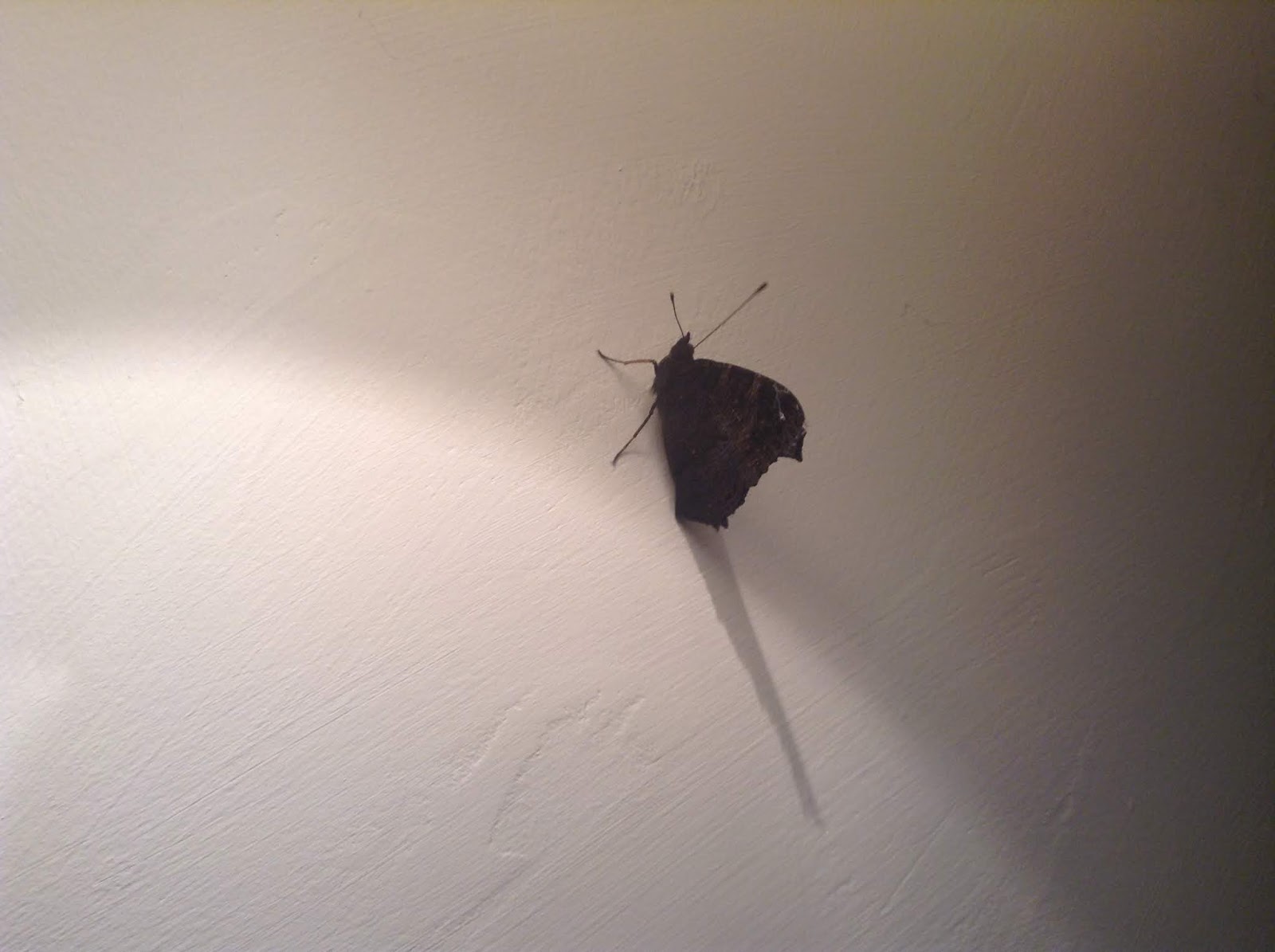
Unlike these hardy moths, butterflies are tucked away in hedges and outbuildings during these chilly months, occasionally fluttering out for an hour or two if the sun warms things up. A typical example has decided to hibernate in our living room where turning on the table lights regularly misleads it into thinking that the sun has come out.  It's a Peacock, very common but also very lovely.


Saturday, 20 October 2018

Two moons


This post dates back a couple of weeks but has been slumbering unfinished in the Drafts file and then  got leap-frogged in my annual excitement at the arrival of the Merveilles du Jour. it doesn't concern particularly interesting moths so much as the effects or otherwise of their supposed navigational guiding light, the Moon.

,

Here is the said Moon, first of all in the morning at about 6am when it was still shining strongly and then during the previous evening when its glow, as you can see, was a worthy rival for the light trap. Moth experts continue to debate about the relationship between the two but in general, and certainly on this evening in particular, a larger moon meant a smaller number of residents in the eggboxes.   


Not that they weren't attractive, whether in the understated grace of the Willow Beauty, above, or the distinctive shape of Blair's Shoulder-knot below. I am repeating myself, for those who have followed me faithfully over the years, but this is one of no fewer than three moths named after a Dr Blair who retired from the entomology department at the Natural History Museum to the Isle of Wight. The latter is a well-known landfall for new additions to the UK list and he first recorded this moth there, and also Blair's Moch and Blair's Wainscot. Well done indeed!


Finally a non-moth overnighter. Who doesn't love a Daddy Longlegs?


Tuesday, 9 October 2018

Simply marvellous


I have been busy with unmothy things lately and so am rather behind. Apologies for the longish gap. I can't help breaking my silence now because that glorious highlight of this time of the year has come calling: the wonderful-looking, wonderfully-named Merveille du Jour.

Not just one, either. TWO! A pair. And if only we still had some pears left on our espaliered fruit trees, I could have posed the lovely little things on one of those and made a small linguistic joke. But perhaps a rosy apple is lovelier.


This is not a rare moth and thus it serves as an ace example of the wonders which surround us if we only look. Admittedly, you will be lucky indeed to chance across an MduJ if you do not have a light trap. But now, at almost five in the afternoon, I could give you that chance. One of the two above is still snoozing on the apple tree. Its lichen camouflage is superbly well-suited.

They are not the only pretty moths around at the moment. Look at these: a Green-brindled Crescent and a Red-green Carpet:  


And as a poignant reminder of the transience of these creatures, which seldom live more than a few weeks, here's the sad but beautiful remains of a Red Admiral which shone out at me from the lawn this afternoon while I was weeding.


Thursday, 27 September 2018

Brightening September

Still no return of the Hummingbird Hawk moth, as I make my way through the garden's weeds, but here's a nice Small Tortoiseshell to add to my autumn collection of butterfly colour. Unlike yesterday's Painted Lady, it was in very good condition, suggesting that the weather is still warm enough for hatching to go on.


Here it is from a distance on our hawthorn hedge, basking in the late afternoon sunshine which was genuinely warm, and then, below, a little closer. Small Tortoiseshells are nervy and extremely powerful flyers, jittering about amid long and muscular swoops, almost like a Scarlet Tiger or Large Yellow Underwing.


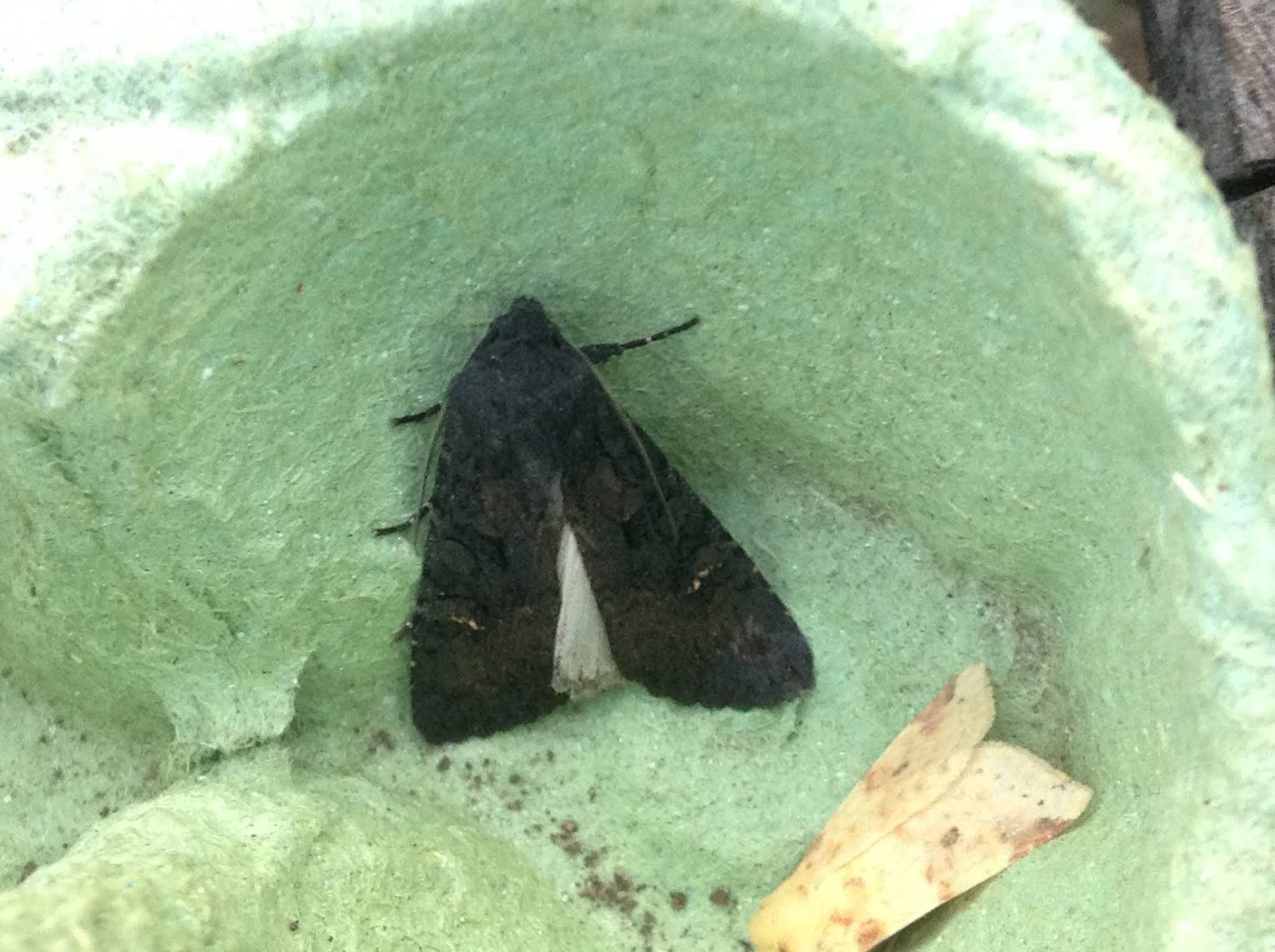
The moth trap meanwhile continues to serve up an interesting selection: a much less orange Large Ranunculus than the glorious one which came earlier in the week; a sinister Black Rustic showing its petticoat, a couple of custardy Sallows - Barred above and plain Sallow below -  a Lunar Underwing and a Depp-brown Dart, the last the unfortunate winner of this morning's Most Boring award.


And finally that elegant but nasty piece or work, an ichneumon wasp, a creature which likes to lay its eggs in live caterpillars. Yuk!


Wednesday, 26 September 2018

Beady eyes


This is a terrific time of the year for the gardener, as swathes of destruction c an be carried out without much fear of harming little seedlings or young plants. Happily, the process seems to be accompanied at the moment by warm sunshine. The mornings, when I inspect the moth trap in my pyjamas, may be chilly, but things have got nice and indeed almost toasty by mid-afternoon.

As a result, I carry in so far as I can, either my iPad Mini or P's iPhone to get a picture of any interesting aerial visitors. I missed the Hummingbird Hawk moth earlier in the week, but above is that marvellous Autumn visitor, the Red Admiral, and below, a veteran Painted Lady and a nice dragonfly.  It is interesting that in all three cases, these insects took a very conservative view of their opportunities in our garden and the surrounding neighbourhood. The Red Admiral kept to a buddleia, the Painted Lady to Michaelmas daisies and the dragonfly to our garden furniture.


I heard the inevitable media doom extract on the radio the other morning about a drop in the numbers of some butterflies, including the Red Admiral. They added, but did not emphasise, that last year was a bumper one for such species. So it was (yet another) non-story; a matter for record but not for gloom.


Saturday, 22 September 2018

Fair copper

I completed my regular hawk moth tally for the year yesterday when I looked up from weeding and saw a Hummingbird Hawk moth nectaring on the small, bright blue flowers of a ceratostigma in the nearby flowerbed. I zoomed in to get the iPad Mini and the moth was still hovering busily about when I got back. But not for long. As I fiddled in my usual inept way with the passcode and finding the camera option, it decided that it had had enough of our garden and whirred off before I could get a snap.

Update:  I should have added that my regular hawks are, in order of frequency: Poplar, Elephant, Eyed, Privet, Pine, Small Elephant, Lime and Hummingbird. I've seen Convolvulus in Cornwall and on photos taken by a neighbour's daughter in Tackley, just up the road from here. And also, memorably, Death's Head in Kirtlington, a couple of miles way.


I thought that it had come back half-an-hour later, but the nectar-seeker this time was this lovely Small Copper butterfly, above.  I didn't notice at the time but as you can see in the photo, it had competition for a drink from a small hoverfly.  Rain all day today and I won't be putting the trap out tonight. But more, I hope, before long.

Friday, 21 September 2018

Orange pips

The moths have gently rebuked me for my rather grumpy observation in my last post that most of the arrivals at this time of the year are brown or grey. That is strictly true but just look at these exceptions which came the night before last: first of all, the delightful. bright orange-flecked Large Ranunculus.


This specimen is a lot lighter than the others I've seen previously, not that it is a common visitor. It came here in 2013 and 205 and never called when we lived in Leeds; it is classified as only locally found. Richard Lewington's painting of it in the Moth Bible , pictured left, shows a much less vivid example as do most online sites.

Its name comes from the buttercup family of plants, oddly as its diet is catholic and includes almost everything herbaceous. I like it so much that I made a composite picture for your delectation, here:


Continuing the orange theme, another resident of the eggboxes was this Orange Sallow in the first two pictures below, one of a large family of yellowy-orange moths which lighten up this time of the year. The third picture shows another of the seven species, the Sallow, whose colouring resembles the top of a creme brulee. Yum! . Below it is a Green-brindled Crescent, another bright spark whose browny-grey background is illuminated by the central area of metallic green wing scales.


I also had another Old Lady visit, the third in a fortnight, and a lively Copper Underwing, shown below. Meanwhile Penny the Ace Indoor Insect Spotter found these sad but interesting remains of a large dragonfly on the back folds of one of our dining room curtains.


Thursday, 20 September 2018

Greeny bug


I was doing some long-overdue weeding in the vegetable patch yesterday when part of a tatty marigold stem which I was tugging appeared to move. Then it definitely did move, and started scuttling off below the safety of a drought-impacted earth clod. It wasn't really safe because I was in hot pursuit and managed to entice it on to a leaf for this photo-opportunity.


It is, I am pretty sure, the 5th instar - or life stage - of a Green Shield Bug, a garden visitor not always popular, especially with those who grow potatoes. It is an attractive little creature, though; not yet with the more angled and genuinely shield-shaped appearance of the adult.


It is also common, like so many creatures which are unfamiliar to most of us in the UK; and it has the final attraction to people of my age of reminding me of Green Shield stamps. Do you remember collecting little books of these, each worth a fraction of a penny like a modern supermarket loyalty point, and then blueing the book, or several books, at a garage on something such as a Dinky toy?
in the moth trap meanwhile, the tone is brown and grey, an unexciting time of the year unless you are lucky enough to be visited by one of the rare exotica such as the light blue/mauve-underwinged Clifden Nonpareil. Wonderful name! They keep turning up on the Upper Thames Moths blog and Buckinghamshire is clearly a good spot to see them. Since I recently rowed past Cliveden, after which they are named, perhaps it will be my turn soon.


Above we have the delightful Frosted Orange, top left, and then proceeding clockwise, a Silver Y, a Black Rustic and a very tattered Old Lady. Below, a Willow Beauty shows off its camouflage expertise above two relatives which are not quite as well concealed.


Finally a trio of typical visitors for this time of year which always send me to the Moths Bible or Hants Moths Flying Tonight, wishing that I had better ID skills. I think that they are an Ingrailed Clay, a  Flounced Rustic and a Beaded Chestnut. Here's hoping.