I was going to reflect on refraction (and reflection) in wing scales today via the medium of the Burnished Brass moth but that will have to wait until tomorrow, because once again I am in a state of great excitement.
 |
| Safely back in the shed (with plenty of windows open if it wants to go). See below |
Behold! The biggest moth ever to visit my trap: a magnificent Privet Hawk which sheltered carefully under three eggboxes in a heap from some early morning rain. It will remain my biggest arrival unless extraordinary good fortune brings me a Convolvulus, a Death's Head Hawk or some exotic creature on the run from Blenheim Palace butterfly house.
 |
| I'd reckon 4ins at full stretch |
Fellow followers of Arthur Koestler's interest in coincidence will note, if they refer a dozen or so posts back, that this is the very same species of moth as that shown in the photograph which my kindly neighbours dug out from when they found a Privet Hawkmoth on a windowsill some ten years ago. I admired their careful use of a ruler for scale and Lo! I have duly learned and done the same.
 |
| Next door's Privet Hawk, ten years ago |
The moth, with its strangely sleek, otter-like black head, was sleeping in the wings-sheathed position, but a little gentle pushing of the wings persuaded it to open up to a good, photographable extent. I didn't want it to get too lively - and it started flexing its wings and generally doing the moth equivalent of 'chocks away' in an RAF film - because I want to show it to the neighbours after breakfast. So it's currently, I hope, in our shed in its eggbox, back in the Land of Nod.

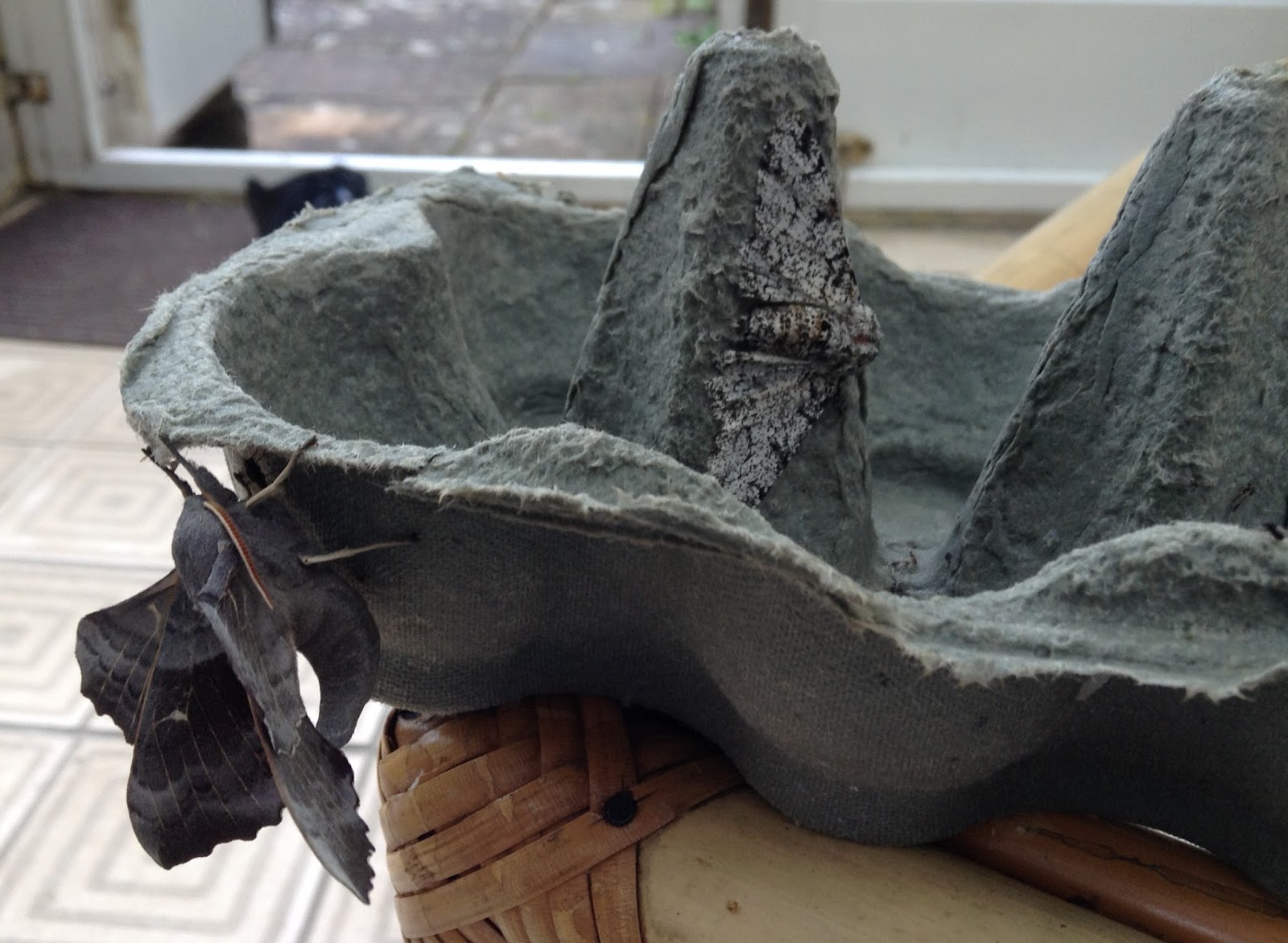
I took a few more pics to give a sense of its size, although the top one wrongly suggests that a Poplar Hawk which also flew in last night is bigger. That's because of its very obliging, photogenic way of resting with its great grey wings open. Check out the tiny micro in the last pic for comparison, too (and admire my continuing use of Penny's ruler).
 |
| You put your right foot out... Dancing lessons with a Common Swift |
 |
| Even the antenna is longer than a Common Swift. Penny points out the cartoony 'cross eyebrows' which may play a role as defensive camouflage, as in the Eyed Hawkmoth which visited last week |
 |
| If moths could speak, this one would be saying: "Small is beautiful, remember" |
Final points on this splendid beast. It can overwinter twice, once as a pupa and once as an adult, and that is very long-lived for a moth. And it is an argument for retaining those otherwise rather dull privet hedges which are a landmark of suburban Britain. Just imagine if there was a Leylandii Hawkmoth...