Sunday, 10 May 2015

Can blackbirds have two wives?


I popped the above question into Google this morning after watching a convocation of blackbirds doing curious things outside the house. I was late back from Leeds last night and Penny told me that strange knockings at intervals during the day had alerted her to a blackbird repeatedly fluttering at a window by the bird feeder. Not crashing into it as birds occasionally do with fatal results, but appearing to attack it while trying to hover like an inept young kestrel.

Sure enough, as I made the tea this morning, I heard scuffles and bangs and there was the bird behaving just as P had described. I haven't yet got a picture or filmlet of it but will post one here if I do. But I saw that it was a female (pic below, apols for the poor quality of my bird photography) and, while I watched, she was joined on an endless forage for food on the lawn and shrubs by a male and two other hens.


Hence my question, which has yet to be resolved as my brief foray on Google only turned up lots of stuff about American novels with 'blackbird' in the title plus references to the Beatles' famous lyric 'Blackbird singing in the dead of night...'  On which score, you may be interested to note a reference to the Fab Four in the blackbird's manifesto for the recent vote on Britain's national bird.

This is generally assumed, including by me, to be the robin, which won the last such vote back in the 1960s. But it may be toppled from its perch after the poll of a shortlist of ten which was held appropriately on the UK's General Election day last Thursday.  The counting process isn't quite as swift as local authorities'. Some 213,000 people have voted which is impressive, but the result will not be disclosed until June.

Here's the blackbird's manifesto from a nice piece in my old paper The Guardian. You can read all its rivals' claims here.

The black bird is expected to make a strong push, relying heavily on the “Beatles effect”.
Nature’s Home editor Mark Ward said a vote for the blackbird was a vote for joy.
“That’s why you should vote blackbird – for no other reason than it being the bird that makes you smile. And who doesn’t need more smiles in their life? Whether you live in town or city, you don’t have to look hard to share some precious time with a blackbird. Vote for your favourite neighbour. Vote blackbird - and smile.”
The Royal Society for the Protection of Birds' website meanwhile observes:
Blackbirds tend to be solitary birds. Small feeding and roosting aggregation sometimes form at good sites, but there is no proper social interaction. 
And finally, I noticed that the window in question gave a very good reflection of me when I pottered past en route to the moth trap (which contained only five Flame Shoulders, the Clouded Drab below, a bee and a slug, hence all this stuff about birds). I suspect the blackbird has noticed its reflection and fears that yet another bride is hoping to move in.

Saturday, 9 May 2015

Contemplatives


Let's think of this chap as a wise old soul contemplating the election results. What he is thinking, I cannot tell, but I do envy him those antennae - one of the few animal characteristics I'd like to see added to the human form, along with the ability to fly (without large wings which would always be getting in the way).

I say 'he' because I can do so with certainty. This is a Muslin Moth and the female is a lovely, pure white. She also shuns the light of traps. Instead she may be seen during the day, scuttling about. Probably shopping.

Only four other moths in the eggboxes last night: two Flame Shoulders, a Swallow Prominent and this newcomer for the year, a Pebble Prominent, named after the two pebbly-looking marks on its neatly-folded forewings. He (or she) is looking thoughtful too.

Friday, 8 May 2015

X marks...


I was hoping to bring you an election moth yesterday but rain dashed that. Last night, however, while all the Xs on the ballot papers were being counted, a moth with an X on its back obligingly flew in. It's the Lychnis above, a handsome insect although carefully neutral in its colouring.


The trap's equivalent of the currently rampant Scottish Nationalists was the Swallow Prominent. Five of them - four shown above - formed a clear majority over two Nut-tree Tussocks, two Hebrew Characters and a couple of Flame Shoulders, one below, a new species for the year for me.


The re-election of Caroline Lucas, the UK's sole Green MP and a hard constituency worker down in Brighton, was meanwhile honoured by this pretty little Green Carpet, another 2015 newcomer.


Finally, the eggboxes contained a couple of those alarming-looking but loveable creatures, the darling Bugs of May. BBC Radio is currently having a Kafkafest including a programme which, somewhat tweely, discusses which insect Gregor turns into in Metamorphosis.  I reckon he looked pretty much like this.

Monday, 4 May 2015

Name game


We took a good friend for a lovely walk yesterday. Good in the sense that she's done much public good, but special to us because she brought us together, and can thus claim quite a share of responsibility for happiness, children, granddaughter and other excellent things.

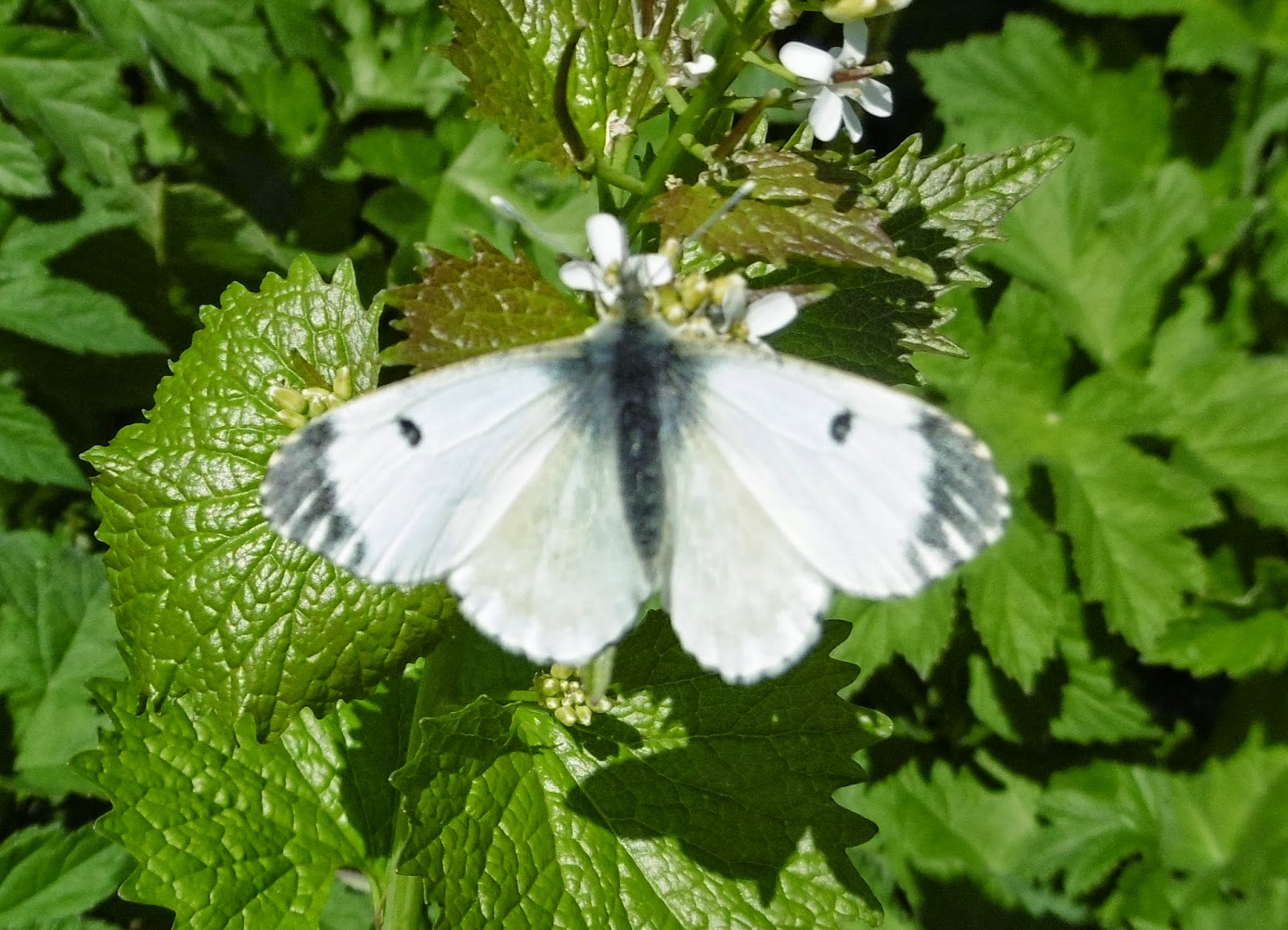
"There's a butterfly with orange tips," she observed as we strolled along a woody ride. "What do you think it's called?" Penny and I asked. "Orange Tip?" she guessed.

Back at home, the moth in the top picture caught her attention as we examined another sparse haul from the trap. "It looks as though it's wearing specs," I said. "What do you think it's called?" "The Spectacle Moth?" she replied.

An intelligent person therefore as well as a good one.


Last night meanwhile saw me put the trap out very late and there was also a wind blowing, even though the weather has turned much warmer. This morning brought a mere three moths but they included this lovely little Carpet, topside above, lowerside below. A Red Twin-spot, I think.


The other two were a Hebrew Character - a name drawn from its prominent marking resembling the Hebrew letter Nun which also intrigued our friend - and this one below which I am guessing to be a Clouded Drab. A blameless creature, but (as regular readers know) I find their lack of distinctive colouring or pattern annoying.

Saturday, 2 May 2015

Fast breeder


The nights remain chilly and catches thin, but there were a couple of nice moths among the eggboxes this morning. The Brimstone, whose eponymous butterfly pal is very common round here during the daytime, brings a welcome splash of bright colour to the rather understated palette of most UK moths.

Quite by chance, a little seed in the box shares the buttery yellow and brown of the moth in my picture, above. Don't worry, it isn't a bit of the insect that's flaked away. The Brimstone will cheer me up for the rest of the summer. Relatively unusually, it has at least three broods before October. Another curiosity of its entry in the Moth Bible is a reference to its caterpillars feeding on - among many other things - the Wayfaring Tree. Better known as viburnum, this is not one for you and me to nibble. The fruits cause diarrhea and vomiting in weedy old humans.


The other agreeable moth was this Common Quaker in very good condition and there was also a Brindle Beauty, a tabbycat of a moth, and four Hebrew Characters. Meanwhile, here's a close-up of two of my Emperor Moth cocoons which - pace yesterday's post - seem set on slumbering for another year. Note how soil and even a small pebble have been woven in as camouflage and armour, assisting the row of spikes around one end of the cocoon to deter predators.

Friday, 1 May 2015

Earliest hawk


Happy May Day one and all!  Hope you are enjoying the election campaign and the sunny weather, not necessarily in that order. I find the debates very interesting and there was a cracker from Leeds last night. Mind you, we the People, have a modern version of Morton's Fork: demanding definite pledges from politicians but then criticising them (a) for evasion if they don't promise such-and-such or (b) calling them untrustworthy if they bow to our pressure and make promises which events later force them to break. Terrible system, democracy, but as Churchill said, better than all the others.

Rant over. To business. Only three moths in the trap after another nippy night, but the top one sets a new record, albeit only by one day. It's my earliest-ever hawk moth, a Poplar Hawk. Last year three arrived on the night of 1/2 May but prior to that (between 2008 and 2012 in Leeds), their advent was never earlier than the 20s of May or the first week in June.

They are very fine moths, guaranteed to interest those new to the subject and famous among those familiar with it for the distinctive way they hold their wings in reverse order when at rest - front to back, back to front. They are very common, yet how many people never see them; and how many of those fall for media stories about there being no more moths, wildflowers, bees etc?


The other new arrival for the year was the Muslin Moth shown here on my sadly pudgy fingers. Would that I wasn't so fond of pies and ice cream. The trio was completed by that sleek, current regular, a Swallow Prominent.

Tuesday, 28 April 2015

Chiaroscuro


I remember our boys coming home from primary school many years ago and being very taken with a word their teacher had used - chiaroscuro.  Here's an example, courtesy of a Powdered Quaker which shared the trap this morning with three Hebrew Characters and a caddis fly. Lean times continue.

The word means light and shade, the contrast beloved of Italian artists during and just before the Renaissance. It was also very fashionable, excessively so, when I was a teenager and there was a fad for portraits done with one half of the face in chiaro and the other in scuro. Impressive the first time you saw it. Less so by the hundredth.


I looked back at April last year on the blog, meanwhile, and was staggered by the number of species which had visited the trap by the end of the month - five different types of Prominent moth, a Streamer, a Chinese Character and much, much else. Still, it's quite nice to have a slow and dignified start to 2015, so I'm not complaining.

Here, finally, is the companion of our current drive to get the veg patch in order. Little poser.

Monday, 27 April 2015

Night and day


It was extremely nippy last night and the tally of moths was accordingly slim; just two in the trap, a second Swallow Prominent and a Hebrew Character. This morning remained fresh 'til after 10am but it was lovely and sunny, so I carried out another reconnoitre of our coming Beating the Bounds walk.

Butterflies abounded and here are the few which were patient enough to wait for me to creep up on them with my camera: a female Orange Tip (only the males have the colour), a female Brimstone (ditto, in the sense of the male being sulphurous while the female is buttery), a Speckled Wood and two Small Tortoiseshells, one with its wings tightly folded and the second showing part of its lovely topwings.


I also spotted the new (for me) road sign at the top of the post but failed to discover how or why the road was deemed a failure, other than being bumpety and unkempt. Observe finally, the difference between a conventionally fertilised and an organic field of oilseed rape, a crop which is currently turning the Oxfordshire countryside male-Brimstone yellow.


Sunday, 26 April 2015

First swallow


Our ducks are still here, waddling around behind us in search of bread, old porridge and even Special K which we've found deep in cupboards and sprinkled on the lawn. I should be satisfied with this but I have to admit that I'd also like swallows to come here and set up home. A neighbour has them every year and in 2013, enjoyed watching them raise four broods. We will try to provide suitable crannies this year.


Meanwhile here's the first Swallow Prominent of the season, a beautiful moth with a sleek, sportscar-like appearance when at rest. It passed a lonely night after I set the trap very late and in drizzle - very welcome from the garden point of view after a long period without any rain. There was also a Brindled Beauty in the eggboxes and two Hebrew Characters but that was it.

We were late home because of a very enjoyable evening at Kirtlington Film Club, our first experience of village hall films - brilliantly organised with flawless screening, chairs grouped at tables, bring your own food and drink and even little posies of Spring flowers on each table. Much as I enjoy Odeons etc, this was definitely a cut above. The film, Boyhood, was good too.

Saturday, 25 April 2015

It's a boy!


I was beginning to wonder about the five Emperor Moth cocoons which have overwintered here in a cardboard box after I distributed the other 25 or so from a brood of caterpillars which I mothered last season.  Two of the recipients havereported hatchings on the excellent Upper Thames Moths blog, one of them almost a fortnight ago. Yet mine slept on.

Not any more. I checked the cocoons yesterday afternoon as best I could; most of them have curled-up, long-dead hawthorn leaves and even grains of soil woven into their protective armour, and all appeared to be intact. But in the evening, as Penny and I were putting away tools in the garden shed, I heard a tremendous fluttering from the muslin-covered cardboard box.


I still couldn't tell which cocoon had ruptured but here is the new arrival: a healthy male with fabulous antennae - a physical feature which we human beings sadly lack. I like to think that my benign wrinkles and slowly greying hair already make me look wise. A nice pair of elaborate antennae would complete the (misleading) impression.

Here's my moth
 above its painted
 counterpart on
 the cover of
the Moth Bible
I am hoping that the four remaining cocoons include a female, so that I can try the procedure known as 'calling'. This involves placing the moth in a muslin bag or similar temporary prison from which her extremely powerful pheromones can waft. These attract passing males, sometimes from great distances, and the breeding cycle starts again. The urge to reproduce in Emperor Moths is exceptionally powerful; they have been seen at it before a female's wings have fully unfolded after hatching from her cramped cocoon. Given that the adult moths do not eat and therefore only live a short time, reproduction is their overwhelming instinct - a short but I hope enjoyable finale to their amazing, year-long development from egg, via caterpillar and cocoon to adulthood.

One of the authors of the Moth Bible, Martin Townsend, took a few cocoons from me last year and well describes 'calling' on the UTM blog here.

Thursday, 23 April 2015

Othello, Act 2, Scene 2


Happy Birthday Shakespeare! And in case you are wondering, my title refers to the stage direction: 'Enter a Herald with a proclamation, people following'. In my case, there was no proclamation as moths cannot speak, but appropriately for the day - which is also St George's Day - the Herald Moth above entered the trap.

I'm sorry that it isn't a brilliant picture, as I continue to get to grips with our new camera, but you can always Google for better ones of this very fine moth. It appeals to me because it is so different from the general run both in colouring and particularly in shape. It has the honour of appearing on the spine of the Moth Bible where Richard Lewington's masterly painting has it in its usual pose, much resembling a shield from the era when heralds entered with proclamations.

My specimen is a bit tatty which isn't surprising as this species spends the winter as an adult, holed up in outbuildings - or, as the Bible says romantically, caves. It's a common enough moth in the UK and I hope that you get to see one for yourself.


Elsewhere in the world of flying things, we have been adopted by a beautiful whiteish mallard duck which gets bolder by the day, as you can see in the second picture. We're devoutly hoping that she rears a brood here to add to the many which frequent the Oxford Canal, about 100 yards from our garden as the duck flies. In our two summers here, there has been a pure white mallard on the canal and the hamlet is notable for whiteish ducks and drakes, presumably her descendants.

Ducks don't seem to fly a lot, so much as waddle, and apparently they are rather careless parents. Ours has already laid one egg - second picture - which she promptly abandoned. We were hoping to eat it but magpies or jackdaws got there first. Maybe this was a practice run for the duck herself

Observe my wain;
appropriate for a Wainwright
Now that part of our time is spent on grandparental duties, we are great experts on small children's songs which are often addictive. With that warning, I much recommend the strange but compulsive Duck Song. I'd much like to meet its author one day. The YouTube version to which I've linked has had 186 million views.


Wednesday, 22 April 2015

Good moth, good man, good tea


The nights continue cold between glorious days and accordingly the moths remain modest. But a pleasant, if familiar, one came to roost two nights ago: the Early Grey above, which is in truth a little late in its usual season of early March (sometimes late February) to May.

Actually, our household's champion spotter of insects outside the trap, Mrs W, did find an Earlier Grey indoors more than six weeks ago when the trap was out of action and we didn't know how to use our new camera. Here's our somewhat blurry record, left.

I like the moth for three reasons, none of them scientific. It is a welcome contrast from the infuriating world of small, browny-grey lookalikes which I still can't tell apart. Its name reminds me of our early morning tea, half builder's, half Early Grey, which I must soon take up to my above-mentioned companion. And it also brings to mind Lord Grey of Fallodon who as British Foreign Secretary made the memorable remark in 1914: "The lamps are going out all over Europe. We shall not see them lit again in our life-time."


He was also a formidable naturalist and there is a lovely passage in his book The Charm of Birds which  catches the joy of walking and watching alone in the countryside and the wealth of wildlife which will be seen as a result. Observe an example, right: Viscount Grey with a robin on his hat. The tea is not named after him but his great-grandfather's older brother, the second earl, who was Prime Minister at the time of the Great Reform Bill of 1832 and was given a diplomatic present of a packet of tea flavoured with oil of bergamot, as the delicious stuff still is today.

Here's another one which came last night

Tuesday, 21 April 2015

Sleepyhead


Sixty five years is a long time to wait to see a new phenomenon, but last night I enjoyed this experience. I was pottering in from setting the moth trap as dusk drew in, when I noticed a slightly unusual petal on a white daffodil. Looking closer, I saw that it was the beautifully green-flecked underwing of an Orange Tip butterfly, fast asleep on the flower.

I took the photograph above and crept off. This morning I nipped out to check and there the insect still was, as in the picture below.  It is interesting to think how many of these little creatures are slumbering around us in this way, unseen. The number will run into many millions.


I am familiar, I should add, with sleeping butterflies in the shape of hibernating species which have featured on the blog on quite a few occasions. The Tortoiseshells and Peacocks disturbed in theatres, for instance, by the opening of the vast stage curtains which make a perfect wintering home. They are famously seen as good omens for new productions in the Spring, a tradition which perhaps should not be troubled by dry entomological reasoning.


Here are some of our current hibernators; lusciously sunny though the days are, we are getting frosts at night and so they are maybe well-advised to sleep on for a while. Not that the cold troubled my Orange Tip. After a little gentle prodding this morning, it fluttered prettily away.


I tickled the Peacock in the first picture, to tempt it into showing its glorious topwings rather than the austerely well-camouflaged underside which is all that you normally see in a hibernating example. Perhaps I should have let it sleep on, because I came across the second pair immediately afterwards: one in the conventional position and the other splayed open; lovely but alas dead, victim of the hibernators' great enemy, a spider.

The final picture is of a sleeping Small Tortoiseshell, many of whose livelier relations were flitting about on a sunny walk I took yesterday to reconnoitre a route for our parish's Beating of the Bounds next month. I also saw Peacocks, Holly Blues, Brimstones, Orange Tips, Commas and Speckled Woods. Vintage Spring weather for butterflies, yum!