Monday, 27 April 2015
Night and day
It was extremely nippy last night and the tally of moths was accordingly slim; just two in the trap, a second Swallow Prominent and a Hebrew Character. This morning remained fresh 'til after 10am but it was lovely and sunny, so I carried out another reconnoitre of our coming Beating the Bounds walk.
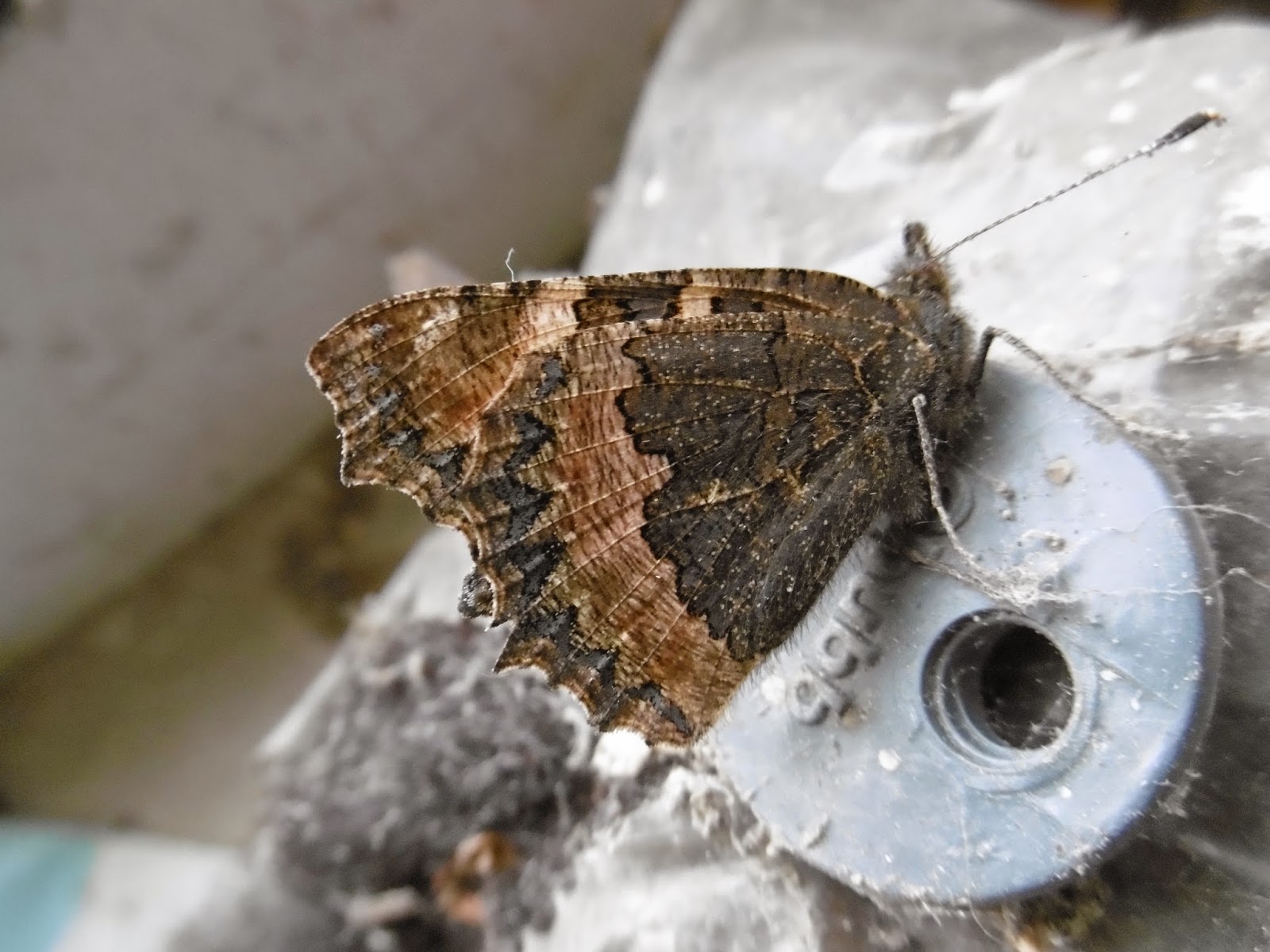
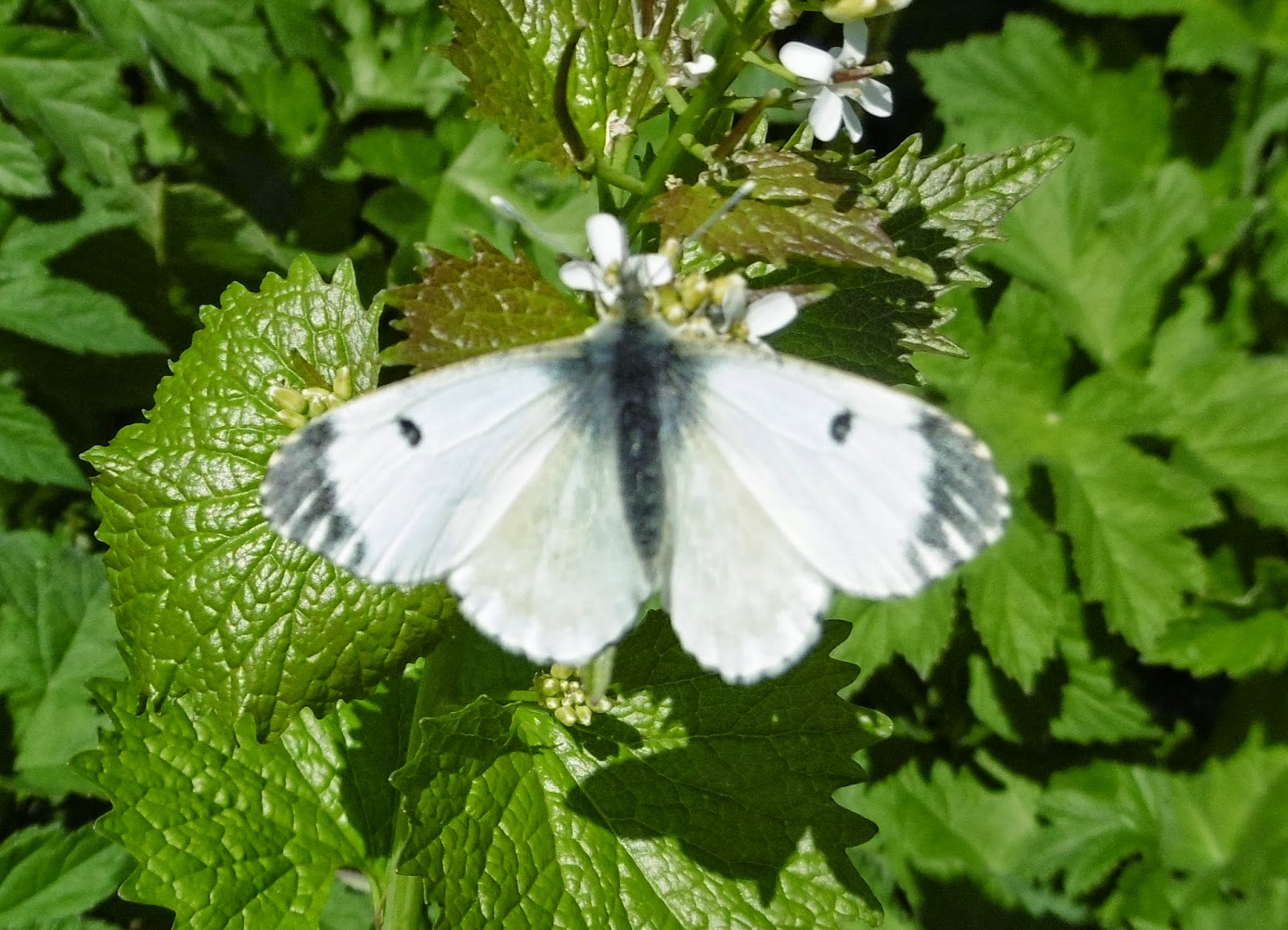
Butterflies abounded and here are the few which were patient enough to wait for me to creep up on them with my camera: a female Orange Tip (only the males have the colour), a female Brimstone (ditto, in the sense of the male being sulphurous while the female is buttery), a Speckled Wood and two Small Tortoiseshells, one with its wings tightly folded and the second showing part of its lovely topwings.
I also spotted the new (for me) road sign at the top of the post but failed to discover how or why the road was deemed a failure, other than being bumpety and unkempt. Observe finally, the difference between a conventionally fertilised and an organic field of oilseed rape, a crop which is currently turning the Oxfordshire countryside male-Brimstone yellow.
Sunday, 26 April 2015
First swallow
Meanwhile here's the first Swallow Prominent of the season, a beautiful moth with a sleek, sportscar-like appearance when at rest. It passed a lonely night after I set the trap very late and in drizzle - very welcome from the garden point of view after a long period without any rain. There was also a Brindled Beauty in the eggboxes and two Hebrew Characters but that was it.
We were late home because of a very enjoyable evening at Kirtlington Film Club, our first experience of village hall films - brilliantly organised with flawless screening, chairs grouped at tables, bring your own food and drink and even little posies of Spring flowers on each table. Much as I enjoy Odeons etc, this was definitely a cut above. The film, Boyhood, was good too.
Saturday, 25 April 2015
It's a boy!
Not any more. I checked the cocoons yesterday afternoon as best I could; most of them have curled-up, long-dead hawthorn leaves and even grains of soil woven into their protective armour, and all appeared to be intact. But in the evening, as Penny and I were putting away tools in the garden shed, I heard a tremendous fluttering from the muslin-covered cardboard box.
I still couldn't tell which cocoon had ruptured but here is the new arrival: a healthy male with fabulous antennae - a physical feature which we human beings sadly lack. I like to think that my benign wrinkles and slowly greying hair already make me look wise. A nice pair of elaborate antennae would complete the (misleading) impression.
![]() |
| Here's my moth above its painted counterpart on the cover of the Moth Bible |
One of the authors of the Moth Bible, Martin Townsend, took a few cocoons from me last year and well describes 'calling' on the UTM blog here.
Thursday, 23 April 2015
Othello, Act 2, Scene 2
Happy Birthday Shakespeare! And in case you are wondering, my title refers to the stage direction: 'Enter a Herald with a proclamation, people following'. In my case, there was no proclamation as moths cannot speak, but appropriately for the day - which is also St George's Day - the Herald Moth above entered the trap.
I'm sorry that it isn't a brilliant picture, as I continue to get to grips with our new camera, but you can always Google for better ones of this very fine moth. It appeals to me because it is so different from the general run both in colouring and particularly in shape. It has the honour of appearing on the spine of the Moth Bible where Richard Lewington's masterly painting has it in its usual pose, much resembling a shield from the era when heralds entered with proclamations.
My specimen is a bit tatty which isn't surprising as this species spends the winter as an adult, holed up in outbuildings - or, as the Bible says romantically, caves. It's a common enough moth in the UK and I hope that you get to see one for yourself.
Elsewhere in the world of flying things, we have been adopted by a beautiful whiteish mallard duck which gets bolder by the day, as you can see in the second picture. We're devoutly hoping that she rears a brood here to add to the many which frequent the Oxford Canal, about 100 yards from our garden as the duck flies. In our two summers here, there has been a pure white mallard on the canal and the hamlet is notable for whiteish ducks and drakes, presumably her descendants.
| Observe my wain; appropriate for a Wainwright |
Now that part of our time is spent on grandparental duties, we are great experts on small children's songs which are often addictive. With that warning, I much recommend the strange but compulsive Duck Song. I'd much like to meet its author one day. The YouTube version to which I've linked has had 186 million views.
Wednesday, 22 April 2015
Good moth, good man, good tea
The nights continue cold between glorious days and accordingly the moths remain modest. But a pleasant, if familiar, one came to roost two nights ago: the Early Grey above, which is in truth a little late in its usual season of early March (sometimes late February) to May.
I like the moth for three reasons, none of them scientific. It is a welcome contrast from the infuriating world of small, browny-grey lookalikes which I still can't tell apart. Its name reminds me of our early morning tea, half builder's, half Early Grey, which I must soon take up to my above-mentioned companion. And it also brings to mind Lord Grey of Fallodon who as British Foreign Secretary made the memorable remark in 1914: "The lamps are going out all over Europe. We shall not see them lit again in our life-time."

He was also a formidable naturalist and there is a lovely passage in his book The Charm of Birds which catches the joy of walking and watching alone in the countryside and the wealth of wildlife which will be seen as a result. Observe an example, right: Viscount Grey with a robin on his hat. The tea is not named after him but his great-grandfather's older brother, the second earl, who was Prime Minister at the time of the Great Reform Bill of 1832 and was given a diplomatic present of a packet of tea flavoured with oil of bergamot, as the delicious stuff still is today.
| Here's another one which came last night |
Tuesday, 21 April 2015
Sleepyhead
Sixty five years is a long time to wait to see a new phenomenon, but last night I enjoyed this experience. I was pottering in from setting the moth trap as dusk drew in, when I noticed a slightly unusual petal on a white daffodil. Looking closer, I saw that it was the beautifully green-flecked underwing of an Orange Tip butterfly, fast asleep on the flower.
I took the photograph above and crept off. This morning I nipped out to check and there the insect still was, as in the picture below. It is interesting to think how many of these little creatures are slumbering around us in this way, unseen. The number will run into many millions.
I am familiar, I should add, with sleeping butterflies in the shape of hibernating species which have featured on the blog on quite a few occasions. The Tortoiseshells and Peacocks disturbed in theatres, for instance, by the opening of the vast stage curtains which make a perfect wintering home. They are famously seen as good omens for new productions in the Spring, a tradition which perhaps should not be troubled by dry entomological reasoning.
Here are some of our current hibernators; lusciously sunny though the days are, we are getting frosts at night and so they are maybe well-advised to sleep on for a while. Not that the cold troubled my Orange Tip. After a little gentle prodding this morning, it fluttered prettily away.
I tickled the Peacock in the first picture, to tempt it into showing its glorious topwings rather than the austerely well-camouflaged underside which is all that you normally see in a hibernating example. Perhaps I should have let it sleep on, because I came across the second pair immediately afterwards: one in the conventional position and the other splayed open; lovely but alas dead, victim of the hibernators' great enemy, a spider.
The final picture is of a sleeping Small Tortoiseshell, many of whose livelier relations were flitting about on a sunny walk I took yesterday to reconnoitre a route for our parish's Beating of the Bounds next month. I also saw Peacocks, Holly Blues, Brimstones, Orange Tips, Commas and Speckled Woods. Vintage Spring weather for butterflies, yum!
Sunday, 19 April 2015
Friends Reunited
There were three Hebrew Characters (second picture) - so named because the marking on their wings resembles the Hebrew letter 'Nun' - and two Twin-spot Quakers, one of them shown above. The modest haul gives me time to catch up on the brown/grey moths which came on my first night's trapping this year, and here they are. First, a couple of Clouded Drabs (I think):
Next, a Powdered Quaker:
Then - I think - a Small Quaker (You've maybe got my post heading by now...):
But what, mmmm, are these? Clouded Drabs maybe?
Meanwhile, there is exciting news of successful hatching by fellow-enthusiasts of some of the Emperor Moth cocoons which I distributed locally last year after a magnificent female laid eggs in - appropriately - one of the (hens') eggboxes which provide sheltering nooks for moths which enter the trap. I have five cocoons myself, all still sleeping. More on this in the next post.
Thursday, 16 April 2015
When the light comes on again, tra-la
Hooray! I'm back in action at last, with apologies for my sloth, the demands of grandparenting and the business of getting a new mercury vapour bulb after the last one expired on the twelfth day of Christmas. Alas, I have cut it a bit fine this morning to say much, partly because of the time I spent trying to photograph the curious insect below. Sorry it's so blurred but the little beast darted about at high speed and our new camera's 'automatic intelligence' takes time to focus (although it's very intelligent when it has done).
I think it's another type of bee but its flight was different and it hovered moth-like in front of leadwort blooms with a long proboscis doing the business. But it's much too small to be a Bee Hawk of any kind as well as too early in the year. Any ideas, if the pic isn't too vague?
Meanwhile, the stars of my first trapping were seven Brindled Beauties - top picture - and two Nut-tree Tussocks, one of them below. There was much else of the smallish brown and grey variety which I need more time to sort out will appear here before too long.
From beetle to bee
I finally lit the lamp last night and will be posting about the results later today. Meanwhile, the stairs in our house are earning a reputation as a natural history hunting ground. Following last week's big black beetle, I assumed a return visit when I blearily came down to make the tea yesterday and saw a black object on a tread.
Oh no, mud from my going outside in my slippers, was my first thought. Then, when it moved, I made the beetle assumption. Intent on my tea mission, I decided to check things out later but it was Penny, going down for a refill, who reported: "There's a massive bumble bee on the stairs."
Here it is again, apparently interesting itself in Spanish. It was notably restless and crawled around without stopping as I tried to get a picture, but made no attempt to fly and only whirred its wings briefly after trying to climb the dictionary's spine and toppling backwards.
Bumblebees are famous for these indoor incursions which are often suicidal; I remember talking to a tomato grower in East Yorkshire who despaired of them coming into her greenhouses to certain death.
I managed to get this one to safety by tempting it on to my guerrilla knitting crochet hook and putting it gently out of the window on to our grapevine where - apologies for continuing blurring as I struggle to master our Panasonic Lumix - you can see it here, taking a breath of fresh air and, at last, a break.
Wednesday, 8 April 2015
Bright mite
After my interesting beetle, of which more in a mo, here is a mite or possibly a mini-spider which scuttled across a patch of soil which I was tilling with our almost equally tiny granddaughter for her coming sunflower patch.
It was amazingly red, more so than my efforts with our new and still not wholly familiar camera show. Identifications much appreciated as ever, though I shall do some Googling too, under the tag of 'bright red mite spider'.
Talking of identifications, it was very helpful to have Ben Sale's suggestion for my pointy-bottomed beetle on Comments under the last post. He suggests a member of the Tenebrionidae - probably a Darkling Beetle of some kind. I'm not (yet) sure whether this confirms or crosses with the following excellent email observation from my highly skilled entomological relative Martin Skirrow, who traps at a beautiful spot where the three lovely counties of Gloucestershire, Herefordshire and Worcestershire meet.
He writes: I am pretty sure your beetle (April 1st blog) is a Churchyard Beetle Blaps mucronata. Its shape is particularly characteristic. I quote from Michael Chinery's excellent Pocket Guide on insects of Britain and Western Europe:
"A flightless, ground-living beetle of caves, cellars, stables, and other damp dark places. Strongly nocturnal, like most members of the family. Scavenges on vegetable matter. Emits foul smell when alarmed."
So I wonder whether you really did smell a 'rat'!
Many thanks both and I will continue to sleuth. Meanwhile, here's to the glorious weather which has arrived, and the first blaze of butterflies of 2015. So far, I have seen many Brimstones, Small Tortoiseshells and Peacocks. I will soon get my photographic act together and hope to have the moth trap lit regularly from next week.
Wednesday, 1 April 2015
Foolish beetle
| Any coleopterist know what it is? |
But this was no April Fool. A large beetle was indeed trying to burrow its way to safety in the far corner of one of the treads. After a brief photographic sesh with our snazzy new Panasonic Lumix camera, I let it on its way, murmuring Isabella's entomological lines from Measure for Measure:
The sense of death is most in apprehension;
And the poor beetle, that we tread upon,
In corporal sufferance feels a pang as great
As when a giant dies.
Good news, meanwhile. A new mercury vapour bulb for the trap is at last ordered and so normal service should resume within days. Stand by for Martin's Moths of 2015...
Wednesday, 4 March 2015
Shouldering the task
It doubles my tally so far, which shows how sparse the harvest is when the moth hunter's mercury vapour bulb expires. But these are early days and the mornings remain too cold and insufficiently light to galvanise me to order a replacement.
Wednesday, 25 February 2015
Dotty
I'm afraid that my moth lethargy continues for the time being, with my trap bulb broken and rather a lot of other projects on the go. But Penny enlivened our cosy evening tonight with a cry of "Moth!" and there on the kitchen window - outside- was my very first record for 2015: a Dotted Border.
Here's its underside too. It clearly liked our kitchen since the first sighting was at 7pm, just before the latest dramas in the ever more frantic The Archers, and it's still here at 9pm, dozing away while we get ready for Wolf Hall.
By a happy coincidence, the Dotted Border was one of my first moths last year too, and features on the blog for this very Wednesday in February twelve months ago.
Monday, 16 February 2015
All quiet on the moth-ern front
Hello for the first time in 2015 - and apologies for the inertia here. Life's been busy, the weather hardly conducive to mothy excitement and, most significant, my bulb went, possibly after sterling work as a Christmas bauble (see previous post).
I'm not in any hurry to get going, as it happens, with reports on the sterling Upper Thames Moths blog pretty sparse since Christmas, and the mornings only just beginning to get light enough to tempt me out of doors at the earlyish hour which trap inspection requires. However, I will get myself sorted to email Watkins & Doncaster for a new mercury vapour bulb and probably start operations in early March.
Meanwhile I was mulling over my situation and Holman Hunt's painting The Light of the World, which hangs just down the road in Keble College, Oxford, floated into my mind. Via the wonders of modern technology I have adjusted it to show how things feel here. I also adjusted the halo, since I do not deserve one of those.
Wednesday, 24 December 2014
MERRY CHRISTMAS!
Behold! It is enjoying a new, 12-day role as a Christmas bauble.
The container is the partly-built treehouse which Penny and I are making for our granddaughter; slowly, because that is how increasingly we do most things, but at a reasonable pace because it needs to be finished before she is old enough to an express an opinion like that demanding little girl who harasses her Dad about her treehouse in the TV ads.With the help of our younger son Olly, we cut stars (and a moon; she is very keen on the moon) in old cardboard boxes from our move, blocked up the windows and Bingo! I hope you like the effect.

Whether any moths are attracted by this strange object, will be an interesting issue. I will report after Twelfth Night.
Meanwhile, I hope that you and yours have a very happy time.
Subscribe to:
Posts (Atom)