Tuesday, 9 October 2012

Hairy guys


A dry night was forecast last night and so it proved; but it was also extremely cold and the moths - see previous post - never got the chance to warm up and take off. There were none in the trap whose only occupants were these two caddis flies, above and below.


The caddis is a wonderful creature. It belongs to a separate order from butterflies and moths whose name, Trichoptera, means 'hairy wing', just as Lepidoptera - the term for butterflies and moths - means 'scaly wing'.  You can see the little hairs in the pictures. Aren't the patterns on the wing membranes fascinating too?


Caddis meant a coarse type of wool in the days when the word was in common usage. This may refer to the hairyness but more likely comes from the larvae's remarkable construction of silk homes underwater. They also come to resemble small scraps of that cereal of my youth, Fru Grains.


The flies emerge en masse from their youthful element, water, into their adult one, the air, a habit which  ensures their survival because the males and females meet immediately and mate almost as soon. This is just as well because predators make hay with them; birds and especially fish. The caddis is probably best-known outside the entomological world as lure used by fishermen and there are some wonderfully realistic examples online. It's specially worth checking out the ones which are on this website here - so good that some daft anti-creationist book pinched them as illustrations but didn't notice the hooks!

Monday, 8 October 2012

Warming up

I'm a bit slow to get going on these colder mornings, which are also darker and make photography tricky at the trap. That will change a bit when the clocks go back at Hallowe'en but not by much. But at least the moths are facing these problems as well.


I've just been tucked up with the Autumn issue of Butterfly, the magazine of Butterfly Conservation, excellent if misnamed because it also has plenty about moths. Two of its most vivid pictures this time are infra-red photographs of a Large Yellow Underwing and a Privet Hawk moth warming up to get ready to fly. This can take several minutes as the moths vibrate their wings in an insect equivalent of pilates, to get from the low teens in Centigrade to the late 20s which is warm enough to take off. Here's an infra-red diagram of the process from this American educational website.

Moth warming is a process also similar to propellor planes, which go through a repertoire of revs and shudders before lumbering down the runway. When it gets even colder, other wonders of Nature kick in, for example with the Winter moth whose equivalent of blood is essentially the same as anti-freeze.


Wonderful that people such as Dave Green are doing this sort of thing. His pics are in Butterfly, which I urge you to buy, but here's one above from the very good public domain website Now Public of a moth and a bat. Have you ever watched that section in A Question of Sport called 'What happened next..?'

Tuesday, 2 October 2012

Home alone

I finally had the trap running again last night after all the waterspouts and hurricanoes which have plagued this part of mother Earth. A dry night for Leeds, said the BBC, and it was so; but not a warm one. Even after sunup when I went to examine the eggboxes, it was nippy.


Not so very surprising, then, to find just one moth in residence - choosing to settle on the barcode as so often happens. I have aired my theory previously that this is a conscious attempt to find a multi-coloured or -textured surface. Maybe someone more scientific will prove that one day
.

The moth is a not very black Black Rustic, starting to look a bit battered as it lives out its short span. I persuaded it out of the eggbox and into cover where it took up residence next to this snail which I hope is not a mothivorous sort.

Monday, 1 October 2012

Late Admirals

Lord Nelson would have had them keel-hauled - or maybe even shot like poor old Admiral Byng whose execution for 'not doing his utmost' in the face of the enemy led to Voltaire's famous comment in Candide: 
Dans ce pays-ci, il est bon de tuer de temps en temps un amiral pour encourager les autres. (In this country they kill an Admiral from time to time to encourage the others).
I'm talking about Red Admirals which this year, like Admiral Byng in his battle off Menorca, are very late to arrive. But they have done now, and here is a handsome one enjoying the sun. As I have mentioned previously, neither they nor the lovely White Admiral have nothing to do with the Navy. The word is a transition from 'Admirable'.


The sun is essential for their appearance. We haven't had a lot of it recently - in contrast to the lashings of rain which account for my moth lethargy. But the equation is consistent: sunshine = Red Admirals. Dull weather = their disappearance.

I can feel the autumn coming now that we are in October, and even the winter. Ah well, spring will not be far behind.

Sunday, 23 September 2012

Women on top

When we moved into our house 25 years ago - a quarter of a century, crikey - we had a blazing red and orange carpet to compensate for dark nights or days of low cloud. The current cold (but to be honest, bright) weather has brought a sudden glory of Red-green Carpets, albeit of the mothy rather than textile kind.


There were seven beautifully fresh examples in the trap this morning, much to my particular joy because in the all-but-total absence of blue from the UK moth colour palette, my favourite colour is green. Here are some pictures of four of them.


I find it interesting how either green or 'red' - actually more a russety brown - predominates depending on how you look at them - eg in the first two photos which are of the same moth. Do you remember those 'magic pictures' for children (of all ages) which played that trick, showing two different subjects, each predominantly made up of a different colour or very similar tones?


The mother rules in the Red-green Carpet family, surviving the winter by hibernating in a way which males do not. Hardy creatures! And they are getting practice at the moment on very cold nights. Look, the one below which was on the canopy rather than in the trap, actually has dew droplets on its wings.


Their life cycle might form a nice allegory for feminist writers: a moth which goes to sleep when the men are around as usual but wakes to find that she's in an all girl's world - until her eggs hatch and her briefly peaceful idyll is shattered.


Friday, 21 September 2012

A bat and a bird

Sorry, I have been a bit inert in the moths department on account of busy-ness and dodgy weather. But the rest of the natural world has carried on as normal. Red in tooth and claw, they say, which is true. It is also true that an animal's life is hazardous and usually short.


I hope that this bat which came down our chimney survives. It somehow avoided the gas fire and crash-landed on the hearth. We gingerly scooped it up in a pond net, to its annoyance, and took it outside on which it flew off, although not altogether normally.  Last time we found ourselves in charge of a bat was many years ago. We rang the local bat hospital in Otley, whose staff came round and spent all evening with us, only leaving when they detected a passing bat of the same species and released the one which had flown into one of our boys' bedrooms.  I think they liked Penny's tea and ginger cake.


There was no doubt about the fate of this thrush, sadly. It flew into a window pane and that was it.  I reckon we lose about half a dozen birds a year in this way - by far the most spectacular being a sparrowhawk which hit our sitting room window in July 2009 with such a thump that its claws, legs and part of its body left a ghostly outline on the glass. You can read about that here.


Isn't the thrush's plumage lovely?  What a sad waste.

Sunday, 16 September 2012

Turning to the dark side?


The mornings are getting darker, and so are the moths. The year's first Black Crescents arrived last night, twin Darth Vaders with a little corps of wasps to serve as their Imperial Stormtroopers. Mind you, they were all so sleepy that Luke Skywalker and Princess Leia could have locked them up without their ever knowing. Appearance isn't everything - and actually, don't you think that their tiny wing-crescents of glittering gold are a sign that they're not really from the dark side?


One of them posed without protest for me to photograph its underwing, above. And here below is another Star Warsy character, although it's only a Silver Underwing (sorry, I meant Silver Y - see Comments)  seen from an unusual angle. I mustn't go on and on about many moths resembling jet planes, but this is definitely another which does.

Saturday, 15 September 2012

Morning all

How do you greet the morning, especially on Saturday which is often the modern day of rest? Bleary or perky?


My moths are usually in the first category, or an even sleepier one called 'comatose', but not all of them. Those with slenderer bodies often seem to be jittery and ready to flutter away by the time I get to inspect them, especially in the summer when the dawn comes so much earlier. Curiously, in my family, the opposite applies: I am always up early while my slender companion in life dozes on.


Here are two morning trap arrivals, ready for take-off: a plume moth, whose curious T-shape always fills me with great satisfaction; and a Mother of Pearl, another species whose praises - that wonderful iridescence! - I never tire of singing.

Wednesday, 12 September 2012

Piggy back

Colder weather and the return of overnight drizzle didn't make for much of a catch in the trap this morning, but among the seven slumberers was this distinctive moth.


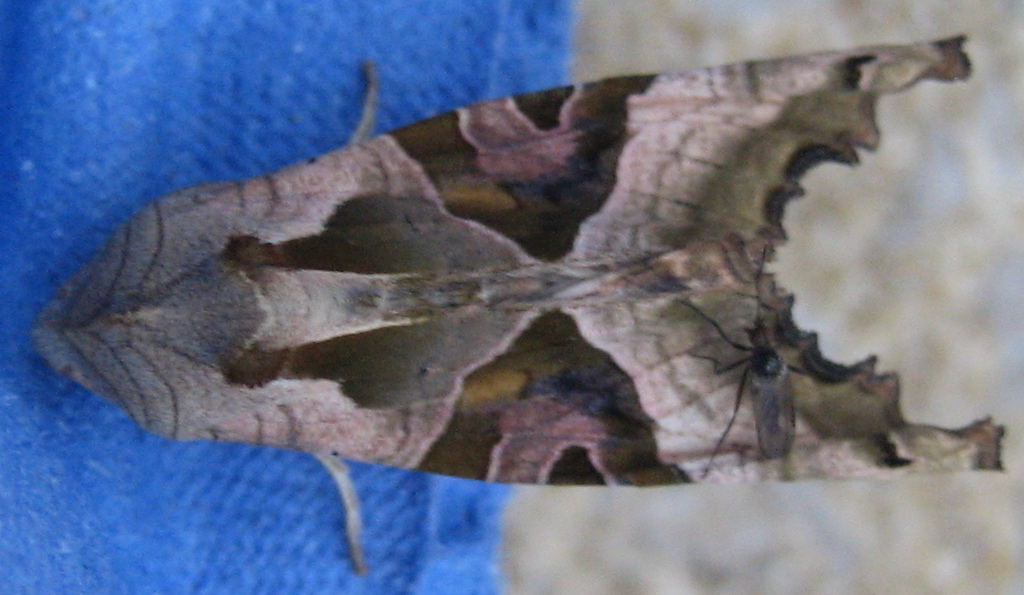
It's an Angle Shades, whose rakish wing shape is perhaps the most dramatic of all UK species. I wonder if one has ever been filmed in flight, to see if the structure gives the moth advantages. Maybe it swoops more elegantly than the average British moth's hectic, late-for-the-train style of dash.


The wing shape can distract you from the beautiful pattern and subtle colouring, even including a trace of my favourite but very rare mothy colour, blue. Here it is closer-up, a view which also reveals a tiny, piggy-backing fly.

Tuesday, 11 September 2012

Carpet and cushion

Here's a Green Carpet on a mauve cushion, a textile composition in Suffragette colours, almost. Give Women Votes - Green, White, Violet. And yet here am I, not even knowing whether this moth is male or female.


You have to examine their genitalia to ascertain that and this involves either killing or freezing or temporarily anaesthetising them, none of which I wish to do. What a pretty moth, however, in spite of its small size. There were several of them in the trap last night.


Here it is again, just to illustrate the problems of moth photography, even with today's brilliant digital cameras such as my Canon Ixus. As the nights draw in and the mornings darken, the task gets that bit harder. Pictures are generally far better without flash, but we are running out of light.

Finally, I should have mentioned in yesterday's post that the caterpillar of the Centre-barred Sallow has interesting habits. It starts life in the bud of an ash leaf, contentedly eating its home in the manner of many moth larvae. When too big for this, and after the remains of the bud have uncurled, it finds a nook low down the tree in the bark and then, at dusk, nips up to feed on the nearest leaves - climbing very quickly, according to my Moth Bible. I would like to witness this.


Here is its close relative the Orange Sallow, which visited last night (and also illustrates the difficulties of photography without flash inside the bowl whose black plastic seems dark to the eye but emits strange background light to the camera). Orange Sallow caterpillars also race up trees but start life as an egg on a twig before spinning leaves together and hiding in them when young.

Monday, 10 September 2012

A glimpse of the elusive underwing

I routinely slag off the various sorts of 'yellow underwing' here, for the specious reason that they are so common. At times, indeed, the trap is almost overwhelmed by them - over 100 on occasion - so that their individual beauty gets forgotten amid exhaustion at the sheer number and the possibility that they may dull my senses to something smaller and rarer.


Their other disadvantage is that, when at rest, they very seldom show the vivid underwings which give them their name. I have managed to photograph and post a few glimpses over the years; and there was one rather dramatic image of a moth disappearing into a blackbird's beak. But here, above, is one which allowed me to get a closer look, albeit largely from behind. It couldn't object, because it was dead.


I couldn't re-arrange its wings because it must have perished when we were at the Paralympics in London and it had gone stiff, as in the American nickname for a corpse. When I was a boy collector, I used to get some sweet-smelling stuff called 'relaxing fluid' from our local chemist (who also supplied me with 'killing fluid', no questions asked). This softened the muscles and allowed you to 'set' the specimen; but those days have gone.


In the same, yellow, part of the spectrum, here's a nice arrival in the trap: a Centre-barred Sallow. The sudden, straight end to its patterning along the back is unusual compared with the subtler camouflage of many moths. Like dazzle-painting, I guess it breaks up the moths' shape and helps them escape blackbirds and other menaces by that means. And get on with doing the Guardian's quick crossword...

Friday, 7 September 2012

Paralympic papillon

I've been down in Olympiclandia in London having a truly amazing week at the Paralympic Games whose marvels have been much-described, and rightly so.  Among the many delights of the park (which is very big, taking a good half-hour to cross from side to side) is the wildflower planting which is extremely beautiful. It has also been done with an eye to attracting wildlife, including the Brocade moth.


How excellent that such a vast project should take account of such a small creature, and see the value in publicising this too. I didn't see any Brocade moths and wouldn't have recognised them if I had done - my Moth Bibles being in Leeds - but there were masses of these Common Blue butterflies, above, skittering about in the wetlands area beside the river Lea.


Penny's vivid clothing also attracted this ladybird, which we consider to be a sign of good luck in our family. And we finished up a great spell, including three bronze medals in swimming for our older son and daughter-in-law's bridesmaid Susi 'Suse Missile' Rodgers, by clambering up the most famous 'animals' in the park - the squid and octopus whose writhings make up Anish Kapoor's Orbit tower.

Friday, 31 August 2012

Tea, or chai, for two


This moth shouldn't puzzle me, should it? It looks most distinctive, but in my usual fashion, I have come away from my moths Bible in a state of uncertainty about what it may be. I think that it's a Grey Chi, which is an appealing name, sounding like the word used for 'tea' in Eastern lands; and, as so often when I write these bulletins, I am in bed sipping my morning tea.

The name actually comes from the Greek letter Chi, which the vaguely cross-like shape on the forewing was thought to resemble (see left). Reading online about the moth just now, I did at least come across the reason for my persistent failings. The entry on Wikipedia refers to 'markings which vary in intensity', and this is the problem. There is so much variation in moth wing colourings and patterns.

I've got more sure during the writing of this post that it is a Grey Chi. I shall stick my neck out and say, it is. Chi is also part of the Christian symbol, the ChiRho for Christ, so this moth is a brother in religious symbolism to that regular visitor to the trap earlier on in the season, the Hebrew Character.

Thursday, 30 August 2012

Shirty - and waspy

I'm a bit distracted at the moment by the Paralympic Games which look set to be as much of a triumph as their Olympic predecessors. We have a particular interest because Susie Rodgers of the GB swimming team, aka The Suse Missile, was 'best girl' at our elder son's wedding.


Here is one of the said son's shirts, ironed by his loving Mum as he and our equally lovely daughter-in-law Abi are over here from Mexico, where they work, to support Susie. What a surprise: a moth has decided to perch on the shirt, a pretty little Single-dotted Wave, complete with its perversely many dots.

Also, I mentioned in the last post that we clambered up Roseberry Topping, and on the way back, we had a cream tea in Helmsley. We were sitting outside and, since cream teas involve jam, we were much-visited by wasps. Penny dealt with this by making a wasp decoy and placing it on a nearby (empty) table. You can see how well it worked.


The little red dots are interesting. I assumed they were footprints or other traces of messy wasps but Penny thinks that they are jammy wasp poos.

Wednesday, 29 August 2012

Bright arrivals

What a relief. I was getting seriously worried that our soggy summer was going to deny us the beautiful Vanessid butterflies whose arrival towards the end of summer coincides with the blooming of the honey-drenched buddleia which they love.


Hooray! Yesterday's lovely sunshine - the sort of weather we should be having and have been largely denied - brought out three Red Admirals and a whole flutter of Peacocks. We were in a bit of a rush because we took advantage of the day, and a day off to boot, to head for Middlesbrough and climb Roseberry Topping, best of mini-mountains; but I managed to get this quick pic of a Red Admiral basking on a warm, white window frame.


This is a habit the Vanessids indulge, sun-bathing when they are not feasting on buddleia nectar. A call from the bathroom then alerted me to another, a Peacock, which had taken this habit too far and come inside to sun itself in even warmer circumstances (albeit ones which could do with a lick of paint). Butterflies can often batter themselves badly when they come indoors; but I opened the window more widely and off he, or she, flew.

Interesting isn't it, btw, how dark the undersides are of the wings of these specially glorious creatures? Here is another Peacock illustrating the point while it sups rapturously away.

Monday, 27 August 2012

Chocks away!


A bit of a diversion this morning, because I was arrested by this image of four Riband Waves lined up on the runway of the trap's transparent collar. They took me back 30 years to the return of HMS Invincible from the Falklands campaign, to be greeted by - among many others - Mrs Thatcher and me.


Don't you think the moths look just like a squadron of fighter jets? Here's the real thing which I photographed back in Portsmouth harbour in 1982, for comparison. And although my moth identifying skills may be rubbish, I don't think we need any help with the character in the picture I took on the flight deck, below. Doesn't she look young though? We all did then...

Sunday, 26 August 2012

Copper belt

After yesterday's bungling, I am on safer ground this morning with the Copper Underwing. Except... Let me quote to you from the three wise men, Messrs Townsend, Waring and Lewington:

The two British species of copper underwing are very similar. The most reliable way to separate them is to examine the underside of the hindwing. This can be done on an anaesthetised live moth (see Introduction for further details).


No, I don't think I am going to do that. So this is either a Copper Underwing or a Svensson's Copper Underwing, the latter being a moth which, again according to TW&L, has 'become more frequent in Yorkshire in recent years.'

The two species were separated in 1968 by an entomologist called Fletcher, although Svensson's seems to have received its own Linnaean name in 1949 from another scientist called Rung. Who were these people and who was Svensson? I don't yet know but I intend to find out. I am often surprised at how hard it is to find out about the history of such things, even with the mighty assistance of Google.  After yesterday's Sallow blunders, I will research patiently and see what else I can discover, but this may take some time.


I have also failed, so far, to persuade a Copper Underwing to show me its underwing, let alone the underneath of its underwing. As you can see from the picture above, their main intention when the trap is opened is to scurry into the nearest dark nook. But here below is a very battered yellow underwing - a Lesser Broad-bordered, I think - which was less modest.

Saturday, 25 August 2012

After that, the dark


The Copper Underwings are here. See above. Eek! But since I haven't yet persuaded one to show me its actual copper underwing, about which they are very shy, I will stay a little longer in the realms of light.


Following yesterday's Sallows, here are a couple of Dun-bars, very pretty late summer moths and very like the Sallows. It isn't easy for the camera to bring out their true colours, I find. Something about the spectrum involved can dull the brightness and the light. But I hope these pictures give an idea. As you can see in the second, rain is a problem these nights, although so far it has been gentle.


Actually, I'm having second thoughts about whether the second one may be a Sallow after all. I will ponder the question after breakfast. Update: See Comments and weep....  What we have hear is actually a Sallow followed by an Angle-barred Sallow. Many thanks to Bill and one day I will learn...

Friday, 24 August 2012

Hello Sallow

I am quick to defend British moths against accusations that they are all small, hairy and brown; and here are two of my allies which flew in last night. I have to admit that they stood out rather in a trap which was well-stocked with, um, small, hairy and brown neighbours. But they weren't the only ones, as the delicate little micro in the first and last pictures shows.


Above, first of all, is a Sallow with its delicate and slightly sulphurous colouring, and then below an Angle-striped Sallow which has richer orange tones. Penny noted that the scientific forename for the Sallow is Xanthia and suggested that this sounds like a character from Just William, an older sister maybe for Violet Elizabeth Bott. The Angle-striped Sallow is called Enargia, which might be the name of the daughter of  someone working in the power industry. Or are we getting too fanciful?


Here's the micro again, below, having reached the summit of its egg cone. I am pretty sure that it is Eudonia mercurella. Eudonia? Would anyone call their daughter that?