Thursday, 16 April 2020

Wiggly Woggly


Last night was a little warmer but still with a frost as you can see from my gardening gloves below. As always, I left them out by mistake. The fabulously sunny day weather has long since returned their suppleness and Penny and I are hard at work again, digging for victory.

No moths of any great interest, therefore, but at lunchtime P spotted this tiny 'looper' caterpillar,  shown in my first picture, making its way across my hand. There's one to tax the iRecord experts!

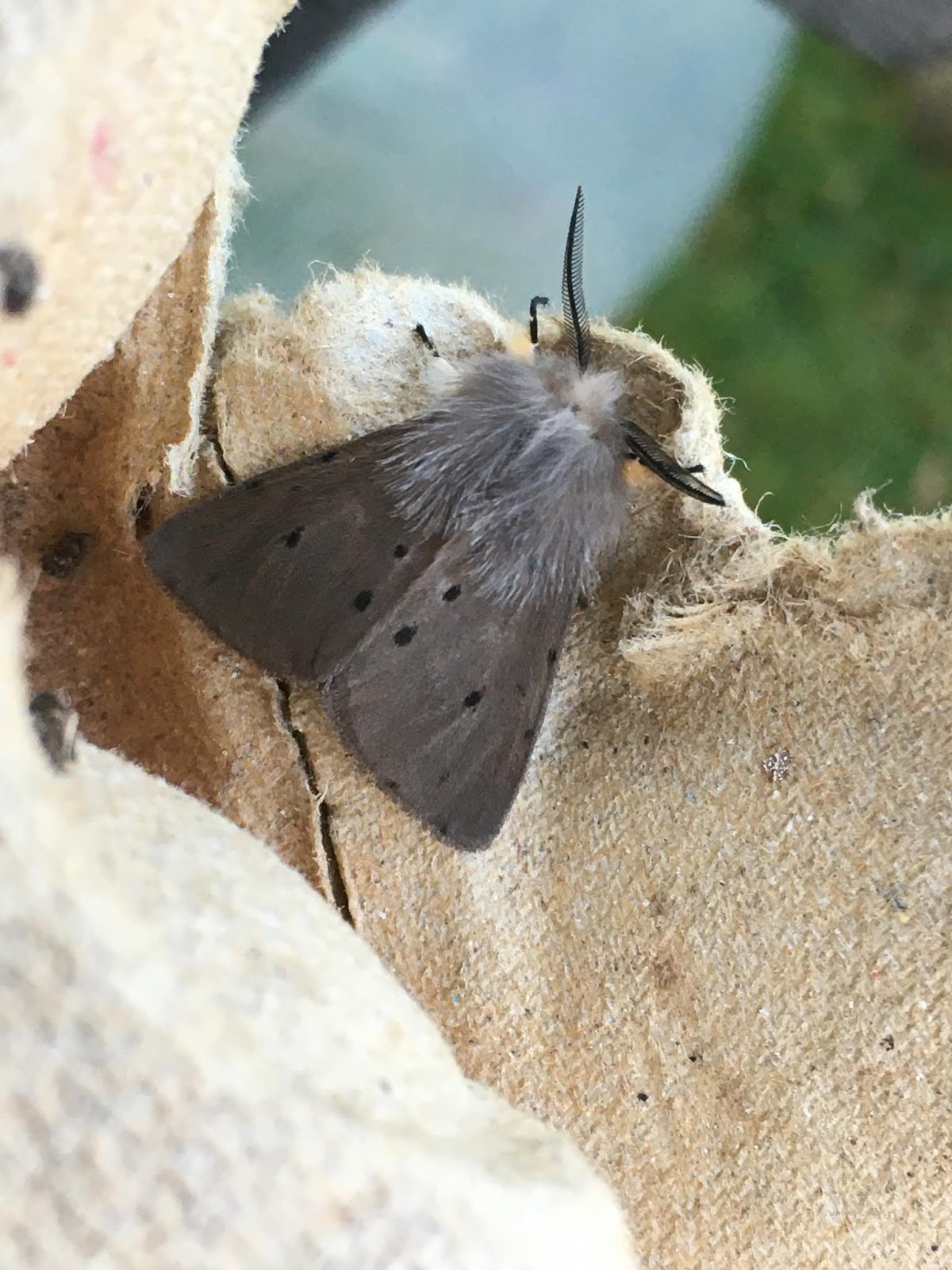
I will just make one moth observation. There were two Muslin moths in the eggboxes this morning and both had their antennae out, although they were otherwise inert. Nearly all moths in my experience fold the antennae away when sleeping. I wonder if the Muslin is an exception, constantly on the qui vive.  According to the Moth Bible, the female behaves rather unusually, not coming to light but active during the day and sometimes to be found crawling about on undergrowth.  An interesting moth!


Wednesday, 15 April 2020

Other guests (spider alert, for arachnophobes)


There was a frost last night and it emptied the eggboxes as thoroughly as the virus lockdown has cleared the country's usually bustling streets. There were just three moths with the fortitude to be out and about, or possibly they were hiding in the eggboxes from two nights ago: a Small Quaker, a Powdered Quaker and a Brindled Beauty. There was also a menacing looking spider - below - which reminded me to have a little catch-up on light-trap visitors which are not moths. For example, the Dor or Dung beetle at the top.


Here's the spider, with the remains of its prey - the sort of image which understandably turns many people into spider-haters, in spite of the best efforts of children's books such as Charlotte's Web. We have quite a lot of spiders in the house and always have had, including one enormous one in Leeds which used to come out to watch the then Nine O'Clock News on the BBC  We called him or her Bob. But they don't have the rather fierce and sinister appearance of these garden ones.


I am waiting to hear about their ID from iRecord's spider expert(s). Meanwhile, I have had very quick confirmation of these two caddis flies, below, from Dr Ian Wallace of Liverpool University, the head of the National Trichoptera Recording Scheme who dealt with my records at fantastic speed.   The top one is Grammotaullius nigropunctatus (the second part of the name presumably meaning 'Black Spot' like in Treasure Island) and the darker one is Limnephilus affinius. What a wonderful thing iRecord is!


Likewise, I have had this ichneumon wasp identified as Ophion scutellaris by Dr Gavin Broad of the Natural History Museum in London.  A very big thank you to both.


I am faring less successfully with the snails which creep into the bowl from time to time. Being completely ignorant of the genre, I sent them off just as 'Snails' which led the iRecord computer to send some of them to a marine mollusc specialist.  He kindly directed me to a snail enthusiasts' Facebook page to help me try a more precise guess which the appropriate expert can then examine. So there is another enjoyable lockdown task.


Update:  I have to admit that my latest iRecord was not very heroic. I sent off the photo below with the category 'Millipedes', which I thought these squiggly chestnut things which abound in our garden, to be.  Back came the laconic comment from the millipede expert: 'Centipede!'  Whoops...  I have re-submitted the record as a 100 (rather than 1000)-legger and await developments.


Tuesday, 14 April 2020

A day in the life


The trap was by a garden wall on Sunday night and in the morning I found this Swallow Prominent resting on the grey stone. Thanks to the lockdown, Penny and I were around all day and I checked occasionally to see if it had gone.  It was an interesting experiment, if modest, because we had quite a lot of different weather: a cool start, warm sun by early afternoon, much colder by teatime and close to freezing once night had fallen.


So, at the top of the post is the moth as I found it, at 6.35am.  The same picture is in the top left hand corner of my composite, above, followed in a clockwise direction by the moth in warm sunshine at 3.30pm, cooler evening sun at 6.45pm and finally, when I stiffened my resolve and went out to check at 8.50pm with my clockwork torch, whirring its wings ready for take-off.  It was too cold to stayn and watch its actual departure, but it must have happened very soon afterwards.

I'm interested that the moth was prepared to sleep openly, albeit camouflaged, and that its presence went undetected by predators. I guess the main reason for the latter was that it didn't budge an inch but remained completely immobile.


Otherwise my chief pleasure during the day was photographing the year's first Green-veined White butterflyhere, an insect which I come to loathe as our brassicas develop in the veg garden, but very beautiful even so. It was lucky to catch it with the light illustrating the delicate patterning of its wings, specially for me as a very ham-handed photographer saved only by the incredible virtues of my iPhone camera.


I am keeping a lookout in the moth trap's eggboxes for a Pale Brindled Beauty and initially I had hopes of the moth on the left above. Instead, it serves to show how varied the standard Brindled Beauty can be. I posed it alongside the more typical, darker specimen which was one of another half-dozen who stayed the night.


Finally, there is no particular reason to show this Powdered Quaker, other than the beauty of its latte, milkshakey colour and gentle patterning. But that's a good enough reason for me.  No trapping last night on account of the cold. We'll see how the temperature goes today.

Sunday, 12 April 2020

Form an orderly queue


It's easy to forget in the quiet months (for moth watching) since November, just how busy the trap can become from early April on. How I managed to keep on top of it while I was working, I can no longer imagine. But it was, and is, such a consuming pleasure.

Saturday and this morning, Easter Sunday, have brought the year's first Prominents, no fewer than three species from that sleek and aerodynamic-looking tribe. They have an immediately recognisable way of resting like crouching cats. Here they are:  at the top, this morning's Lesser Swallow Prominent which chose to sleep on the house wall rather than inside the trap; and then below, in order, a Pebble Prominent and two Swallow Prominents.


I realise that the photos above have a rather 'Police Wanted' look to them, so here is something a little more artistic. This is a moth which I nearly missed during my eggboxes check because it was hanging perilously from the lip of the trap bowl. It's a Purple Thorn, a moth with another distinctive resting position, almost butterfly-like but with some of the grandeur of a Roman Emperor unfurling his royal purple robes. I photographed it shortly after sunrise from both sides and you can see how the camera, or rather its digital working system, tells two different stories - neither really a lie as the moth also changes appearance to the human eye in different light.


While in this cheerful part of the colour spectrum, here's another Herald which came on Friday night and adopted a rather striking, vertical dive pose (and there was a third one in the trap this morning):


And here are a couple of lovely 'firsts' for 2020, a Lunar Marbled Brown with its little moon (similar to that on the Purple Thorn and quite a number of other moths), followed by a Poplar Kitten, a member of a very attractive family of moths:


The house wall is an excellent place for me to spot moths; a little more challenging than simply working through the eggboxes, much as I like their colours and bold advertising claims (I mean, what is a 'Happy Egg'?)  I almost missed this Early Grey, below, for example, so well does its pattern fit into the stonework and lichen.  The birds seem completely incapable of seeing the sleepers which remain all day, as I mentioned in my last post with the Brindled Beauties and a Streamer. I will check up on these later on.  Mind you, I think that bird vision depends a lot on movement. The Brindled Pug  in my final photo was also undetected in his bed on the trap's canopy.  Or maybe he was too small to make a decent meal.


Oh and finally, finally, here's a Nut-tree Tussock. Quite a crowd, altogether.

Friday, 10 April 2020

Outsiders


This is the best time of the year for moth watchers. Arrivals are increasing in both number and variety and trap inspection time coincides with dawn - above. Today's guest list includes an interesting locally common moth, the Frosted Green, which needs an oak tree. Luckily, we have a fine example in the garden.


An interesting feature of last night's visitors was how many preferred to stay outside the trap and roost on our nearby house wall.  Here's the tally: a whole load of Brindled Beauties, a couple of Streamers, one on the wall and one on the trap's transparent plastic cowl beneath the bulb flex, and a Brindled Pug on one of our windows. 


Here's the pug again, full-size, in case I've mis-identified it, which would not be surprising. And below that, one of the other Brindled Beauties which preferred the eggboxes. I disturbed it by mistake, and it obligingly responded by opening its wings and showing off its antennae.


Here's a Clouded Drab, too and then a picture showing how little moths get up to during the day. I took this at 6.30pm and there are the three Brindled Beauties still on the wall. They haven't moved all day. The Streamer was slumbering away as well, just out of shot.


Today was gloriously sunny and the butterflies were out in scores. I saw my first Comma, below, my first Holly Blue which wouldn't stop for a photograph, and dozens of Orange Tips, one of which, a female, paused long enough for me to record her marvellously delicately patterned and coloured underwing. 


Wednesday, 8 April 2020

Happy times are here again


A bit of colour at last! That handsome moth the Herald flew in last night - and was keen to fly off this morning. Unlike most of the snoozing residents of the trap, it was keen to wander around and then sat in the early sunshine, warming its wings before taking off and jinking away to safety in a hawthorn hedge. Considerately, it gave me time for the photo above before taking its leave.


The other new arrival for the year was a Muslin moth, a species which is deceptively grey at first glance but has a wonderfully shaggy head, fine antennae and striking yellow knee-breeches. The other guests were ones which have been here before - lots of Hebrew Characters, Common Quakers and the like, plus a trio of Brindled Beauties, one of which had gone to sleep pretending to be a butterfly with its wings raised, rather than swept back in the usual manner. Is there a reason for this? If anyone has an answer or opinion, I'd be very interested to hear it.


Here's a handsome March Moth too, left, more colourful than the usual, run-of-the-mill versions. But then my attention turned to butterflies. We are enjoying absolutely beautiful weather and, I'm glad to say, Orange Tips have made their appearance to join the Brimstones, Peacocks and Small Tortoiseshells which are abundantly around.

Here below are a male - with the orange - and female - without, pausing for a welcome moment for the photographer in their usual restless circlings of the garden and next door properties.  Then the male and female separately What a beautiful creature!


Monday, 6 April 2020

Warm night, guest list growing


I have often lamented the fact that we humans don't sport antennae, which are perhaps the one advantage given to moths and other insects, but not to us. Maybe not everyone would want a giant pair of extra eyebrows, like the ones on this morning's Brindled Beauty; but I find them handsome as well as very useful for the jobs of direction-finding, scent and other skills which they give to their owners.


Here's the entire moth; a male, as are most moth-owners of large or complex antennae. This has much to do with detecting pheromones given off by the females of the species, I think, a process shown most spectacularly by the Emperor moth, as I have found during several breeding seasons here after a female bequeathed me her eggs in, appropriately, one of the trap's eggboxes. 


The trap's other residents were the most diverse of the year so far, after what I think was the warmest night of 2020, with rain only coming at dawn and seen off by the Robinson trap's super-simple but very effective rainshield.  Above is the star, so far as I am concerned: a Streamer with its delicate mauve background colouring. It rather tones with the rug which my Brindled Beauty was exploring, don't you think?


Then we have the angular March Moth, above, coming a little later than the eponymous month, followed by the pretty little micro Acleris literana, a somewhat battered Nut-tree Tussock and a second micro plus a pug which I'm hoping the ever-wonderful experts on the Upper Thames Moths blog will ID for me in due course.

Update: Dave Wilton duly and kindly says that the first is Epiphyas postvittana or the Light Brown Apple moth, a regular caller, and - with allowances for my haywire photography when moths perch on the trap's black bowl and are too jittery to move to more helpful backgrounds - that the pug looks like Double-striped, which would fit at this time of the year.  Thanks as ever.