Tuesday, 18 June 2013

Mellow yellow


A lovely moth this morning: the Buff Ermine, yellowy relative of the pristine White Ermine whose beauty attracted an approving comment below a post a couple of weeks ago. There were two in the trap, along with two White Ermines; the one above which was easy to photograph on its cheerful background of a Happy Egg box (what defines a 'happy' egg? I must ask the company some time). The other was part of this conclave in an eggbox cone below, along with a fading Green Carpet and a Bright-line Brown-eye.


Along with the Ermine came another distinctive moth. You can probably make a decent guess at its name if you look at the picture below. The Nose Moth? No. The Snout Moth? Yes. It is the Cyrano de Bergerac of the tribe, varied in colour as you can see and also larger in the first generation, which is currently on the wing. A second brood will hatch in late August, generally smaller in size.


Things are busying up now, and there were plenty of other excellent moths in the trap after a warmish night with honeysuckle drenching the garden with scent at dusk. Below are a handsome Buff Tip and a lovely Marbled Minor, a Middle-barred Minor (two pics), a Garden Carpet, a Grass Rivulet (I think) and a very handsome Beautiful Golden Y (the Beautiful is part of its name, not me gushing.


The Marbled Minor as first seen. I had to rip open one of my brand new eggboxes to get the other, better pic


Finally, the usual Bafflers. I am working on these...  A micro, a beautifully subtle, small dark moth, a lovely Carpet, a handsome grey Rustic or Shoulder-knot or some such, a Pug and A.N.Other (or is it the same as the small dark one just mentioned?) And hooray!  Ben Sale has been in touch - see Comments - and I've added his unfailing expertise in the captions. Many thanks. Ben).

Celypha lacunana

Tawny Marbled Minor? Ben thinks probably, but can only by distinguished from Rufous by intimate examination...

Is it a Broken-barred Carpet? No, a Common Marbled one (extremely varied species)

Rustic Shoulder-knot gone grey? Nope, a Large Nutmeg, a new moth for me

Grey Pug, poor thing, what a boring moth and name (though maybe it leads a fascinating life. I shall check one day)

Brown Rustic - thanks again Ben

Monday, 17 June 2013

The kindness of neighbours


When you move to a new area with a mothtrap, your heart is slightly in your mouth. Will there be somewhere to put the light without causing annoyance? How normal is it generally reckoned to take such an interest in moths?

I needn't have worried. Not only are our neighbours lovely and welcoming to humans but they show the same generosity towards moths. Two are checking their Solomon's Seal on a regular basis for a particular type of caterpillar which comes annually and which they'd like to identify. Another rang the doorbell on Saturday after reading about the effects of the weather on my eggboxes and the need to pull apart cones to photograph shy moths. She presented me with this magnificent pile of brand new ones, below. (I love photographing eggboxes; look at the delicate pink light on the top left one, like sunset or dawn).


Tesco can pay us later for the advertising (although actually I've avoided Blogger's ads system because I'm fairly sure that the robot would place ones on the blog about products for killing house moths.  That's what appears when I search for particular moth pictures on Google).

Finally, our nearest neighbours have come up with the photograph at the top, taken eight or nine years ago, of a truly magnificent moth: a Privet Hawk which perched on a windowsill when their outside light was on. I will be very pleased indeed if one decides to visit us; it is second only to the famous Death's Head Hawkmoth, and perhaps the Convolvulus Hawk, as the biggest you'll see in the UK (though you will be super-lucky if you meet any of them). Tony who took the photograph is an architect and his ruler is much approved-of by Penny and puts my pencil-measure to shame.


Sorry, finally finally, here's the last of Friday's big visitation - and, alas, the only victim of early morning rain which Mr and Mrs Robinson's simple but effective shield on the trap couldn't entirely prevent. Is it a Streamer Moth?  It was certainly streaming and, sadly, terminally wet.

Sunday, 16 June 2013

Father's Day in black and white


It would be handy if there was a Father's Moth and even more so if it came to the trap to mark Our Day (a step backwards in the view of cynics, who reckon we used to have 364 – ie all of them apart from Mothering Sunday – until this one was invented in 1909 by a determined American woman called Sonora Dodd).


It's well worth following this link to the Wiki history of the day, which faced additional cynicism because its keenest supporters apart from Sonora were 'the manufacturers of traditional gifts to fathers, for example ties and tobacco pipes.' There is a moth called the Smoky Wave which might therefore fit the bill; but Penny's got more chance of spotting one in Cumbria, where it is relatively common, than I have here. (She's texted me from the summit of Pike O'Blisco where it was windy but thank Goodness not wet).


So to business. I was struck by the black and white theme of several fine moths which were in the trap with yesterday's Ghost Swift, notably the Coronet pictured twice at the top which is a new moth to me and is categorised as 'local', halfway between common and rare. I call it 'black and white' and it appears so initially, but look more closely (you can enlarge the pics by clicking on them) and you will see purples, browns and greens.

Observe the  neighbour playing hide and seek

Birds see things differently from us and though I didn't mean to blur this, maybe it gives an idea of how effective camouflage may be to different types of eye

The relationship between green and black is interesting. Penny once did research for a magazine article about Sir Henry Ripley of Bradford whose fortune was made from a black dye which did not fade into very dark viridian green as its predecessors tended to do. Was that on the mind of the Peppered Moth in the second and third pictures, which uses its famous camouflage to good effect on a greenish-grey eggbox?


Also in this company were two nippers, a delicately beautiful Small Magpie and another of the 'bird dropping brethren' which I think is the micro Cochylis antricapitana. I'll leave you, though, as I head off to smoke my pipe and try to tie my tie, with this beautiful Poplar Grey, another newcomer which mixes black and white to velvety-soft effect.


More hide and seek under way

Saturday, 15 June 2013

Seeing a ghost

1.30pm pic

8am pic

I woke to the drip-drip of half-hearted rain and also the realisation that, although I put the trap out last night, Penny has gone to the Lakes for the family's annual Women's Walking Weekend and the camera has gone with her.

But up stepped my iPad Mini, a very welcome present from my dear departed Guardian colleagues, and so I can bring you the picture above of a fine-looking female Ghost Moth. It's not as good as the regular camera but pretty amazing how close these little tablet computers can get. Update: my first photo was actually a bit dark, so I just went out at 1.30pm to where I'd hidden the moth and it was still there. So we had another brief picture sesh before the rain came down again, and the pic at the top is the result.

For all their glamour, in matters of love the females Ghosts are the pursuers rather than the pursued. The males, which are white and more spectral, adopt a strange, swaying flight at dusk, each like a pendulum over a particular spot, while releasing a scent reminiscent of goat. My Moth Bible continues in one of its most lyrical passages:

This attracts the female which sometimes flies directly at the male and both fall to the ground. Mating pairs are conspicuous on low vegetation by torchlight.

Goodness. I attach a pic from the famous Oberon/Olivier Wuthering Heights in tribute. My moth was in a deep sleep but what she had been up to before, I cannot tell.

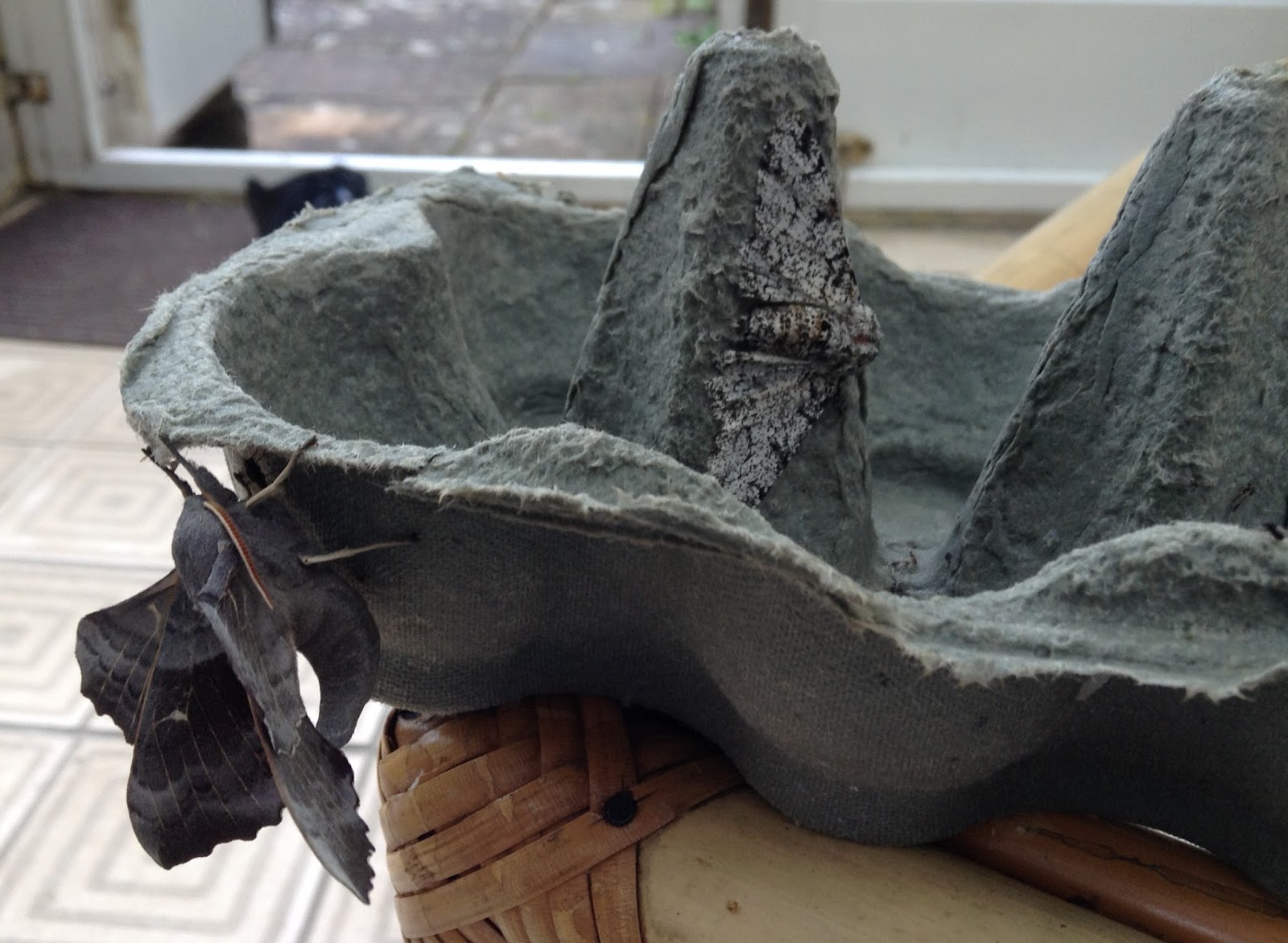
There were plenty of other, excellent things in the eggboxes which I'll check up on and describe later, but here below is one of them: our old friend, a Poplar Hawkmoth, looking like something out of Tolkien - beware, that small green elf or hobbit which you can see in the top left-hand corner. (Actually, there's no need. It's a Green Carpet and moths don't eat one another).


Since I spent the last two days in Manchester and Salford, I'll finish with a photographic souvenir of the rainy cities, although I saw no moths nor butterflies. I was at MediaCityUK, where the BBC runs its completely excellent northern operation (new press complaints body, please follow suit), and coincided with the start of a rally of powerful sports cars.

Alas for this one, which conked out. The sign on the AA van said something impressive like Special Operations Technical Team, the motoring world's equivalent of my brilliant experts whose comments on posts put me right on the identity of moths.


Friday, 14 June 2013

I spy a bumper crop


Here's looking at you, kid. See below 
It's catch-up time today, with no spare moments to put out the trap last night or sort out eggboxes of dozing moths this morning. I've been too occupied in looking through the smaller arrivals which came with the Eyed Hawkmoth on Tuesday night; my first real bumper crop of visitors.

Trousermeister

I've featured the one directly above before, but I so like his woolly trews: a Pale Tussock which perched on the rim of the trap's bowl. Then there was a major favourite of mine, a regular in Leeds but only now arriving in Oxford, which chose to grip to the bulb flex. It's a Spectacle Moth and I think you'll see why in the picture at the top.

Spectacle sideways on

The Spectacle is quite a sepctable from sideways on too. Meanwhile the Common Wainscot, below, is an agreeable-looking moth, even when it creeps as far as it can into an eggbox cone. Gently ripping these open explains why I am always on the lookout for new boxes, which neighbours have kindly begun to supply. There are still quite a few from Yorkshire, though, as with the Eyed Hawk's choice of one from a farm at Burton Leonard.

Common Wainscot being shy

Then here is a Setaceous Hebrew Character, markedly different in shape and pattern from the straightforward Hebrew Character but sharing with it the dark mark which resembles the Hebrew letter 'nun'. Setaceous means 'bristly', an attribute which isn't immediately apparent unless it refers to the moth's emotional character.


Where are its bristles?

Next, Heart and Darts have been a favourite of mine since the very first days of the blog in 2008 when they featured in the first fortnight and a soap shop in New York came across them and sent a nice comment. They are not over-exciting to look at, but then that's also true of many very nice and interesting people.

Heart and Dart - maybe a good name for another TV cops series?

And so to what I think is probably an Engrailed although it looks to my hopeless eyes more like a Willow Beauty; but these fly later in the year. And then some returnees: two rather different Rustic Shoulder Knots (I think and hope) and a Shears.

Engrailed, I suspect

Rustic Shoulder Knot methinks

And again

The Shears scaling an eggbox cone

I'm inserting a close up of the Shears' little pincer marks to make the point. We could do with a pair of these to get obstinate picture-hanger nails out of the walls of our new house.


Finally, a rakish Angle Shades and a Treble Lines in its neat brown coat which to my way of thinking suggests Quadruple Lines as a more accurate name. Plus the distinctive, russet-blotched version of the Common Marbled Carpet.  I am in a good mood about Carpet moths because according to Dave Shenton (see comments on previous post), I correctly identified the Oblique Carpet yesterday.


Fighter plane - the Angle Shades


How many lines can you see?

Thursday, 13 June 2013

All a blur


Yesterday saw a spectacular example of deterrent camouflage in the Eyed Hawkmoth. Here's one of its companions in the trap, a Scorched Wing, which uses a different kind - disorientating patterns which disguise its shape and muddle the potential hunter.


The USS West Mahomet painted in dazzle - thanks Wikipedia
The process was made famous during the First World War when Lieutenant Commander Norman Wilkinson persuaded the Admiralty to paint some of its fleet pink and pale blue as well as a stack of black and white zigzags. At a time when there was no radar and crews maintained watch from the bridge or crow's nests high on masts, the patterns broke up the familiar outlines of warships.


Bridget Riley & Co did the same thing with Op (for optical) Art paintings which had my eyes defocussing as a teenager, although I am the proud owner of an Op Art tie. I find the same thing with the remarkable patterning of the Scorched Wing. I cannot decide whether pictures of it, including my ones here, are slightly blurred or whether that's the effect of the camouflage.


I have a pile of other moths to catch up on and here is just one for now. As so often, I am umming and erring. Could it be an Oblique Carpet?