Friday, 11 July 2025

Rosy and her relatives


The moths are flooding in during the current delicious weather (can it be too hot? Not as far as I am concerned). But it wasn't until I checked the very last eggbox yesterday that I found the beautiful Rosy Footman above. This is a moth I have yearned for over the years; I was very pleased to see my first last year in the granddaughter's trap in Wiltshire. But how satisfying to at last attract one of my own. The colouring is exquisite and the patterning extraordinary. The only comparable squiggle I can think of is own the far commoner Buff Arches, below:


Other arrivals are old familiars but marvellous nonetheless. I will never tire of the Black Arches' fabulous mixture of Op Art camouflage, a pink body modestly concealed and TV aerial antennae on the male.


Here are a couple of closer looks:

This one shows the little bit of red at the moth's head 

And here's a different view of those excellent antennae, again with the small gleam of red

I think that I have another new species for the garden, next. I'm checking with Upper Thames Moths but it looks like a slightly discombobulated Kent Black Arches. This moth may have to be rechristened as it has spread most successfully from the county which gives it its name.


And here are some regulars, several new for this year but all familiar from the trap in Summers past:

Lime-speck Pug - the Bird Poo Moth

Dark Umber

July Highflyer

Im not sure what this is - possibly a Very Faded Something


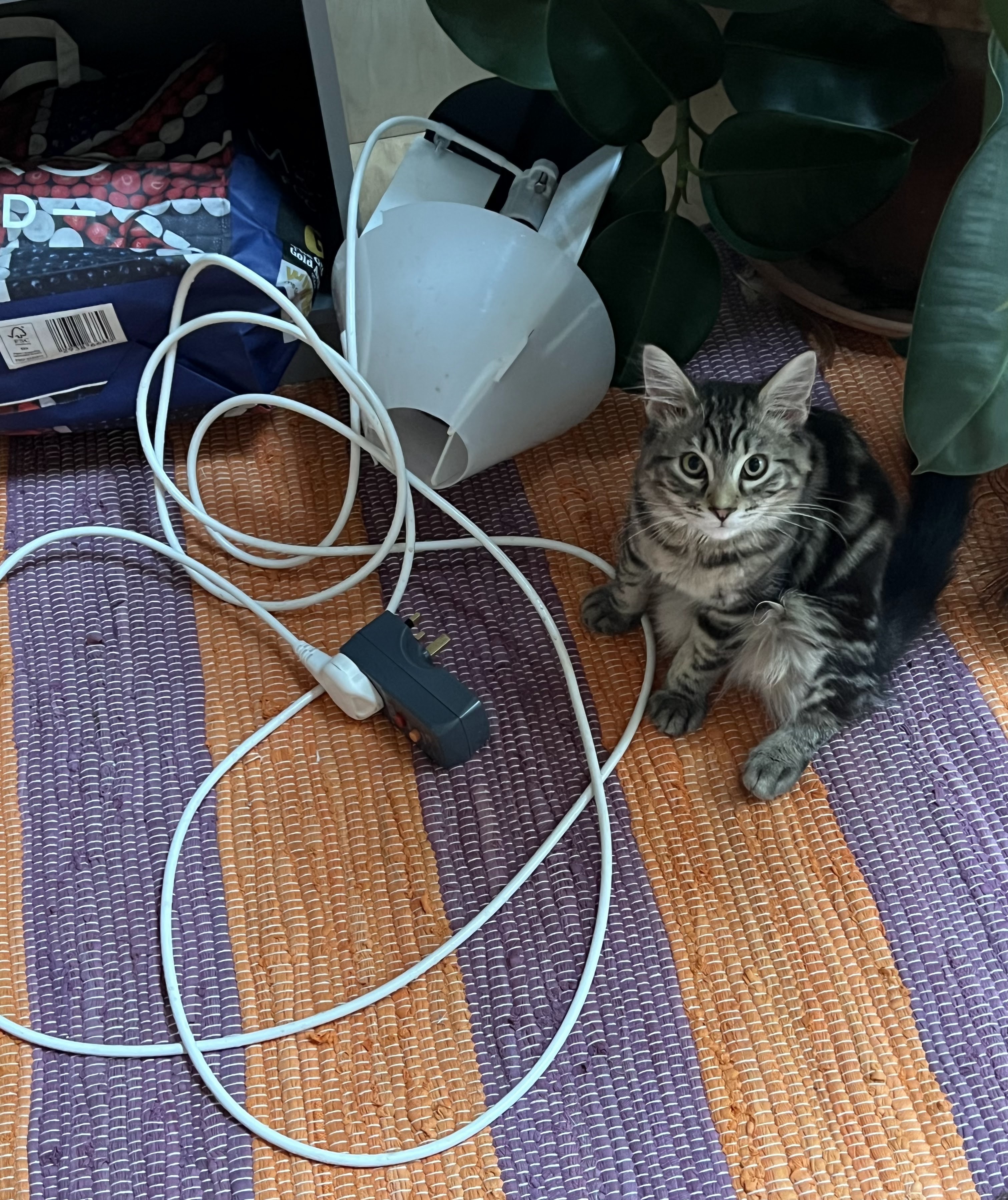
And finally here's my faithful attrendant, ever hopeful of a mothy snack which I do my best to deny him.

Thursday, 10 July 2025

Down at the Granddaughter's


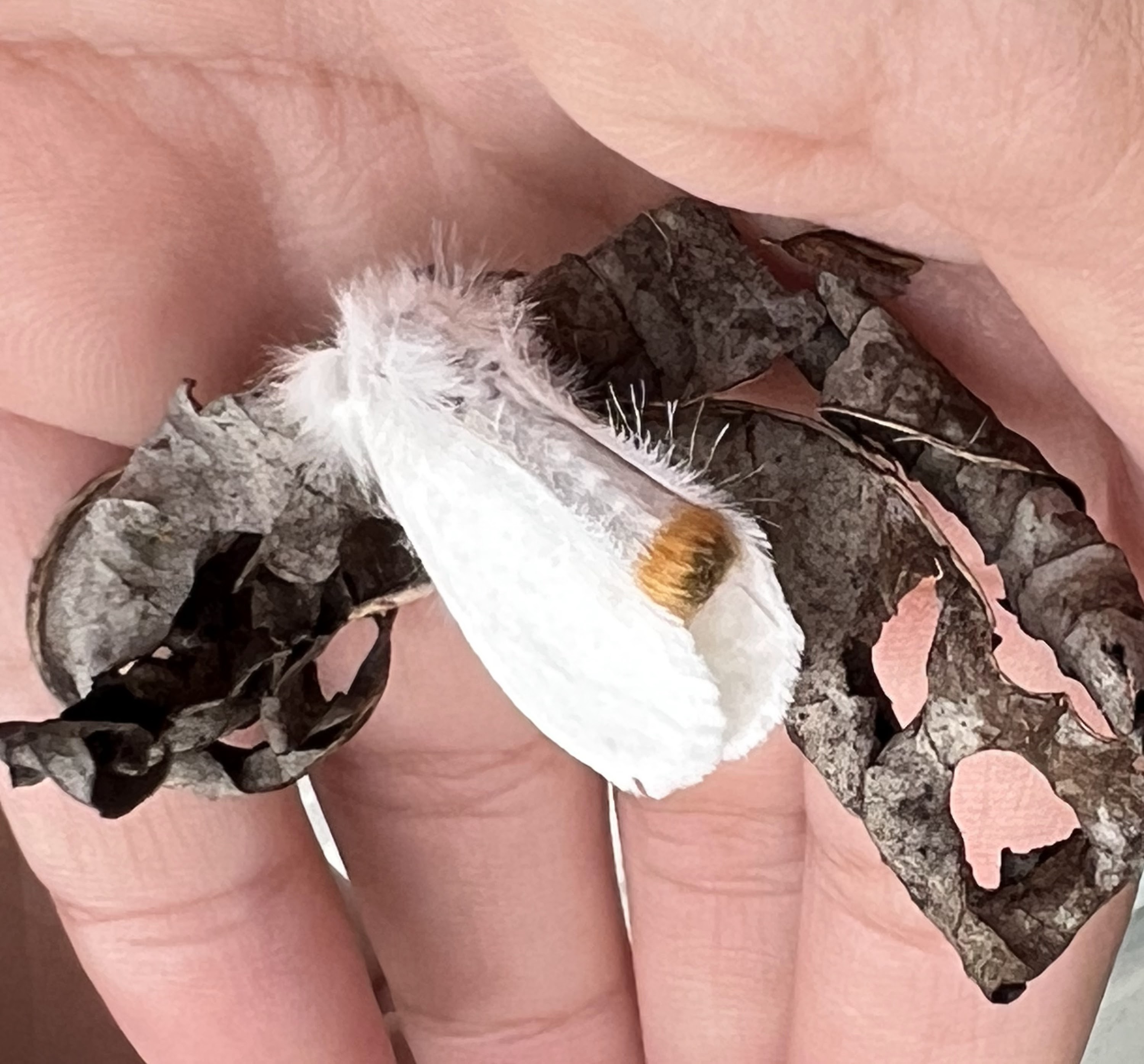
Penny and I paid our first visit for a while to the grandchildren's this week and caught up with the moths in their part of Wiltshire. They run a small actinic light with great success; indeed on overwhelming mornings here, when there can easily be several hundred moths in the mercury vapour lamp's bowl, I envy the manageability of their usual list of visitors.  It is nicely varied too and usually with at least one outstanding moth among the arrivals. So it was this time, when we peeped out in the morning and saw the bundle of 'fur' in my top picture on the outside of the trap.


I was pleased that a surprise awaited the grandchildren - although the trap was given to the eldest of them, she shares it generously and the other two are interested; indeed the youngest has just enjoyed a school project on minibeasts. Their visitor is called a Yellow-tail and the two pictures below explains why.


The moth's bright little brush is the property only of the female and is used to cover her newly-laid eggs for a few hours. The Yellow-tail also shares the tactic of quite a few animal species of pretending to be dead when in trouble, flopping over to one side. How effective this is, I am not sure. I don't think that it would stop my perpetually-nearby Robin from swooping in for a snack. Luckily the local birds have yet to clock on to the grandchildren's moth-hunting activities which are more intermittent than my own.


Their other visitors included both Orange and Common Footman, the latter peeping at you above, and a nice Ruby Tiger which showed off its red-breeched legs on one of their fingers. This is still a favourite practice of the grandchildren who like to be tickled by the bigger moth guests such as the Privet, Poplar and Elephant Hawks which also spent a night in the trap.


The proceedings were watched with interest by one of the family's two recently-acquired kittens who are currently a lot more interesting than the grandparents, except when it comes to the subject of moths.


Elsewhere in the eggboxes were a Heart and Dart, a Bright-line Brown-eye, a Heart and Club and a Nut-tree Tussock.


The second night we were there brought in Silver Y, Riband Wave, Dark Arches and Shuttle-shape Dart. 


And look what greeted me here this morning. Not surprising, mind you. First described in 1775 by the Swiss entomologist, painter and first recorder of the Daddy Long-legs spider Johann Füssli, the moth is found throughout Europe, deep into Russia and down to India and even Sri Lanka.


Monday, 30 June 2025

Pea in a pod, or at least an eggbox


Who wouldn't fall in love with a moth with the name of Cream-bordered Green Pea? Certainly not me. I've been waiting for this delightful speck of green to arrive for more than 20 years and finally it has. Way back in 2010, I wrote wistfully in a post about green moths that one day I hoped that the Pea would appear in the eggboxes. So, a warm welcome!

It is pretty scarce locally as you can see from this excellent map of records produced by Upper Thames Moths for which I am very grateful. I wonder if this is a one-off caused by our exceptionally lovely warm weather, or whether it will visit me again.


My second Hummingbird Hawk of 2025 came flying in yesterday but sadly I only discovered it after it had found its way into our greenhouse and expired from the heat. These beautiful little moths, which are so fascinating to watch, are plentiful in local gardens at the moment. A neighbour has just WhatsApped with a sighting of three at once.

Other hawks are incredibly abundant too. I had more than 30 bright pink Elephants in the trap on the first night back from the States. Dozing beside them were two Privets, the UK's third largest moth, and a Poplar. I still await Pine and Eyed this year.


The Leopard moth comes here at least once a year and last night was its tryst for 2025, a highly distinctive creature with an element of hornet beneath its delicate white and spotted veil of wings. It was also good to find a White Satin whose curious head markings prompted me to add an emoji spook.


Other arrivals, below, include Flame Shoulder, Poplar Grey, Riband Wave and the dreaded Box Moth, followed by Clay, Broad-bordered Yellow Underwing, Swallowtail and the large micro European Corn-borer which was a rare migrant until it took to English life in the 1930s and started spreading.


Another debut for the year is the Peppered Moth below, famous in disputes about natural selection and seldom found these days in the melanistic, dark form which was prevalent in the days of heavy industrial pollution. A little ermine micro provides scale.


Back in the world of multitudes, the Dark Arches has assumed its familiar late-June role as top moth and the heatwave has brought hundreds of the little white/transparent micro which litter the base of the trap, looking dead but usually just asleep.


Navigating them here in conclusion is a Small Fan-footed Wave. More tomorrow from this busy, busy time of the year.

Saturday, 28 June 2025

American interlude


So you're not in England, Mr W?

Nope. How did you guess?


Well, we certainly don't see glorious Scarce Swallowtails like that here. In France, Spain or Greece, OK, plenty. But we're too foggy and damp.

True enough, though this wonderful creature is actually an Western Tiger Swallowtail, an American relative of the Scarce, because P and I have been in California for a week, attending a touching memorial and celebration for her first cousin. A couple of days after taking the pictures above in Palo Alto, the centre of Silicon Valley, I spotted a similar-looking butterfly in the beautiful grounds of the nearby historic home of Filoli. I nearly didn't bother to take another picture but I.m glad I did. This one, shown in the two pictures below, was not an Eastern Tiger but another relative. The Pale or Pallid Swallowtail; aptly named as you can see if you compare it with the stronger lemon-yellow of the Eastern Tiger.


We pride ourselves on the beauty and inventiveness of English names for butterflies and moths, with good reason, but the Americans go one better in my view. There's an energy and directness, perhaps like Mark Twain compared with Jane Austen. Here's the Buckeye for example, in a garden (or yard as the Americans prosaically call them) in downtown Palo Alto:


And here's a Fiery Skipper and a Lulworth Skipper, separately and then darting about in either angry or amorous manoeuvres on lavender with a possible Rural Skipper involved as well. 


Sharing the bush with them in the Alto Hills was a Funereal Duskywing, a very solemn moniker for an admittedly rather subdued-looking insect - although it has a light fringe not unlike the Camberwell Beauty whose alternative name is Mourning Cloak.


On a bush in a wooded part of the trail - doubtless toxic like the ubiquitous Poison Ivy and Poison Oak which put you off exploring very effectively, I also saw these two butterflies which the iPhone's Bug identifier suggests are members of the Copper family, the second perhaps a Tailed Copper judging by the just-visible detail on its left hindwing.


This very definitely tailed beauty, below, in the Elizabeth F Gamble garden in central Palo Alto - a lovely, freely-open space tended by eager volunteers - is a Grey Hairstreak, another very smart-looking butterfly which we sadly don't see in the UK:


And so to my only moth, a drab visitor on the doorstep of the cousins' home which another young cousin, a very keen insect student, identified kindly as a Black Rustic. It lacks the distinctive golden wing marks and steeply isosceles shape of our UK moth of the same name but has a similar, rather foreboding presence. My iPhone counters that it may alternatively be Aseptis fumosa, a moth widespread in the Western US but apparently not yet honoured with an English name.


My last American minibeast is a Carpenter Bee, perhaps a Valley one. It was single-mindedly nectaring on the Baby Sage and took no notice of my cautious pursuit.


The chaparral or maquis and woodland above Palo Alto is full of other animals, some of which we did not want to meet - see below. Our cousins have had rattlesnakes, bobcats, coyotes and - once - a cougar or mountain lion in their garden and the notices on the hiking trails are to be taken seriously.


Here are some milder animals and birds, all of them very common both in the wild and the gardens of the large houses which fringe the hills: deer, wild turkeys, Western Fence Lizards, quails, a humming bird, a raven and a mourning dove.  


And not forgetting Sasha the resident Jack Russell and Winston the aptly-named visiting bulldog.