Sunday, 11 August 2024

Another Touch of the Vapours

I was walking along the canal towpath yesterday in intermittent sunshine when I saw a vivid, unusual chip of russet brown jinking along, too small to be a Comma and brighter than a Gatekeeper. I managed to follow it for a while but then it disappeared and I carried on with my humble grocery expedition.


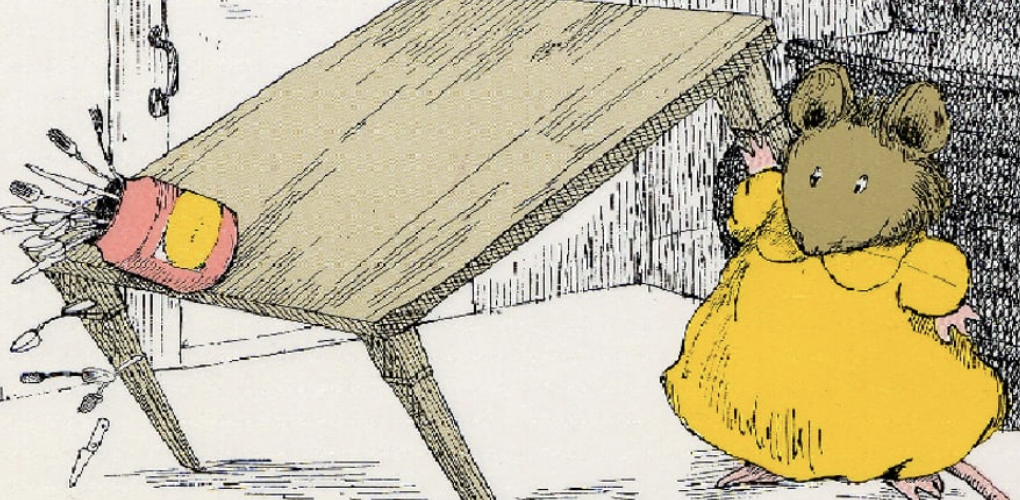
When I checked the moth trap the following morning, I found a major suspect: the Vapourer Moth shown above, with its 'eyes' whose placing reminds me of Naught Nora in that most excellent, rhyming children's book. It is an unuausal creature with a fine caterpillar as my younger sister discovered earlier this year when she lighted on one in her garden in Bradford. I remember finding one beside me some years ago when I was high up in our treehouse, trying to make a bit of aerial walkway less unsafe. I took the picture below but kept away from those long hairs which can cause a rash.


Only the male Vapourer has wings capable of flight; the female resembles a woodlouse and spends her life on a tree trunk waiting to mate and lay eggs. The scented pheromones which they use to attract suitors give the species its name. Like Emperor moths, which are highly susceptible to their females' pheremones, the male Vapourer also flies by day frequently, interestingly when he is blessed with such handsome antennae which usually come into their own for moths when it is dark.

One of the commonest moths in the trap at the moment is the Flame Shoulder, whose rather exciting name was mocked dismissively by my granddaughter who thought it a great exaggeration. I will show her my second photo, below, which makes the object of her scorn a little more dramatic.

Second generation moths are around now, freshly-hatched and lovely, including this Grey Dagger which I most associate with the earlier emergence in the Spring. Welcome also a Setaceous Hebrew Character and a delicate Latticed Heath, one of the best of the moths which pretend to be butterflies when at rest.


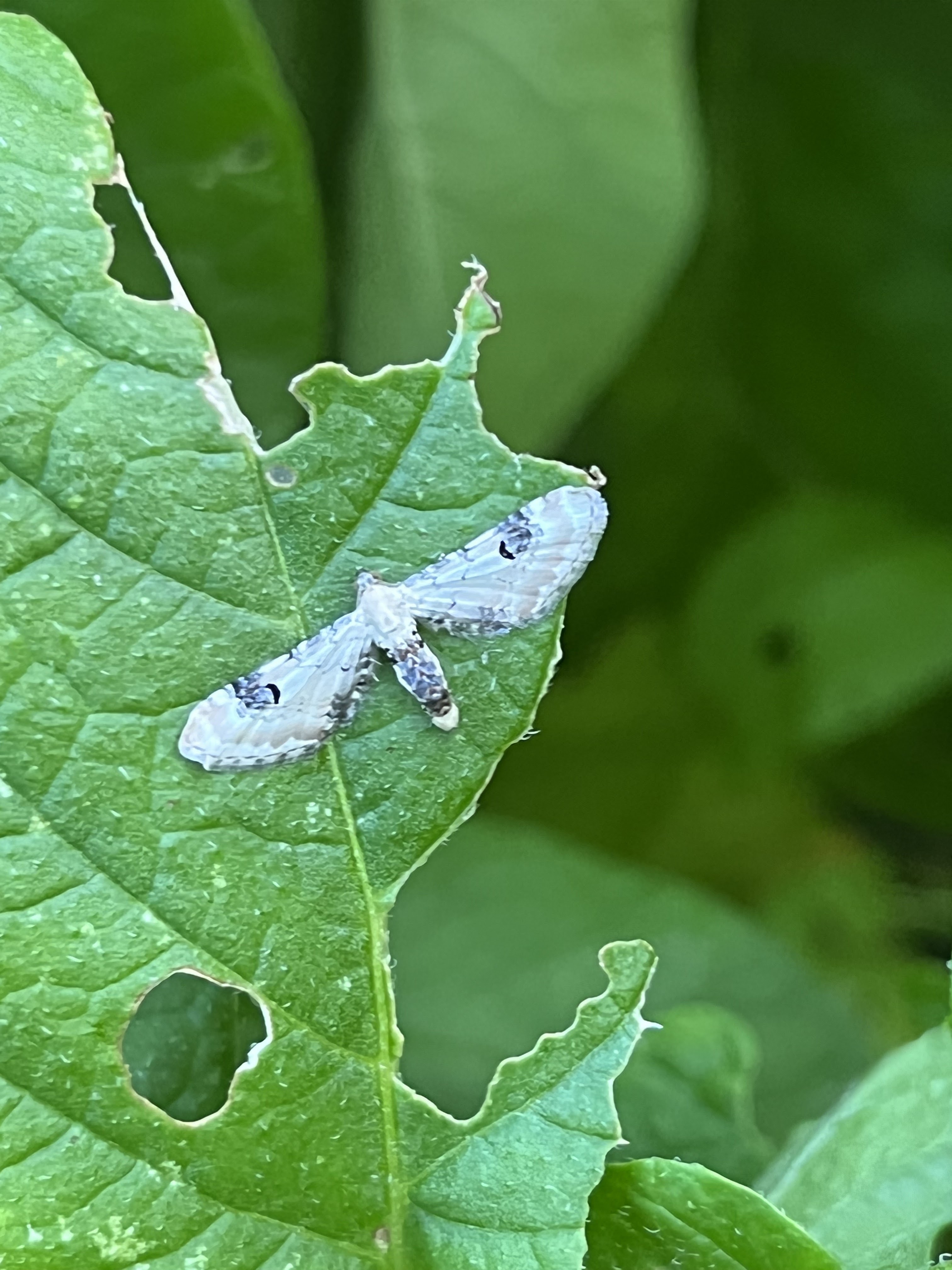
I need to spend a little time with the Moth Bible to ID this rather finely-patterned arrival below whose complicated designs remind me of William Morris wallpaper. Update: I put the suggestion of Cabbage Moths to the wondrous Upper Thames Moths blog and bingo! I was right. Under him or her, we have a Marbled Beauty examining my wedding ring, then another but less interesting ID puzzle for me (Update: actually it turned out to be very interesting - see next post) followed by the first of this year's Copper or Svennson's Copper Underwings with their wholly distinctive little monocle.


It was nice to have a Common Marbled Carpet on the bulbholder, a spindly Scarce Footman and a Nut-tree Tussock with its wings unusually widely-spread.


Next we have a lightish Dark Arches,  a third ID query which I recognise and should nail soon but can't immediately, a Lime-speck Pug (the Bird Poo moth) and two views of an attractive August Thorn.


Less happily, I have been keeping a rigorous eye on the nasturtiums chosen by Large - and Small - Whites as a breeding ground. I am afraid that I place our interests in the form of cabbages, broccoli and Brussels sprouts above those of the caterpillars.


I found a very plump, solitary Large White one only yesterday and I am sure that, Darwin style, some will escape my vigilance. Finally, here is a lovely male Banded Demoiselle keeping its cool as I approach, plus proof that I can occasionally get the focus right for that other, very common day-flying moth, the Silver Y.
Wednesday, 7 August 2024

Another new arrival, albeit a familiar face


I have grown blasé about the Jersey Tiger after seeing no fewer than four round the granddaughter's trap plus regular glorious meetings on holiday in Greece. So it took me time to realise that this visitor in my first few photos today is a first for our garden here in Oxfordshire. Rather extraordinarily, we had one in Leeds in 2008 but never yet down in these parts.


It is my sixth new arrival this year which began memorably way back on St Valentine's Eve with the debut of the Oak Nycteolene and has continued with the Buttoned Snout,  Kent Black Arches, Brown-veined Wainscot (just last week) and the micro Anania perlucidalis which must have been here often before but always mistaken by me for a small, very similar Mother-of-Pearl of which I get hundreds. I must add them all in to my species list.

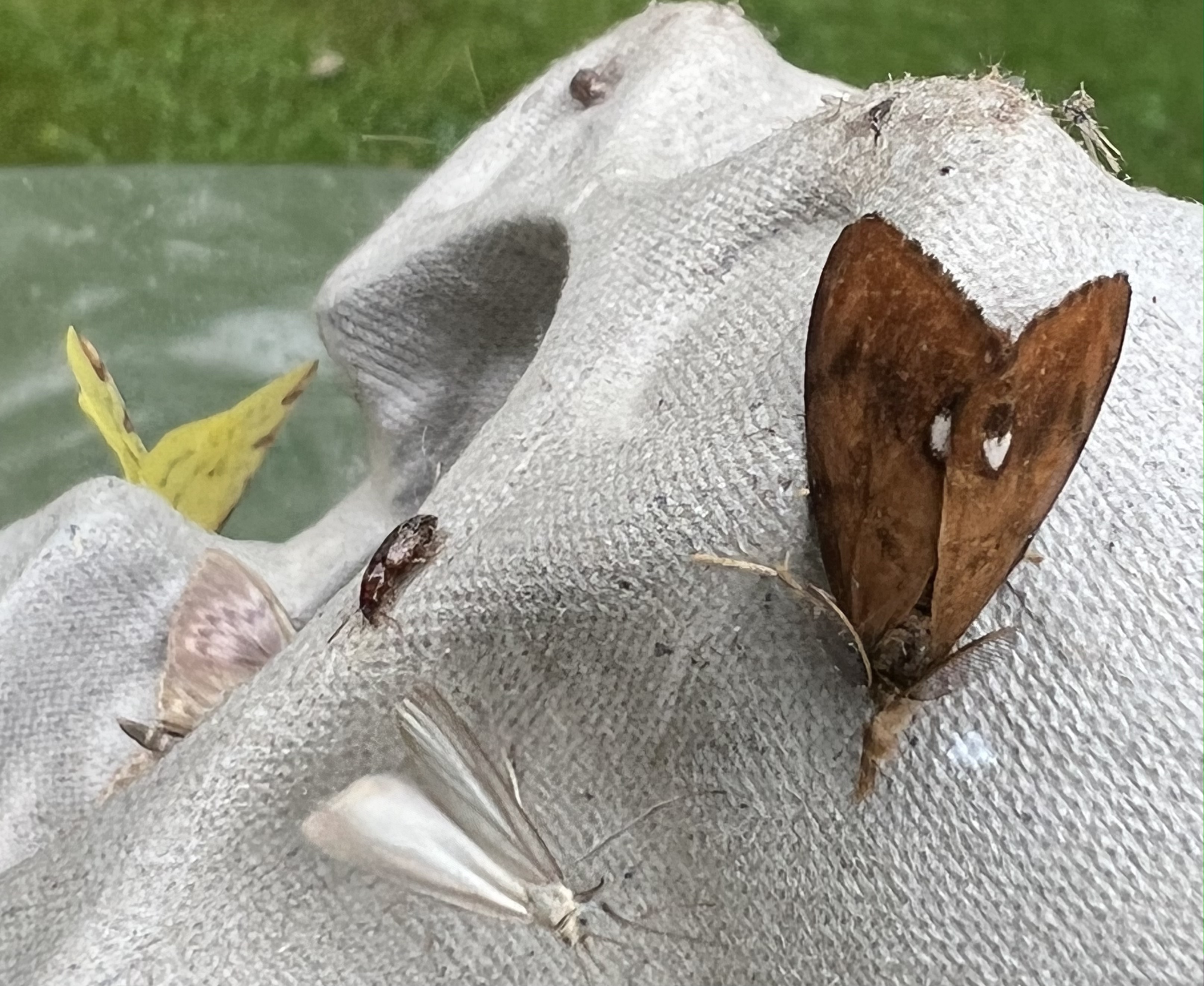
Other excellent moths flew in alongside the Jersey Tiger on a balmy warm evening, something of a treat given the weather this year. As below, there was a big Gypsy Moth with its antennae like a hare's ears, a very fresh Treble Bar, an op-art Black Arches and a Sallow Kitten with its wings partially outstretched rather than in the usual tightly-folded resting position.


Away from the trap, P and I had a fascinating time at the current Franz Kafka exhibition at the Weston Library in Oxford where other visitors were treated to the sight of this curious insect below. We can't recommend it too highly; a highlight is the way that the iconic photos of the writer which have created a lasting image of a tortured, lonely soul were often cropped from much more cheerful scenes, standing beside a fiancée, for example, or even sitting with a barmaid and stroking a friendly dog.

Monday, 5 August 2024

Poplar Trio


It's easy to become blasé about very familiar moths so I'm glad to pay respect today to one of the most faithful of them all, the good old Poplar Hawk Three of them arrived in the trap on Saturday night and posed willingly on one of our apple trees, Come 9pm, they were still there.


My third picture shows how I left them though they were gone this morning. A pair were in the trap today, perhaps two of the trio, along with a couple of rather worn Elephant Hawks. These two species have been consistent all Summer so far but in other respects it is turning out to be a meagre year. No Lime, Pine, Small Elephant or Hummingbird Hawks so far; and less surprisingly, no return of the Broad-bordered Bee Hawk which paid a solitary call in 2020.


The hawks are also long-standing favourites because of their willingness to perch on my fingers, as shown here from yesterday, and on the rather more elegant ones of my grandchildren. They are tickly but do no harm.


The relative shortage of hawk moths reflects a wider feeling this year that numbers are well down, which was reflected at supper the other evening when our hosts talked wistfully about past Summer evenings when the windows were left open late into the evening as the lights came on in their house, an moths invaded. Luckily, the supper was graced by the presence of a Dingy Footman ab stramineola - pic below - and a cricket which got entangled in another guest's hair.


The eggboxes meanwhile furnished this Mother-of-Pearl micro in an unusual resting position with its wings furled back rather than wide open, a very clearly marked Common or Lesser Common Rustic and one of the yellow underwings.


Less happily, a clutch of Large White butterfly eggs like the one I featured a few posts ago has turned into this colony of small but extremely voracious caterpillars which I have shifted over a wall. Also in the butterfly world, my last set of photos shows a Holly Blue with good taste which I nearly trod on while walking the canal towpath.


Sunday, 4 August 2024

Black, White and a little bit of Gold


The Magpie Moth is one of my longest-standing favourites, dating back to early schooldays when they were abundant and a delight to watch (and catch). As a student I became familiar with their role in genetic experiments, an obvious and appealing candidate because of the way that breeding produced all manner of varieties in the magpie, black-and-white patterns.


They are nice and big too, especially compared with the Small Magpie micro-moth which is large for a micro but very small compared to its big brother.  Finally, I warmly welcomed this one on its arrival in the trap midweek because they have been only very occasional visitors since I first lit the lamp in Leeds in 2005.


My second moth is another favourite because of its delicate colours and patterning and those jet fighter wings so purposefully held back. This is an Oak Hook-tip which initially was resting on the slightly drizzle-speckled transparent cowl of the trap but then fluttered on to the greenhouse floor.


The Black Arches is a third firm favourite and perhaps the best of the 'dazzle camouflage' moths. How much it would have appealed to Bridget Riley and her Op-Art. Unlike other moths with disorientating patterns, it is usually kind to my iPhone's focussing system which can be thrown into confusion by the more muddled, broken-up shades of, say, a Silver Y like the one which I set up from some bushes during a daytime walk on Thursday.


Prominents of various sorts are coming in reasonable numbers - Swallow, Lesser Swallow, Coxcomb, Pale and, here, a rather small Pebble. My final moth is that lovely, small and dainty moth the Marbled Beauty. A delightful assembly, all round.