Wednesday, 28 February 2024

One of Three

 My granddaughter and her schoolfriends rescued a tiny caterpillar - pic above - last week after one of them, blessed with especially eagle eyes, spotted it by an ivy leaf below a wintering beech hedge. With the soft-heartedness common in pre-teen girls, they decided to 'rescue' it and so it came home to Granny and Grandpa at the end of school. (It was our week to be on grandchild duty).

I didn't have my caterpillar Bible but the internet is an even better resource and we soon had a shortlist of possibilities. Because of the cattie's extreme youth, however, a precise ID was beyond our joint powers. But our best guess was the Yellow-tail and that meant searching for hawthorn and blackthorn, with leaves of the species' other foodplants, oak, sallow and other deciduous trees being unlikely at this time of the year.


The girls' main concern was providing the right food and they had already put a selection of other leaves in their collecting box. I meanwhile got on to the ever-excellent Upper Thames Moths blog where the guru Dave Wilton wondered whether the cattie might be a somewhat out-of-season White Ermine. So nettle, deadnettle and dandelion were added to the box.


Then the dots at the side prompted another UTM guru Tim Arnold to suggest that it could be a Jersey Tiger, a species common in Summer around the grandchildren's home. Fortunately their diet is described as 'a wide range of herbaceous plants' so we simply stuck in a bit of forget-me-not.


So there matters rest. The cattie was about a centimetre long last week. We will be back in ten days' time to see how it is getting on.

Monday, 19 February 2024

New Year, New Moth


I've just had the trap out for only the second time this year - the first back in late January yielding a visitor total of exactly nil.  This time, the unusually mild night of Valentine's, saw more than 40 moths snugly asleep in the eggboxes.  Among them, most unusually after all my years of shining the light, was a new species for the garden.

Behold the Oak Nycteolene, in its full glory in the first picture above and as I found it in the second, below. I say that it is new to me but as you can see, it is very self-effacing and therefore easy to miss. Its colour also makes for good camouflage in the creamy and grey boxes, so I may have overlooked it on previous visits.

The moth is a macro but very similar in both size and appearance to some of the micro Agnonopteryx family in whose ranks it has occasionally been mistakenly numbered in the past (see pic of the worst offenders below from the Micro-moth Bible). To double-check, I posted my top picture on the invaluable Upper Thames Moths blog with its many expert contributors, asking while about it if any of them knew what its curious second name might mean.

My Googling got me as far as linking the Nyc part to the Greek word for night but otherwise I was left with my fantasy that Nycteolene might be some sort of oil or paraffin which could power a portable moth trap out in the wilds. So many thanks to Tim Arnold, one of the experts mentioned above, who kindly commented thus:


A very big thank you for this solution to my puzzle.

The Oak Nycteoline is classed as only locally common but is well-distributed and tends to emerge from winter hibernation at this time of the year. It varies a lot, as you can see from its entry below in the Moth Bible. I was lucky to get one of the more obviously ID-able forms, lychenoides.


As for my other visitors, here's a selection, all familiar arrivals from late Winters and early Springs in years gone by: Dotted Border, slightly different Dotted Border, Pale Brindled Beauty,  Dark Chestnut (I think), Common Quaker, Hebrew Character, Spring Usher (great name!), March Moth and a second, rather different Common Quaker. 


Altogether, a very rewarding night.

Saturday, 23 December 2023

Merry Christmas from - and to - the Moths


Here's an exciting game of Spot the Moth for what is probably going to be my final post for 2024, though - who knows - a quiet and not-too-cold spell before the New Year may persuade me to plug in one last time. Anyway, the solitary resident of the eggboxes two nights ago was an attractive and good-condition Angle Shades. Can you spot it, above? Hours of fun, or half a minute at least.

Here it is from closer too, along with its protective Santa.  The behaviour of trapped moths always interests me; many of the smaller ones flutter off as soon as they can and I have missed hundreds over the years which scarper as soon as I lift out the bulb and take the transparent cowl off the bowl. But the pudgier ones are incredibly comatose, particularly on cooler mornings.


That was the case with this Angle Shades which was originally slumbering as shown above. It woke up a little during my festive transfer and crawled the entire length of Santa but once comfortable, it settled in on the garland and was unfazed by quite strong gusts of nippy wind. It was still there at 4.30pm, unmoved, when we went to meet a train but when we got back at 5.15pm, it had taken wing. The effect of the dark, I presume.


I have not posted since before the birthday of my entomological granddaughter two weeks ago, when the moths provided a terrific display. Traditionally, they have been outstanding at recognising these significant dates. There were more than 20 December Moths in the trap and I ceremoniously exhibited quite a few of them to her on this cushion whose bright colouring lifts the rather solemn - although beautiful - livery of the moths. You can see some of them below as they were in the trap, and I've added a few close-ups to show their excellent antennae - all are males.


And I have kept the really exciting news until last. For her birthday - only her tenth - the said goddaughter received...a MOTH TRAP!  It is quite small and has a softer actinic bulb than my great lighthouse, but she should do well with it. So when this trapper moves on to the land of eternal moth bliss, he will have a successor.  Merry Christmas and the happiest of New Years!


Sunday, 19 November 2023

Autumn colours


Two Feathered Thorns came last night and you could be forgiven for thinking on first glance that they might be different species of moth. The yellowy, softly-shadowed one above is unlike any other I have had in the trap before. The one below is the usual form.

Both are males with their excellent antennae. Their solitary companion in the trap was a dozy Sprawler - like the Feathered Thorns, the possessor of a nice warm, furry collar on its thorax.


As is my habit if we're asked out, I took these moths to some friends who had kindly invited us for lunch. The moths behaved well after a little initial panic and settled down on a window to admire the view. We had such a nice time that I completely forgot about them and it was left to our host to chase us down the street with the moths in our granddaughter's collecting box.  Thank goodness. I didn't need the moths but would have got into trouble if I'd lost the box.

We liberated the moths on the spot and they flew vigorously away in the dusk. Barring interception by bats or birds, they have started a new life - and perhaps new families - seven miles south of here.

Wednesday, 8 November 2023

Whiskery gents


As happened last year, I find myself making the mistake of thinking that the season is over and then being surprised new arrivals. I put the trap out rather absent-mindedly on Monday night, not expecting anything much, but the morning brought this very welcome bunch of Sprawlers. The species is named after a curious reflex of its caterpillar when threatened but it always puts me in mind of a John Buchan style gathering of gents in a club, as below.


It's partly the name, which conjures up Harry Enfield's incoherent old buffer in his armchair, and partly the tweedy outfit of the moth. Mind you, the beads of dew on the lower left one in my first photograph obscured the pattern so much at first sight, that I thought that I was dealing with something else altogether. Here is how it looked, below.  It must have been deathly cold.


Two of the other three Sprawlers were in the eggboxes while the third had a perch on the bulbholder, below. Another new species for this year was the Winter Moth or rather two of them and the guest list was completed by a Feathered Thorn.


Sunday, 5 November 2023

Previous Pasha


As an epilogue to my last post, I thought that I should show you a photo of the only other time that I have seen a Two-tailed Pasha, on the serpentine island of Meneghello near Hvar in Croatia some 20 years ago. Unlike the hill-topper in Provence, it was swooping about on a beach and took cover in a fissure in the rocks - there is scarcely any sand in that part of the world. I managed to get the photo above but then it was off, and it did not come back.


I overlooked a discovery in France as well, a very familiar caterpillar which Penny saw scuttling across a forest path on our way back from inspecting an ancient 'rucher' or apiary, surrounded by warnings that bees can sting. I've already featured quite a few of these larva thanks to my granddaughter's excellence at spotting and breeding them - the Pale Tussock, or 'hop dog' known and often cursed by Kentish hop-pickers who reacted to the mild toxins on its hairs.


The beehives in hollowed out cork oak were fascinating. Known about for years in documents, they date back to the 17th century but were only rediscovered and restored in 2006. New hives were installed and now house more than 5000 Provence black bees. The forests of sweet chestnut, cork oak and arbutus - the last the larval foodplant of the Two-tailed Pasha as I mentioned in my last post - suit them well and their honey is most flavoursome.


Back here, I put out the trap last night in spite of the chilly weather - maybe warmed as well as illuminated by Guy Fawkes displays. I'm glad I did. My first December Moth of the year arrived in its smart fur coat, along with two Feathered Thorns.  Here's the December Moth:


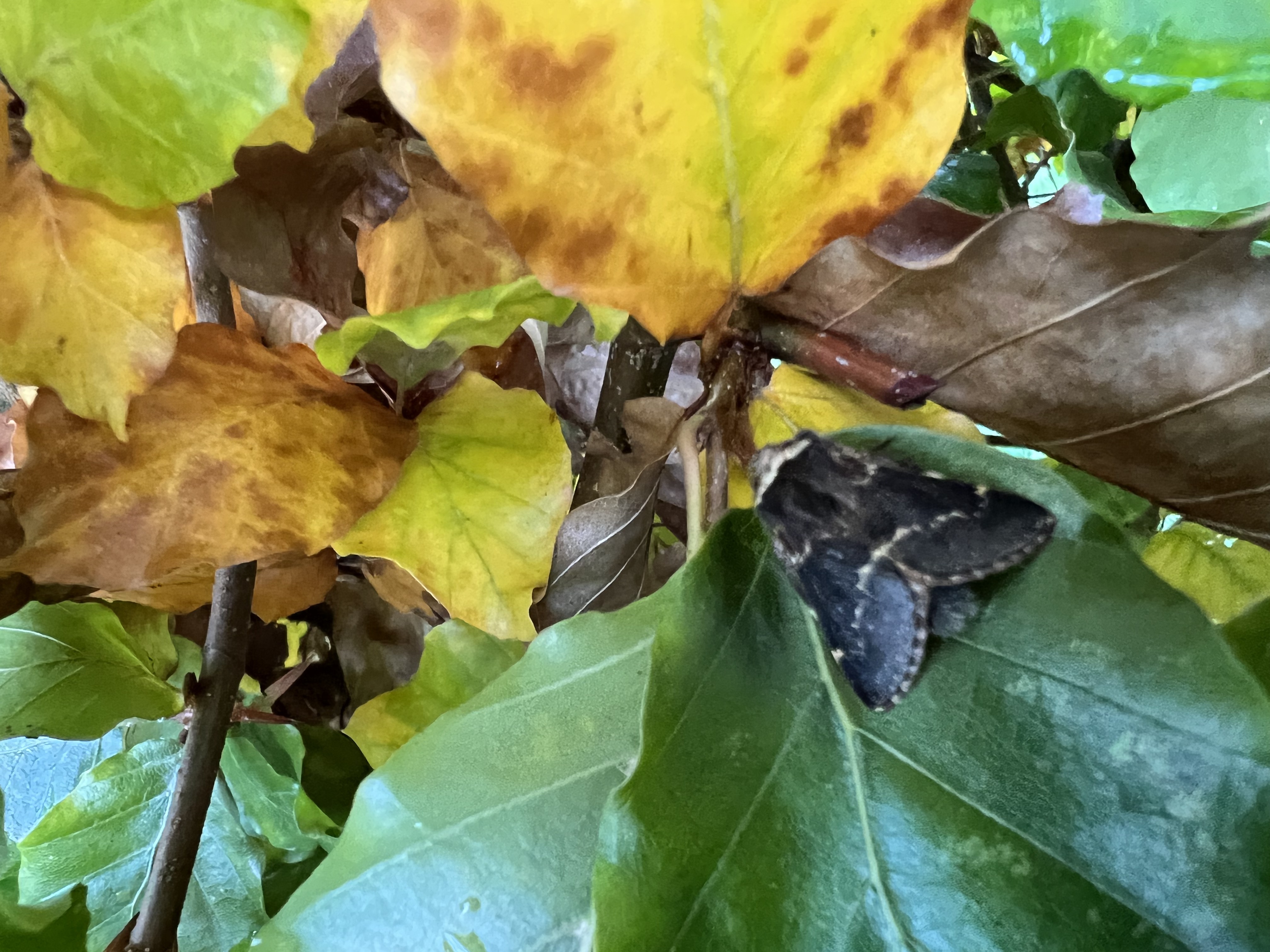
I moved it to our beech hedge for the Autumn colours, to remind me how early it has come - in terms of its name.  Last year I did not record one until December had begun, although I was trapping very intermittently,  And now here are the Feathered Thorns, one on the cowl and the other in an eggbox.


Finally, one a wall beside the light, I found this, below, which I think is a Satellite but I am studying further.


Oh, and a little non-moth too:


Monday, 30 October 2023

This year's treat


For almost all of the 20 years that I have run a moth trap, and indeed going back very much further to my schooldays' butterfly collecting, I have been blessed by a regular series of surprises and delights.  My teenage capture of the rare Charlotta variety of the Dark Green Fritillary butterfly was perhaps the first although I had been rewarded by First Hawkmoth, First Fritillary and other highlights well before then. Later I chased down a magnificent iridescent blue and green Peacock Swallowtail in Indonesia and explored the little rainforest, rich in insects, created by the unending spray from the Victoria Falls.


This year's treat - because they have become almost annual events - is late in the day but certainly worth the wait: a gloriously prolonged encounter with a Two-tailed Pasha, Europe's largest butterfly species, on a mountain-top in Provence. Checking the European Butterfly Bible, I found it described as a confirmed 'hill-topper' and this exactly chimed with the rocky peak above Roches Blanches in the Massif des Maures where Penny and I found ours.


I thought at first that the best picture I would be bringing you would be the third one, above - the sun-drenched edge of rock where the big, and that stage unidentified butterfly perched after a prolonged and dizzy dance when we first disturbed it. It soon took off again but luckily, by my age, you know from experience that most butterflies are territorial. It disappeared over large stands of Arbutus unedo, the Strawberry Tree which is its caterpillar's food plant. But within a minute it was back. On its third circuit it settled more conveniently for me and - snap! - I got my pictures. 


Is it exclusively a 'hill-topper' though? Or could it be that butterflies are harder to spot when you are clambering up mountains or slithering down them, rather than the open space of the summit where you have time to rest and look thoroughly around. There were other nice butterflies there including the Wall Brown immediately above and several very restless Clouded Yellows flashing around. We also set up a Large Mountain Grasshopper - well-named and perhaps the inspiration for La Fontaine's reworking of Aesop's famous tale of fecklessness and prudence.


La Fontaine would also have been very familiar with the Blue-winged Cricket which zipped about on hot days - I filmed this one below at our local bus stop and then isolated the stills - not exactly a triumph of photography but I hope that it gives the idea.


Other discoveries during our five days in the lovely village of La Garde Freinet included the Large White and Small Copper below, plus the millipede and beetle whose exact ID I leave to passing experts, if any.


A final pleasure of the holiday was the little Musée des Papillons in St Tropez whose incredibly good-value admission charge of only two Euros admitted you to a lovely little townhouse whose former owner collected butterflies from all over the world and then used them to supplement paintings of his native Provence.  Reached by following butterflies inlaid in the pavement of an alley, it also had some terrific pictures of butterfly collectors in the old days.  Merci beaucoup!