I am very fond of the small but distinctive Prominent family of UK moths with their characteristic pose like a cat or dog stretching out forepaws. Here they are, above, with some useful information about eggs which I always like sharing. And, below, a bright little Brimstone moth, also the first for 2019, on the trap's cowl to welcome them.
Sunday, 28 April 2019
Making a summer
I am very fond of the small but distinctive Prominent family of UK moths with their characteristic pose like a cat or dog stretching out forepaws. Here they are, above, with some useful information about eggs which I always like sharing. And, below, a bright little Brimstone moth, also the first for 2019, on the trap's cowl to welcome them.
Tuesday, 23 April 2019
Good company
The warm weather has done its stuff with a clutch of excellent new arrivals including the handsome and well-antenna-ed Lunar Marble Brown above and the rather similar, fur-coaty Nut-tree Tussock below. Following the latter are the very different Pine Beauty and Waved Umber which usually start appearing here in early May, so this season continues to be an early one.
The locally common Frosted Green, a moth which never came calling in Leeds, has also made its 2019 debut with a pair arriving a fortnight earlier than previously. I guess that at any moment we will experience the nasty nips of our main entomological nuisance in this part of the world, the Blandford Fly, usually a May pest. Here's the Frosted Green below, whose name is accurate if you look closely and in certain lights; and the further North the moth is found, the greener it becomes. The patterning on the moth is variable and, as you can see, my two are slightly different in their various whorls, dots, dashes and zigzags.
It's seldom that moths are the only creatures in the trap. In the past, their companions have included wasps, hornets and even an angry but sadly well-fed robin. Last night saw the other creatures below: a Daddy Longlegs, two caddis flies and some sort of curious fly which a passing dipterist may one day kindly ID. All are going to be useful for the embroidered and knitted insect-themes cornice which I am currently making for the grandchildren's treehouse. Pictures will appear here in due course.

Finally, the excellent entomologists of Tom Bedford's family - his blog Out of the Blue Sky always makes wonderful and informative reading - have also been hatching great-grandchildren of my Emperor. His camera is much better than mine and he has kindly provided the two pictures below. I wish I could get as close to the marvellous detail of the scales. One day...
Monday, 22 April 2019
Imperial births
Things have been busy in the Emperor Moth Nursery which my friends up the road have temporarily handed back to my care while they go away for an Easter break. A nice female hatched just before they left and they and I have tried our hands at Assembling - the practice of using her and her powerful pheromones as a lure for male suitors which has worked very impressively here in the past as you can see on this link here.
It may have worked this time; it usually does, because the scent mechanism is so powerful and can attract males from over a mile away. But if so, it wasn't during times when we were monitoring proceedings. First my friends tried, then I did here, then we took the moth to the other grandparents in Dorridge. On each occasion, she inspired admiration and interest from other members of our respective families, but no excited male Emperors put in an appearance. It may be that she was successfully impregnated early on, a process which ends the pheromone lure. We will never know, because she took off during her last night here. I hope that she has laid a clucth of eggs on a hawthorn nearby.
Meanwhile, a succession of cold nights kept arrivals at the light trap to a predictable minimum, Below, you can see a Hebrew Character, an Early Grey and a Powdered Quaker. In the meantime, we have been away for a wonderful week of bright sunshine in the English Lake District and the nights have become much warmer. I am now off to put the trap out for the first time in a week, with high hopes of some more interesting guests.
Friday, 12 April 2019
Jack Frost
My friends up the road who are now in charge of the Emperor Moth nursery - the great-great-grandchildren of the original empress which called here in 2014 have more exciting news to pass on. They have now hatched a female - pictured below - and are hoping that she may attract some suitors to see the family onwards into its fifth generation.
Meanwhile, Penny spotted this caterpillar, below, on a walk along the canal. If anyone knows what it will hatch into, please let me know too. It spent the rest of our walk happily stretched out along the magnetic strip of an old Chiltern Railways ticket.
Thursday, 4 April 2019
Spring fling
Spring has arrived in the UK and although it's the 69th I've seen - though I will remain a youthful 68 until 18 May - its pleasures still come as a pleasure and surprise. Top among them of course are the flowers which have suddenly appeared everywhere - the composite at the top le aves plenty out. It's been an additional bonus to help convert some of them into posies for Mothering Sunday (handed out along with slices of my latest superlight cream sponge cake - mouthwatering picture below).
The moth world, too, has shown how - for me at least - the seasons' passings are long enough to make me forget familiar arrivals. Maybe it's more the effect of age, but I was still delighted enough to breathe out "Nice moth!" to myself when I saw the first moth in the eggboxes below.
It is an Early Grey, a faithful annual arrival at this time in every one of the 13 years that I've run the moth trap - and frequently the subject of a quip from me about the delicious brand of tea which we mix with ordinary leaves for the morning cuppa which I'm shortly off to make. But it's so strikingly different from the mostly brown and grey brethren in the eggboxes at the moment (as in the second picture immediately above) that, like the primroses and chionodoxas, it still gives me a start and a lift. So the season is now well under way.
The Early Grey was not the only beauty in the trap; there were also two Brindled Beauties, both males and one of them prepared to show off its beautiful antennae. Like my Earl Grey joke, my wish that human beings had these amazing organs has often been expressed here. I have occasionally attempted a little science too, trying to describe what we know about their purpose and the reasons for the wonderful variety. I'm delighted to say that this has just been done far more thoroughly and interestingly by Tom Bedford, whose family took some of my Emperor Moth caterpillars last year and both photographed and reared them with great success. You can enjoy his findings and photographs of antennae on his latest blog post here.
Finally, it is interesting to see how moths are relatively waterproof. The Hebrew Character above was asleep in its small puddle at the bottom of the trap (even Mr and Mrs Robinson's wonderful rain shield isn't 100 percent effective). It seemed unfazed and woke up in an equable mood before creeping under an eggbox to a dryer spot. More Hebrew Characters appear below, along with a Small Quaker and a Clouded Drab.
Thursday, 21 March 2019
Birth pangs
Lots of Spring things in the natural world are early this year, not by more than a fortnight but that can be enough to cause problems. Here are the battered remains of a male Emperor moth, a great grandchild of the magnificent empress which visited me in May 2014 and gave me a clutch of eggs which started an enormous dynasty.
This chap emerged unexpectedly early from one of a batch of cocoons woven last year by caterpillars in the care of very nice neighbours. Alas, his promptness meant that he was confined and his emergence unexpected. RIP. A close watch is now being kept on the others.
More happily, another neighbour who lives in a narrowboat on the Oxford Canal has enterprisingly reared Silk Moths from a batch of eggs supplied to her by a naturalist firm at Christmas. I have to admit that I was dubious about the chances of the tiny caterpillars which soon emerged, given that their foodstuff was a sort of concentrated leaf extract and their home in a boat which, though very snug, had all the high dependency on curious heaters common among those who live afloat.
I am glad to say that she has triumphed and here are some of the moths, above and below. They are emerging at the rate of four or five a day and their guardian is hoping that they will breed in turn, just as my Emperor moths have done for three generations. In which case, she has promised to give some to me. This may involve the further experiment of freezing the eggs until the time is nearer when I can carry out regular harvests from Oxford's mulberry trees.
What of the silk, meanwhile, which was the original incentive for my friend who is more of a textile enthusiast than an entomologist - though her interest in the latter study is increasing by the day? In spite of the number of cocoons, we are not talking (yet) of the sort of quantities which could make up silk pyjamas or even a hanky. But one of our fellow members of the local Knit and Natter brightly suggested the other night: "What about floss?" I will keep you informed.
Friday, 15 March 2019
Blown about
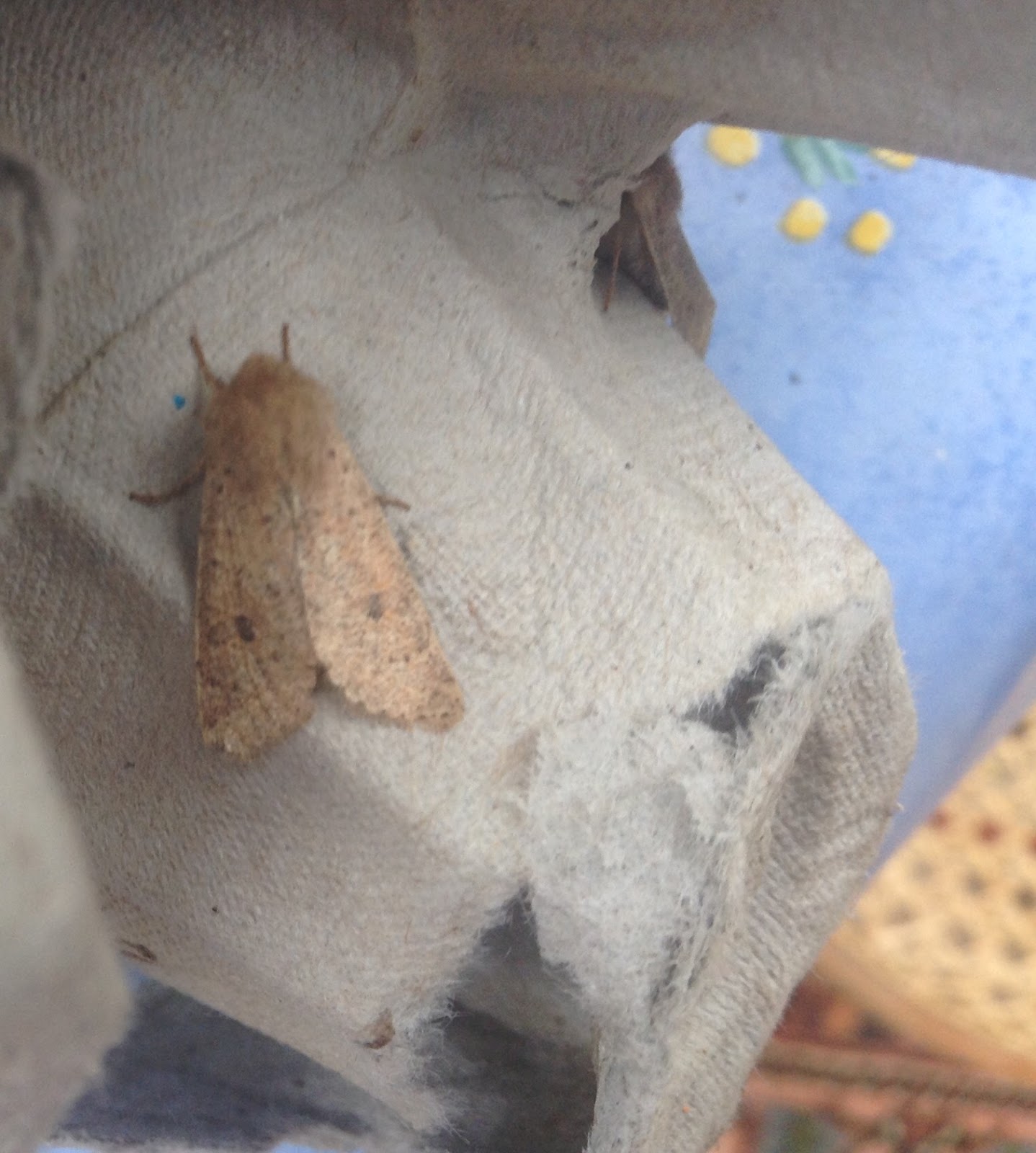
Cold, windy weather courtesy of Storm Gareth isn't deterring the hardy but unremarkable-looking moths which fly at this time of the year. There were over 50 in the light-trap this morning, mostly Common Quakers with a few Small Quakers, a couple of Hebrew Characters and a new arrival for me this year, the Clouded Drabs shown in my first and second pictures (the top moth in the first picture, with a Common Quaker below it).
Here are a couple more: a pair of Common Quakers and another Clouded Drab. More excitingly, and I hope the subject of my next post: a neighbour who lives in a narrowboat here has successfully bred silkworm caterpillars, seen them chrysalise and just hatched her first moths. She's a renowned member of our Knit and Natter group so we may all be clad in silk before long, like Robert Herrick's Julia. Or, as one knitter and natterer said last night, given the small quantities of the material involved, we may alternatively be using home-made, silkworm-spun floss.
Sunday, 3 March 2019
M is for March - and, of course, Moths
I have been slow to start lighting the lamp this year for the moths, which rewarded my tardy session on Friday night by arriving in quite impressive numbers. There were 40 in the trap, including the little assembly of Common Quakers shown above, with three individuals below. This species is one of the first harbingers of Spring, emerging from its underground cocoon from early March and often, as with this year, in earlier mild spells during the late Autumn and Winter. It varies a lot in ground colour but is always modest and plain. Hence its name.
Also in the eggboxes - a much-reduced pile which Penny and I need to supplement by a diet of omelettes and boiled eggs with soldiers - was the Common Quaker's regular companion between March and May, a Small Quaker shown in the next picture, below. It is indeed a little smaller than its Common relative but not by much. It is a feeder, a habit not shared by all moths, and enjoys sallow catkins of which we have many locally. The Common Quaker shares this habit and extends it to blackthorn blossom which has just burst into bloom here this week, filling the hedges paradoxically with white.
Both these moths belong to the Orthosiini genus of the Hadenidae sub-family of the Noctuid family, the largest among UK moths with some 400 members - and a further 21,000 worldwide. The Noctuids are also a controversial family scientifically because species keep being both added and removed by taxonomists rather like one of those large households with extensive dealings with Social Services. As the Moth Bible notes, another of the Noctuids' sub-families, the Ophiderinae, is 'an uneasy ragbag collection of species which did not seem to fit elsewhere, now being disbanded.' Perhaps it has been disbanded as I write, but taxonomy has little appeal to me, although it is an understandable source of fascination to all who like lists.
My third moth is also an Orthosia, albeit of a different faith. Here is that old familiar to readers of my musings, the Hebrew Character, named for the reproduction of the Hebrew letter Nun on its forewings. This mark was allegedly given to it because it had the audacity to speak to God, although what they said to one another (assuming that God wasn't too started to reply) is not known.
Next we have a couple of more distinctive new moths for 2019, a Brindled Beauty - Update: Sorry, it's a Small Brindled Beauty. Thanks v much to Dave Wilton, chief organiser of the superb Upper Thames Moths blog, for correcting me on this in Comments - and a pair of fine Oak Beauties. The trap was placed close to a medium-sized oak tree which I suspect of being their home. The second one is on a grubby old sheet which I have brought into service because the eggboxes are so sparse. I shake the moths out in the morning, for all the world like an old Spring-cleaning housewife.
These are both moths which we expect to find flying around at this time of the year even though overnight frosts persist and have been quite harsh. I would agree with others, though, that this year is a bit ahead of itself. I saw my first Brimstone butterfly last week, two weeks before my previous earliest record, two years ago, of 9th March.
Finally, I was not entirely idle in February and with the help of Penny the ace indoor moth spotter, I photographed these non-trap arrivals:
Three are Mottled Umbers, predictable visitors, but I was pleased to be able to identify the fourth - top right - as a Double-striped Pug, which was out early. It usually gets going towards the end of March. Update: My smugness at ID-ing the D-s P has to be counterbalanced by Dave's kind correction of the three other moths. The one at top left is actually a Dotted Border and the bottom two are Pale Brindled Beauties rather than Mottled Umbers. Apologies as ever. At least it increases this year's meagre tally (so far).
Subscribe to:
Posts (Atom)