No mothing last night because I was on the 8.03pm from King's Cross back home and I was dog-tired when I crept back in. Age... But I was in London for an interesting purpose, interviewing Madeleine Moon, the 'MP for moths', for a Radio 4 programme about our little flying friends which goes out at 11am on Friday 6th May. I'll tell you more later cos the day's duties beckon, but MM is a totally excellent promoter of the study of moths. She has hosted five Moth and Bat nights in Parliament where Butterfly Conservation regularly run a trap (thanks to them for the picture here), and raises the subject of moths at many opportunities. Tony Blair was startled on one occasion when she told the chamber about the Blair's Wainscot (one of an unmatched three moths named after a Dr Blair who trapped very knowledgeably in the 1940s on the Isle of Wight, an obvious landing point for species new to the UK). I don't know if the former PM ever wore a waistcoat and wondered briefly if she was commenting on this.
She is also intrigued by Large Yellow Underwings' counter-measures against bats' sonar (a misleading burst of chirrupy sounds) which may be useful one day in her work as a member of the Commons select committee on defence. More soon, though I must just add that her interest in the natural world is wide-ranging. Her husband is a noted ecologist and when she was Mayor of Bridgend, her constituency in south Wales, they were raising an abandoned blackbird chick which became so dependent on them that they had to take it to civic receptions.
Thursday, 31 March 2011
Tuesday, 29 March 2011
Quiet night
A quiet night, a quiet moth. Although it was warm when I lit the trap at about 8.30 last night, the frost arrived in the small hours and this morning is chilly again. There were about 50 moths in the egg cartons, all familiar: quakers, drabs and Hebrew Characters. Still beautiful, though, in their gentle way, like this Common Quaker with its particularly well-defined wavy cross line. The wood grain is just as good, don't you think, and they both match in their Laura Ashley, camouflage way.
Monday, 28 March 2011
Something lovely in the woodshed
Here's a coincidence, of the sort Arthur Koestler enjoyed collecting in his later years. Two days ago I featured the Herald, a favourite moth, and described how it hibernates over the winter in nooks, crannies and similar dark places.
Yesterday, I was poking around in the garage for something to use as the base of a duck house. We've got a small pond and a duck and drake have come across it and are pottering about, exactly like a young couple house-hunting. I found the remains of a worktable, crudely knocked together from bits of gash wood but still more-or-less intact and forming the frame of a square box. I lugged it into the daylight and saw...the slumbering Herald above.
It was deeply asleep, as I guess you'd have to be to survive the sort of winter we had this year. It took about an hour for its metabolism to wake up, during which I was sawing and hammering so the box was rocking about. Then off it flew.
Something else seems to be hibernating in the cocoon. Flies? Mites? Anyone got an idea? I've left it in what is now an Anneka Rice-style, done-in-a-day, duck house for our new neighbours to inspect, if they move in.
Yesterday, I was poking around in the garage for something to use as the base of a duck house. We've got a small pond and a duck and drake have come across it and are pottering about, exactly like a young couple house-hunting. I found the remains of a worktable, crudely knocked together from bits of gash wood but still more-or-less intact and forming the frame of a square box. I lugged it into the daylight and saw...the slumbering Herald above.
It was deeply asleep, as I guess you'd have to be to survive the sort of winter we had this year. It took about an hour for its metabolism to wake up, during which I was sawing and hammering so the box was rocking about. Then off it flew.
Something else seems to be hibernating in the cocoon. Flies? Mites? Anyone got an idea? I've left it in what is now an Anneka Rice-style, done-in-a-day, duck house for our new neighbours to inspect, if they move in.
Sunday, 27 March 2011
PR Wingpower
I'm giving the moths a rest this weekend, not just because it's gone colder but to avoid over-trapping. I don't know if this is a real danger - Ben & Co, advice welcome - but it seems common sense not to bring the same specimens to light over and over again. They mostly just doze away but it isn't a natural experience for them. Here instead is an advert from The Economist which caught my eye. A curious combination: butterflies and plastic car parts.
Top marks, though, to the designer who sorted the arrangement. It made me think nostalgically of tapes, which is where I used to see the initials BASF. I'll be most impressed if any reader knows what they stand for. Check out the company's interesting entry on Wikipedia to find out.
I said I was giving the moths a rest but that isn't entirely true. In order to show my mother-in-law and brother-in-law the felled trunks of our frost-destroyed Cordyline australis, one of thousands of such victims currently a sad sight in the north of the UK, I turned on our back door's outside light. Within minutes, a moth was fluttering suicidally close to both the light and an adjacent web spun by a cunning spider. Sorry the picture is so poor, but you should be able to make out both moth (to the right) and strands of web. I just checked this morning, and I am pretty sure it escaped.
I am recycling the Cordyline as (a) tree house thatch, using the leaves, as mentioned a few posts below (b) a raft modelled on Kon Tiki using the fibrous trunks and (c) also using the trunks, a floating platform for a duck and drake who have settled on our pond and may need somewhere fox-free to nest. You can read more about this on the Guardian's new Northerner blog btw, though now that the clocks have gone forward (have you remembered..?) you may not have the time.
Top marks, though, to the designer who sorted the arrangement. It made me think nostalgically of tapes, which is where I used to see the initials BASF. I'll be most impressed if any reader knows what they stand for. Check out the company's interesting entry on Wikipedia to find out.
I said I was giving the moths a rest but that isn't entirely true. In order to show my mother-in-law and brother-in-law the felled trunks of our frost-destroyed Cordyline australis, one of thousands of such victims currently a sad sight in the north of the UK, I turned on our back door's outside light. Within minutes, a moth was fluttering suicidally close to both the light and an adjacent web spun by a cunning spider. Sorry the picture is so poor, but you should be able to make out both moth (to the right) and strands of web. I just checked this morning, and I am pretty sure it escaped.
I am recycling the Cordyline as (a) tree house thatch, using the leaves, as mentioned a few posts below (b) a raft modelled on Kon Tiki using the fibrous trunks and (c) also using the trunks, a floating platform for a duck and drake who have settled on our pond and may need somewhere fox-free to nest. You can read more about this on the Guardian's new Northerner blog btw, though now that the clocks have gone forward (have you remembered..?) you may not have the time.
Saturday, 26 March 2011
Tea time
A couple more arrivals, typical of early Spring. First comes the Early Grey, whose salt-and-pepper colouring makes a welcome change from the current general palette of brown. And then the Hebrew Character, whose patterning repays a close look.
I have the familiar problem of an ageing blogger, that I've written about both these before, more than once. But I will repeat my feeble (but true) quip that the Early Grey always sounds like some endearment which Lady Grey might have used to the namesake of that lovely tea. My mind plays a similar trick with the weblink shortener Tinyurl, which conjures up images of a small member of the House of Lords. Penny and I mix Earl Grey half-and-half with supermarket sawdust for our morning brew which, as it happens, I am savouring in between typing this in bed. I very much recommend it. Lady Grey has her own tea too, and that's also a good mixer.
As for the Hebrew Character, I photographed one a couple of years ago on a page of the Hebrew alphabet, showing how the dark mark on each wing does indeed look very like the letter Nun. So I leave it at that for now (and for any reader to decide if they have the energy to scroll back and back and back...) and just say: Welcome both, although the Met Office says we're all going to get a chilly shock later this weekend.
I have the familiar problem of an ageing blogger, that I've written about both these before, more than once. But I will repeat my feeble (but true) quip that the Early Grey always sounds like some endearment which Lady Grey might have used to the namesake of that lovely tea. My mind plays a similar trick with the weblink shortener Tinyurl, which conjures up images of a small member of the House of Lords. Penny and I mix Earl Grey half-and-half with supermarket sawdust for our morning brew which, as it happens, I am savouring in between typing this in bed. I very much recommend it. Lady Grey has her own tea too, and that's also a good mixer.
As for the Hebrew Character, I photographed one a couple of years ago on a page of the Hebrew alphabet, showing how the dark mark on each wing does indeed look very like the letter Nun. So I leave it at that for now (and for any reader to decide if they have the energy to scroll back and back and back...) and just say: Welcome both, although the Met Office says we're all going to get a chilly shock later this weekend.
Friday, 25 March 2011
Herald of Spring
When I was young, we had a couple of Triumph Herald cars in succession - one of them an insanely high-powered beast for a small saloon, a six-cylinder Vitesse. When my Dad turned right at the Weetwood junction of Leeds ring road and pressed the accelerator, we virtually took off and only came back to earth at the Lawnswood roundabout.
Anyway, I always like the cars' perky looks (eyelids on the headlamps) and their cheery name. The same applies to this lovely Herald moth which graced the trap last night. The wing colouring is self-evidently fine, including those four white spots, but I've also included a picture below of its natty white legs.
It's an interesting moth, this one. In spite of its excellent condition, it will have spent the winter hibernating - "in an outbuilding," say Waring, Townend and Lewington, adding romantically "or a cave." We don't have any caves but there are plenty of nooks and crannies at Wainwright Towers, although most have been occupied during the freeze by ladybirds (including the invasive Harlequin). Heralds have two generations annually, one in the summer and the second which hatch from their cocoons in August-November and then - like this one - hunker down.
Have you noticed that I'm getting quite handy at doing links? Silver surfer, eh...
Thursday, 24 March 2011
Quaker meeting
It suddenly went warm this week and after only intermittent trapping since last October, I decided to turn the light on, just in case anything was about.
Goodness...102 moths.
I've been a bit dozy; checking the Moth Bible (Waring, Townsend and Lewington), I see that plenty of species are likely to have been on the wing since early March. And so it certainly proved.
The ones which settled here are mostly Common Quakers, like this cosy pair getting together on the left. You can see the reason for the name in their modest and unshowy colours, but the patterning is delicate and fine. There's also a lovely Pale Brindled Beauty, above at the top with another Common Quaker in my strangely beautiful blue eggbox, and also below.
A couple of other, more distinctive arrivals in the final picture for today: a Twin-spotted Quaker, a little more daring than the others, like those kids at school who made ingenious if very small adjustments to their uniforms; and a Satellite, with that wonderfully specific white mark and its two tiny attendants. Hence the name.
Thursday, 3 March 2011
Can't resist a few more Monarchs...
I'm not specially Royalist, although I can't think of a better head-of-state system offhand, but I hope you'll forgive a few more pictures of the butterfly kingdom's Monarchs. First, though, here's another Mexican butterfly; in fact the only other one which I was able to stalk and photograph.
I think that age is creeping up on me more successfully than I managed to creep up on the butterflies. This delicately beautiful shade-lover, with its marvellous camouflage, was darting about in the Mayan ruins of Coba when Abi spotted it. Like the fritillary in the previous post, I will look it up later, helped by the bugs website kindly pointed-out to me by my 'Exile to a Pompous Land' pal. One thing about the Mayan ruins btw: they are all pronounced differently from my expectations. Thus it's CoBA, and ChiCHEN ItZA. There's a useful tip for life.
Now the Monarchs again - and these are pictures taken by Abi, as is obvious from the better definition achieved by her steadier hand. Aren't they great. I wish I was back there, as I gaze out at early March Yorkshire and the ruins of our Cordyline australis which has had a probably terminal battering from the very cold weather in the UK this winter. You can check out its stark remains on www.guardian.co.uk/uk/the-northerner. But there is a good side. Inspired by Mexico, I plan to use the fallen 'dagger leaves' to thatch my tree house extension.
I think that age is creeping up on me more successfully than I managed to creep up on the butterflies. This delicately beautiful shade-lover, with its marvellous camouflage, was darting about in the Mayan ruins of Coba when Abi spotted it. Like the fritillary in the previous post, I will look it up later, helped by the bugs website kindly pointed-out to me by my 'Exile to a Pompous Land' pal. One thing about the Mayan ruins btw: they are all pronounced differently from my expectations. Thus it's CoBA, and ChiCHEN ItZA. There's a useful tip for life.
Now the Monarchs again - and these are pictures taken by Abi, as is obvious from the better definition achieved by her steadier hand. Aren't they great. I wish I was back there, as I gaze out at early March Yorkshire and the ruins of our Cordyline australis which has had a probably terminal battering from the very cold weather in the UK this winter. You can check out its stark remains on www.guardian.co.uk/uk/the-northerner. But there is a good side. Inspired by Mexico, I plan to use the fallen 'dagger leaves' to thatch my tree house extension.
My son Tom, who is the Economist's man in Central America and the Caribbean, made a virtue of our visit and had a piece in about the Monarchs the following week. I can't link it cos you have to subscribe, but it reported on increased numbers of butterfly migrants this year, and a decline in illegal logging in the forests which are so vital to them. As he pointed out, this is an example of increased tourism actually helping a natural habitat rather than putting it at risk.
Monday, 28 February 2011
Monarchs of the glen
Hello again! There's a while to go 'til mothing starts in ernest in April, but I'm thinking of lighting the lamp one of these nights. The weather keeps shifting; sometimes warm, than back to a wintery chill, but plenty of wings have been fluttering about in the car's headlights of an evening. Increasingly, they don't all look like Winter Moths too.
But first, I have to post some of the results of a fantastic Mexican interlude for Penny and myself, courtesy of our son Tom and lovely daughter-in-law Abi (that's her, above), who laid on an amazing programme in that amazing country. Knowing my butterfly and moth enthusiasm, this included a visit on horseback high into the forested hills above Valle de Bravo, three hours north of Mexico City, to see one of the greatest sights of the butterfly world.
The Monarch Migration. What can I say? It is just stupendous. I have been fascinated by the Monarch ever since I caught my rarest butterfly, the 'Charlotta' variety of the Dark Green Fritillary, as a boy at the exact spot above Kynance Cove in Cornwall where Prof E B Ford (he of the Bible 'Butterflies' in the Collins New Naturalist series, caught a Monarch in 1941. Fewer than 100 have been found in Britain. In Mexico there were millions; all of them winter arrivals from Canada and North America where the cold becomes too much for them. They roost in the warm, moist forests of these hills, mate, lay eggs and in the late Spring and early Summer, their offspring fly back. The species has adapted so well to this unique lifestyle that adults can live for an astonishing seven months (astonishing, that is, for a butterfly, whose span is usally counted in weeks, if that).
They hang in vast swags from the trees above Valle de Bravo and elsewhere on the borders of Mexico's Michoacan and Mexico states. As the day warms, they leave these roosts and spiral up into the sun. My Mum has just died and it was inspiring to watch the beautiful insects stream up into the shafts of light. We could see why the Greeks used the same word - psyche - to mean both butterfly and soul. There's an obituary of Mum, btw, on http://bit.ly/eicke1
Coming back down, we had a picnic and Abi spotted this beautiful butterfly, whose silvery underwing suggests some sort of Mexican fritillary. There is a very comprehensive website on Mexican butterflies, but you have to plod through them one by one. I haven't time to do that just now but will; and I will add the name here when I do.
Saturday, 1 January 2011
First moths of the second decade
And now, happy New Year! And here on our window sill is one of a smattering of Winter Moths which must have been thoroughly confused by the celebration antics here last night. It was mild, if damp, and I turned on the trap after watching London's amazing fireworks on the telly. We'd already had our own rather more modest pyrotchnics plus some of those beautiful Chinese lanterns which sail off into the night while you keep your fingers crossed that they won't set fire to anything. One of our trees meanwhile has a couple of strings of outside lights in it; and finally the sitting room curtains were open, allowing much jollity and brightness to spill out into the night. What a collection of rival glares to confuse a moth...
This one (right) was perched on the actual window. Indoors, by good fortune, we had a learned guest, Tom Greenall, a young architect from London who turns out to be very well-informed on Winter Moths. Via BBC TV's excellent Springwatch, which has also been trapping, he knew that the frail little insects survive savage temperatures through a natural sort of anti-freeze in their blood. The chemical protects them from the effects of, for example, the minus 12C (10.4F) we had before Christmas, although it still takes them ages to generate enough heat to be able to fly. Their method is to exercise their wing muscles continuously until the temperature in the thorax, or central part of the body, is 30C (86F), allowing them to take wing.
Here for good measure is an infra-red image of a warmed-up Winter Moth, courtesy of the website www.harunyahya.com (interesting, albeit creationist and down on evolution for reasons which I don't really follow).
This one (right) was perched on the actual window. Indoors, by good fortune, we had a learned guest, Tom Greenall, a young architect from London who turns out to be very well-informed on Winter Moths. Via BBC TV's excellent Springwatch, which has also been trapping, he knew that the frail little insects survive savage temperatures through a natural sort of anti-freeze in their blood. The chemical protects them from the effects of, for example, the minus 12C (10.4F) we had before Christmas, although it still takes them ages to generate enough heat to be able to fly. Their method is to exercise their wing muscles continuously until the temperature in the thorax, or central part of the body, is 30C (86F), allowing them to take wing.
Here for good measure is an infra-red image of a warmed-up Winter Moth, courtesy of the website www.harunyahya.com (interesting, albeit creationist and down on evolution for reasons which I don't really follow).
Friday, 24 December 2010
Merry Christmas!
Hello everyone! I hope you have a marvellous Christmas and all warmest wishes for 2011. This is the American Christmas Moth which I'm pretty sure is a relative of our Winter Moth featured in the post below. It doesn't normally wear a Santa hat; I've added that after hours of laborious experimenting with Adobe Illustrator, Photoshop etc. No mothing for me tonight, though. Quite apart from the possibility of disturbing Father Christmas on his rounds, it's minus 4C and the bulb might blow. And surely no sensible moth can be out and about. All the very best 'til next time, M.
Thursday, 16 December 2010
Flakes in the dark
The weather is doing a Sword of Damocles act over the North of England at the moment, although the fact that the Daily Express today forecasts the worst blizzards for a century reassures me that it will be mild and warm after all. (My older son has experience of doing weather stories for the irrepressible DE, and what can happen to them after they leave the reporter's tender care.

These moths aren't too worried, anyway. In spite of the doom-mongering (and even my own employers have bee trying to convince me that this may be the worst winter since 1963), I counted seven moths in the car headlights along our road on Tuesday night and another two yesterday evening. A tenth fluttered down from our porchlight, so I thought: blizzards or not, I'll set the trap.


Now, alas my incomplete mastery of Blogspot's new composing and editing system means that this will be a bit messy but...

...with apologies for the blurring, here is a sequence of one of our jays eating the kindly Wainwright peanuts on the lawn. I couldn't get closer because these striking but raucous birds are as jumpy as Mexican beans.
These moths aren't too worried, anyway. In spite of the doom-mongering (and even my own employers have bee trying to convince me that this may be the worst winter since 1963), I counted seven moths in the car headlights along our road on Tuesday night and another two yesterday evening. A tenth fluttered down from our porchlight, so I thought: blizzards or not, I'll set the trap.
Lo! Here are two Winter Moths as a result. Conceivably, the more patterned of the pair might be a November Moth, but I don't think so. Experts, if you are still reading in these largely mothless months, please put me right if necessary. The description of the Winter Moth in my Bible is as accurate as always; it mentions the fluttering in car headlights, the habit of coming to ordinary lights and the susceptibility to light traps.
It also gives space to the unfortunate female of the species, which is virtually wingless (see pic below right, courtesy of bugguide.com) and cannot fly. For those who like sexual excitement, this has the one compensation that males have been known to carry females in flight while copulating. I don't know, and I wonder whether scientists do, whether this involves consent.
Now, alas my incomplete mastery of Blogspot's new composing and editing system means that this will be a bit messy but...
...with apologies for the blurring, here is a sequence of one of our jays eating the kindly Wainwright peanuts on the lawn. I couldn't get closer because these striking but raucous birds are as jumpy as Mexican beans.
Sunday, 5 December 2010
Eerie visitors
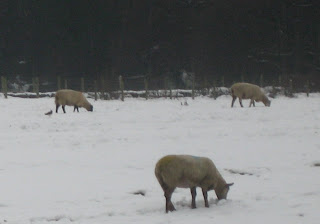
They were peewits, or lapwings. For the second year running, extreme cold has brought them down from the moors to our river valley in Leeds. It isn't exactly warm here, but certainly much less chilly than the birds' usual haunts such as Blubberhouses or Almscliff Crag. I managed to get this rather distant photograph of one of them this morning (above). You can, I hope just make out its distinctive crested head in the close up (right), with the sheep for scale.
Lapwings are full of interest. The name comes from their feint, pretending to be injured and dragging a wing as they lure potential predators away from their open, vulnerable nests. Their eggs were once considered a delicacy. More mundanely, they were used in their thousands by the Government in the Second World War to turn into powdered egg and bolster the ration. Once very common, they are now on the Red List of potentially threatened species, although in Yorkshire there still seem to be plenty about.
Saturday, 4 December 2010
To bee, or in this case not
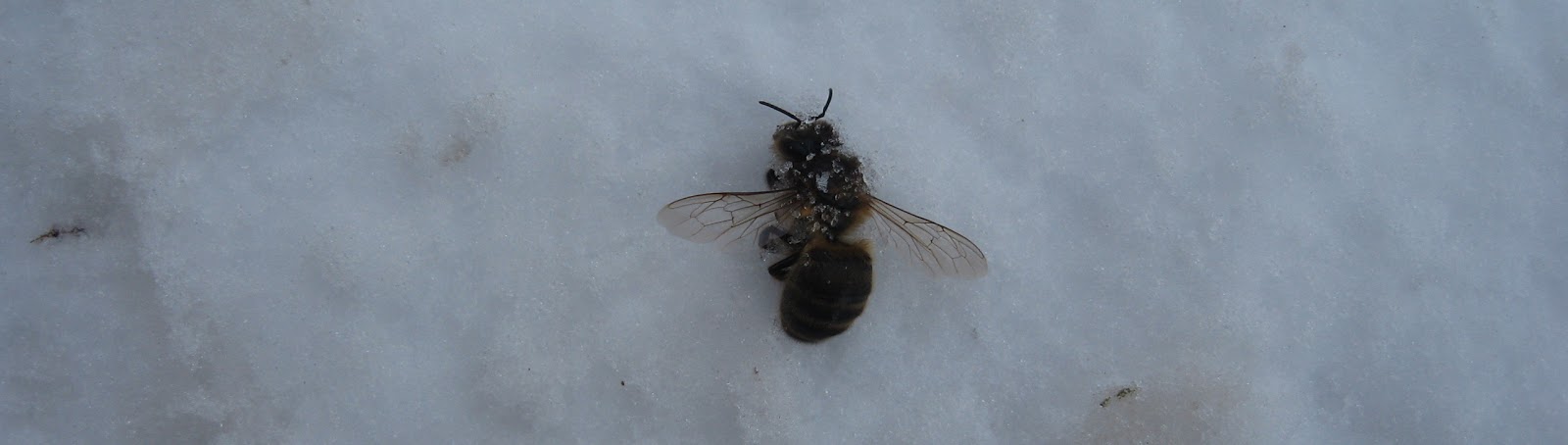
Maybe a car got it. Maybe it succumbed to the intense cold. Thermometers recorded minus 19C in North Yorkshire this week, which for us is pretty severe.
A bee's life is never easy, though. I asked Google the question with which I started this post and here's one answer from www.coolquiz.com/trivia/explain/docs/bees.asp:
"The workers bees and drones, who toiled for the queen all summer, are rewarded for their efforts by a certain death in winter. No bother...they are easily replaced by cheap labor, when the queen lays more eggs in the spring, and puts her new brood to work."
Little fascists. I'd rather be a ladybird such as this one, creeping around on my 'Mousey' Thompson napkin ring, the only thing I could afford at the great woodcarver's store below the White Horse near Thirsk. Ladybirds hibernate en masse in our house and now that we've pumped up the central heating, some of them think that it's Spring.
Lastly, here's my Mum's neighbour (below), prowling around. He's Reynard, according to my Guardian predecessor John Masefield - remember the many, many couplets of Reynard the Fox...
"From the Gallows Hill to the Tineton Copse
There were ten ploughed fields, like ten full-stops,"
De-dum, de-dum
Or he's Mr Tod, in Beatrix Potter's eyes (and I bet she was thinking of the German todt, meaning death). But my favourite name is Mr Cunningly Sly, from an old children's book about Diggy the hedgehog. Whichever, here he is:
Tuesday, 30 November 2010
Brrrrr!
I recall from school the value of proving a negative. That's what I seem to have done last night, when I put out the trap to see if any late-flying moths might brave the snow. It was extremely cold and after I had gone to sleep, the snow came down again. The brilliance of Mr and Mrs Robinson's trap was proved once more, with the shield working perfectly and the bulb shining brightly for frozen hours. But no moths came. There are some about at this time of year, including the appropriately-named November and December Moths. But I think that they fly only on warmer nights. If we get any such, we may see.
Monday, 1 November 2010
Hello again, unexpectedly
We had our friends the Webbs from Honley and their family round for a Sunday roast yesterday. (See the post on 27th August for the scale and quality of meals they supply...) Dorothy is a major enthusiast for the moth trap, so I showed her it, neatly stashed away in winter hibernation like all the sensible British moth species which have now gone into pupation 'til the Spring.
It was getting towards dusk, it was very mild (Leeds continues to enjoy an Indian summer, adding to the stats which consistently make it drier than Barcelona), and so I thought: why not demonstrate the trap in action? Dorothy turned on the switch, the lamp blazed and this morning the exercise proved worthwhile. The tawny visitor above and immediately below is new to my records, a Feathered Thorn. Not surprising that I haven't recorded it before, though, as it only flies late in the year, mostly after I have shut up shop.
Only the male of the species has the wonderfully complex antennae shown in the picture below (and actually above, too; in both cases, the thin white line is the antennae's leading edge). Scientists still have plenty to find out about the power and purpose of these complex instruments, but looking close-up like this suggests that moths may have lessons to teach the eaves-dropping spooks at places such as Menwith Hill, not far from here. Along with the Thorn, there were half-a-dozen November Moths showing their accurate knowledge of the calendar, twice as many Carpets which I will try to identify at leisure, and a straw-coloured species which, again, I will muse over when I have more time.
This picture (below) of assorted Webbs marvelling at the trap shows why Stuart and Dorothy are in such demand as extras in the many films which are constantly in production in the lovely and characterful North of England. I asked Dorothy if she could look amazed and awestruck at the moth trap, and you can see how she instantly and instinctively obliged.
I can also tell you a story about how Stuart and Dorothy made national newspaper headlines when they were both on Holme Valley council as Liberals, Stuart as chairman. It's called The Affair of the Green Mugs, but it will have to keep for now. By the way if, like me, you were wondering what the eggbox 'Understanding' is about, I've just been down to clear the trap away and check, and it's to do with Egg Codes. They are almost as complicated as Carpet moths.
It was getting towards dusk, it was very mild (Leeds continues to enjoy an Indian summer, adding to the stats which consistently make it drier than Barcelona), and so I thought: why not demonstrate the trap in action? Dorothy turned on the switch, the lamp blazed and this morning the exercise proved worthwhile. The tawny visitor above and immediately below is new to my records, a Feathered Thorn. Not surprising that I haven't recorded it before, though, as it only flies late in the year, mostly after I have shut up shop.
Only the male of the species has the wonderfully complex antennae shown in the picture below (and actually above, too; in both cases, the thin white line is the antennae's leading edge). Scientists still have plenty to find out about the power and purpose of these complex instruments, but looking close-up like this suggests that moths may have lessons to teach the eaves-dropping spooks at places such as Menwith Hill, not far from here. Along with the Thorn, there were half-a-dozen November Moths showing their accurate knowledge of the calendar, twice as many Carpets which I will try to identify at leisure, and a straw-coloured species which, again, I will muse over when I have more time.
This picture (below) of assorted Webbs marvelling at the trap shows why Stuart and Dorothy are in such demand as extras in the many films which are constantly in production in the lovely and characterful North of England. I asked Dorothy if she could look amazed and awestruck at the moth trap, and you can see how she instantly and instinctively obliged.
I can also tell you a story about how Stuart and Dorothy made national newspaper headlines when they were both on Holme Valley council as Liberals, Stuart as chairman. It's called The Affair of the Green Mugs, but it will have to keep for now. By the way if, like me, you were wondering what the eggbox 'Understanding' is about, I've just been down to clear the trap away and check, and it's to do with Egg Codes. They are almost as complicated as Carpet moths.
Tuesday, 12 October 2010
Time to say Goodbye, for now
Subscribe to:
Posts (Atom)