Monday, 28 February 2011

Monarchs of the glen


Hello again! There's a while to go 'til mothing starts in ernest in April, but I'm thinking of lighting the lamp one of these nights. The weather keeps shifting; sometimes warm, than back to a wintery chill, but plenty of wings have been fluttering about in the car's headlights of an evening. Increasingly, they don't all look like Winter Moths too.
But first, I have to post some of the results of a fantastic Mexican interlude for Penny and myself, courtesy of our son Tom and lovely daughter-in-law Abi (that's her, above), who laid on an amazing programme in that amazing country. Knowing my butterfly and moth enthusiasm, this included a visit on horseback high into the forested hills above Valle de Bravo, three hours north of Mexico City, to see one of the greatest sights of the butterfly world.

The Monarch Migration. What can I say? It is just stupendous. I have been fascinated by the Monarch ever since I caught my rarest butterfly, the 'Charlotta' variety of the Dark Green Fritillary, as a boy at the exact spot above Kynance Cove in Cornwall where Prof E B Ford (he of the Bible 'Butterflies' in the Collins New Naturalist series, caught a Monarch in 1941. Fewer than 100 have been found in Britain. In Mexico there were millions; all of them winter arrivals from Canada and North America where the cold becomes too much for them. They roost in the warm, moist forests of these hills, mate, lay eggs and in the late Spring and early Summer, their offspring fly back. The species has adapted so well to this unique lifestyle that adults can live for an astonishing seven months (astonishing, that is, for a butterfly, whose span is usally counted in weeks, if that).

They hang in vast swags from the trees above Valle de Bravo and elsewhere on the borders of Mexico's Michoacan and Mexico states. As the day warms, they leave these roosts and spiral up into the sun. My Mum has just died and it was inspiring to watch the beautiful insects stream up into the shafts of light. We could see why the Greeks used the same word - psyche - to mean both butterfly and soul. There's an obituary of Mum, btw, on http://bit.ly/eicke1
Coming back down, we had a picnic and Abi spotted this beautiful butterfly, whose silvery underwing suggests some sort of Mexican fritillary. There is a very comprehensive website on Mexican butterflies, but you have to plod through them one by one. I haven't time to do that just now but will; and I will add the name here when I do.

Saturday, 1 January 2011

First moths of the second decade

And now, happy New Year! And here on our window sill is one of a smattering of Winter Moths which must have been thoroughly confused by the celebration antics here last night. It was mild, if damp, and I turned on the trap after watching London's amazing fireworks on the telly. We'd already had our own rather more modest pyrotchnics plus some of those beautiful Chinese lanterns which sail off into the night while you keep your fingers crossed that they won't set fire to anything. One of our trees meanwhile has a couple of strings of outside lights in it; and finally the sitting room curtains were open, allowing much jollity and brightness to spill out into the night. What a collection of rival glares to confuse a moth...

This one (right) was perched on the actual window. Indoors, by good fortune, we had a learned guest, Tom Greenall, a young architect from London who turns out to be very well-informed on Winter Moths. Via BBC TV's excellent Springwatch, which has also been trapping, he knew that the frail little insects survive savage temperatures through a natural sort of anti-freeze in their blood. The chemical protects them from the effects of, for example, the minus 12C (10.4F) we had before Christmas, although it still takes them ages to generate enough heat to be able to fly. Their method is to exercise their wing muscles continuously until the temperature in the thorax, or central part of the body, is 30C (86F), allowing them to take wing.

Here for good measure is an infra-red image of a warmed-up Winter Moth, courtesy of the website www.harunyahya.com (interesting, albeit creationist and down on evolution for reasons which I don't really follow).

Friday, 24 December 2010

Merry Christmas!

Hello everyone! I hope you have a marvellous Christmas and all warmest wishes for 2011. This is the American Christmas Moth which I'm pretty sure is a relative of our Winter Moth featured in the post below. It doesn't normally wear a Santa hat; I've added that after hours of laborious experimenting with Adobe Illustrator, Photoshop etc. No mothing for me tonight, though. Quite apart from the possibility of disturbing Father Christmas on his rounds, it's minus 4C and the bulb might blow. And surely no sensible moth can be out and about. All the very best 'til next time, M.

Thursday, 16 December 2010

Flakes in the dark

The weather is doing a Sword of Damocles act over the North of England at the moment, although the fact that the Daily Express today forecasts the worst blizzards for a century reassures me that it will be mild and warm after all. (My older son has experience of doing weather stories for the irrepressible DE, and what can happen to them after they leave the reporter's tender care.


These moths aren't too worried, anyway. In spite of the doom-mongering (and even my own employers have bee trying to convince me that this may be the worst winter since 1963), I counted seven moths in the car headlights along our road on Tuesday night and another two yesterday evening. A tenth fluttered down from our porchlight, so I thought: blizzards or not, I'll set the trap.


Lo! Here are two Winter Moths as a result. Conceivably, the more patterned of the pair might be a November Moth, but I don't think so. Experts, if you are still reading in these largely mothless months, please put me right if necessary. The description of the Winter Moth in my Bible is as accurate as always; it mentions the fluttering in car headlights, the habit of coming to ordinary lights and the susceptibility to light traps.
It also gives space to the unfortunate female of the species, which is virtually wingless (see pic below right, courtesy of bugguide.com) and cannot fly. For those who like sexual excitement, this has the one compensation that males have been known to carry females in flight while copulating. I don't know, and I wonder whether scientists do, whether this involves consent.


...with apologies for the blurring, here is a sequence of one of our jays eating the kindly Wainwright peanuts on the lawn. I couldn't get closer because these striking but raucous birds are as jumpy as Mexican beans.

Sunday, 5 December 2010

Eerie visitors

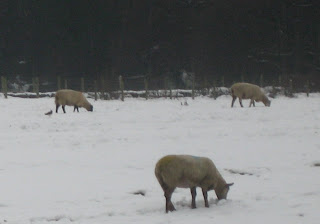
Penny and I were walking back last night from our car, which we're leaving at the end of our steep and windy road during the snow, when we heard plaintive wails from the fields below our house. It was twilight, and we could just make out shadowy shapes wheeling around the dozy clusters of sheep. It was from these shapes that the wails came.
They were peewits, or lapwings. For the second year running, extreme cold has brought them down from the moors to our river valley in Leeds. It isn't exactly warm here, but certainly much less chilly than the birds' usual haunts such as Blubberhouses or Almscliff Crag. I managed to get this rather distant photograph of one of them this morning (above). You can, I hope just make out its distinctive crested head in the close up (right), with the sheep for scale.
Lapwings are full of interest. The name comes from their feint, pretending to be injured and dragging a wing as they lure potential predators away from their open, vulnerable nests. Their eggs were once considered a delicacy. More mundanely, they were used in their thousands by the Government in the Second World War to turn into powdered egg and bolster the ration. Once very common, they are now on the Red List of potentially threatened species, although in Yorkshire there still seem to be plenty about.

This has nothing to do with moths, I admit, although lapwings will have disposed of many a moth in their time.  It's much too cold to use the trap at the moment,  and very little would be on the wing.  One of the hardy souls in Yorkshire Butterfly Conservation (see link, above left) reports finding a wingless female Winter Moth, but that's dedication for you. I'm heeding Ben's warning (see Comment two posts below) that the mercury vapour bulb may blow at -5C. Here's the RSPB's pic of a lapwing, btw, to compensate for the faraway blurriness of mine

Saturday, 4 December 2010

To bee, or in this case not


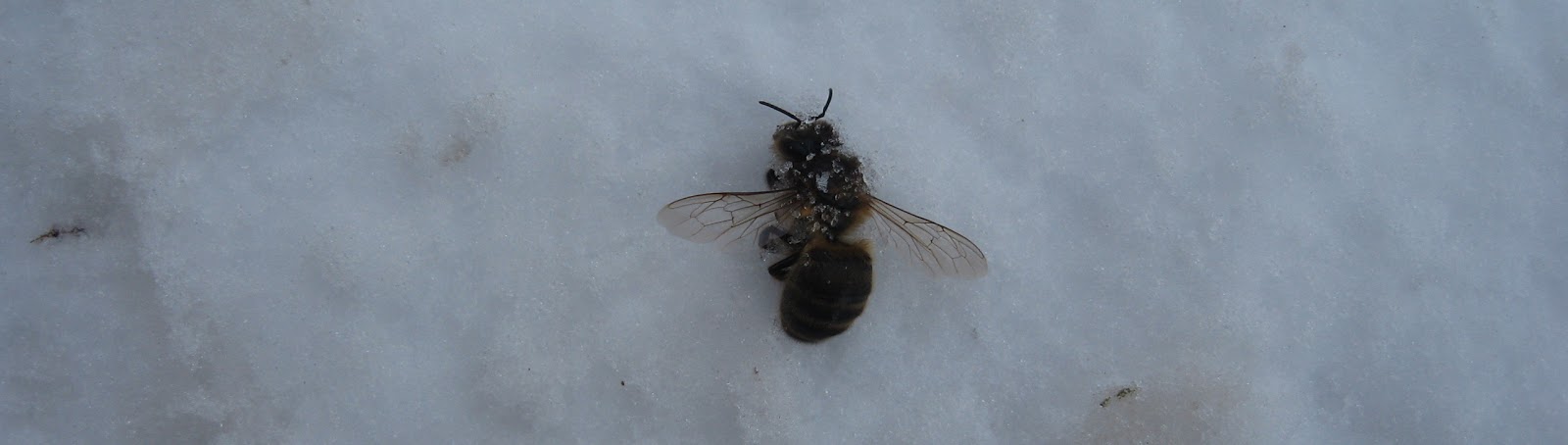
What happens to bees in winter? In the case of this one, nothing more. The rest is silence. I spotted it on our road, a sad little speck in the snow. You seldom encounter dead insects in the wild, but this one showed up in the overwhelming white of our local world just now.
Maybe a car got it. Maybe it succumbed to the intense cold. Thermometers recorded minus 19C in North Yorkshire this week, which for us is pretty severe.
A bee's life is never easy, though. I asked Google the question with which I started this post and here's one answer from www.coolquiz.com/trivia/explain/docs/bees.asp:


"The workers bees and drones, who toiled for the queen all summer, are rewarded for their efforts by a certain death in winter. No bother...they are easily replaced by cheap labor, when the queen lays more eggs in the spring, and puts her new brood to work."


Little fascists.  I'd rather be a ladybird such as this one, creeping around on my 'Mousey' Thompson napkin ring, the only thing I could afford at the great woodcarver's store below the White Horse near Thirsk. Ladybirds hibernate en masse in our house and now that we've pumped up the central heating, some of them think that it's Spring.


Lastly, here's my Mum's neighbour (below), prowling around.  He's Reynard, according to my Guardian predecessor John Masefield - remember the many, many couplets of Reynard the Fox...


"From the Gallows Hill to the Tineton Copse
There were ten ploughed fields, like ten full-stops,"
De-dum, de-dum


Or he's Mr Tod, in Beatrix Potter's eyes (and I bet she was thinking of the German todt, meaning death).  But my favourite name is Mr Cunningly Sly, from an old children's book about Diggy the hedgehog. Whichever, here he is:


Tuesday, 30 November 2010

Brrrrr!


I recall from school the value of proving a negative. That's what I seem to have done last night, when I put out the trap to see if any late-flying moths might brave the snow. It was extremely cold and after I had gone to sleep, the snow came down again. The brilliance of Mr and Mrs Robinson's trap was proved once more, with the shield working perfectly and the bulb shining brightly for frozen hours. But no moths came. There are some about at this time of year, including the appropriately-named November and December Moths. But I think that they fly only on warmer nights. If we get any such, we may see.

Monday, 1 November 2010

Hello again, unexpectedly

We had our friends the Webbs from Honley and their family round for a Sunday roast yesterday. (See the post on 27th August for the scale and quality of meals they supply...) Dorothy is a major enthusiast for the moth trap, so I showed her it, neatly stashed away in winter hibernation like all the sensible British moth species which have now gone into pupation 'til the Spring.


It was getting towards dusk, it was very mild (Leeds continues to enjoy an Indian summer, adding to the stats which consistently make it drier than Barcelona), and so I thought: why not demonstrate the trap in action? Dorothy turned on the switch, the lamp blazed and this morning the exercise proved worthwhile. The tawny visitor above and immediately below is new to my records, a Feathered Thorn. Not surprising that I haven't recorded it before, though, as it only flies late in the year, mostly after I have shut up shop.

Only the male of the species has the wonderfully complex antennae shown in the picture below (and actually above, too; in both cases, the thin white line is the antennae's leading edge). Scientists still have plenty to find out about the power and purpose of these complex instruments, but looking close-up like this suggests that moths may have lessons to teach the eaves-dropping spooks at places such as Menwith Hill, not far from here. Along with the Thorn, there were half-a-dozen November Moths showing their accurate knowledge of the calendar, twice as many Carpets which I will try to identify at leisure, and a straw-coloured species which, again, I will muse over when I have more time.


This picture (below) of assorted Webbs marvelling at the trap shows why Stuart and Dorothy are in such demand as extras in the many films which are constantly in production in the lovely and characterful North of England. I asked Dorothy if she could look amazed and awestruck at the moth trap, and you can see how she instantly and instinctively obliged.


I can also tell you a story about how Stuart and Dorothy made national newspaper headlines when they were both on Holme Valley council as Liberals, Stuart as chairman. It's called The Affair of the Green Mugs, but it will have to keep for now.  By the way if, like me, you were wondering what the eggbox 'Understanding' is about, I've just been down to clear the trap away and check, and it's to do with Egg Codes. They are almost as complicated as Carpet moths.

Tuesday, 12 October 2010

Time to say Goodbye, for now


Right, we really will stop now. The weather has chilled again and the mornings are getting dark. I'll leave you for 2010 with this fine Angle Shades which came the other night in spite of rain. It found a dry perch underneath the trap's plastic collar and was snoozing undisturbed when I braved the drizzle. Also there was the moth below, providing a textbook Laura Ashley example of how much slip to show (short enough to be interesting, etc). It's a November Moth, which seems a suitably seasonal note on which to conclude. I'm umming and erring about doing a monthly trap over the winter, just to see if anything is about. There is, for example, a handsome insect called the December Moth which I remember catching at our porch light in Leeds when I was a boy. But otherwise, see you in April, and many, many thanks for all the interesting and helpful comments.

Monday, 11 October 2010

Coffee morning


I'll stick my neck out this morning and say that this arrival last night (above) is a Green-brindled Crescent, although nothing about it is green. That is because it is the aberration capucino, named like the drink from the brown and white habit of Capucin monks and found almost exclusively in formerly heavy industrial areas such as Leeds. It baffled me at first, in spite of the distinctive white marking, because there didn't seem to be anything quite like it in my Waring, Townsend & Lewington, but a photo on UK Moths' excellent website (see list on left above) looks identical to mine.

It is a newcomer here, as is this second moth, if I have identified it correctly as a Pale Mottled Willow. There are a number of similar species but the clincher for me has been the PMW's fondness for peas. We have grown more peas this year than ever before, which isn't actually very many; maybe ten dinners' worth. But that would be a mountain of feasts for a PMW caterpillar, and something certainly burrowed into part of our crop.

Sunday, 10 October 2010

A green thought in a green shade


Back in Leeds, back at the trap. Lots of interesting visitors thanks to the warmth. Just one of them for now: only a Red-Green Carpet, but isn't it a lovely thing? More tomorrow because I must now to bed, after a happy day down in Dorridge with the in-laws and many other assorted members of the Wainwright and Dharmaratnam genuses of the Homo sapiens species, clustering around Radha's Sri Lankan curries like so many intoxicated moths.


Saturday, 9 October 2010

Packing-up postponed


I was going to say that our revels now are ending. But even in the Lake District, the weather has been astonishingly mild and I'm minded to keep the trap going for the next few days, back in Leeds. Last night we all went out to eat at the Woolpack near Brotherilkeld, at the foot of the great, wild curve of upper Eskdale, and although it was blowy, the wind was as balmy as in the South Seas. During a day's round of Burnmoor Tarn, the lofty heights above Wastdale's Screes and back up lost little Mitredale, we found plenty more Broom Moth caterpillars around, an elusive brown, dotted moth jittering about in the bracken in daylight (any identification ideas, anyone?), and a Comma resting on a Forestry Commission warning sign about tree-felling. In the evening, yet another Small Tortoiseshell fluttered into Penny's and my bedroom and came to rest on Barbara Kingsolver's The Lacuna (above). There's a great, human and instructive read, as the butterfly seemed to know.

Kingsolver btw is the sister-in-law of a very nice American academic called Mark Whitaker who has written a biography/analysis of the murdered Sri Lankan journalist Sivaram Dharmaratnam, younger brother of my in-law Suri and Uncle of our Tom's lovely Abi, supplier of interesting news of moths to this blog from Mexico City. I live in hope of meeting BK one day. Details of Mark's book are on www.amazon.co.uk/Learning-Politics-Sivaram-Revolutionary-Anthropology/dp/0745323537


Friday, 8 October 2010

Small things in big places


I walked from Boot to the Jaws of Borrowdale yesterday, over Scafell and Scafell Pike.  Fifteen words to describe eight hours in Paradise, especially as the mist lifted shortly before I became, for half-a-minute or so, the highest person in England. Thereafter the sun shone and shone. My Paradise opinion seemed to be shared by a Small Tortoiseshell which was basking in the sunshine on Broad Col. This is pretty impressive, as the col is 3030ft high and the weather there volatile. Only yesterday, four of our party were driven back down from just the same spot by rain, thick mist and even hail. 

What was the Tortoiseshell doing then?  Maybe it flew up yesterday from the nearest bunch of nettles, its larval foodplant which isn't to be seen anywhere near Broad Col. Or perhaps it finds shelter deep in the omnipresent piles of stones (see the pic of the Pike's summit, Broad and Ill Crags, above) which also make excellent storage heaters to bask on when the sun does shine. Either way, I was so surprised to see the butterfly that I failed to sort out my camera in time. But down in Borrowdale, I saw three more on the roadside verge between Seatoller and Rosthwaite and here is one of them. Also a dead shrew on the fellside between Burnmoor tarn and Scafell summit. There is, or was, a lot of life in them there hills.

Thursday, 7 October 2010

God (or Nature) and Man (or Woman)


A bright flutter of colour sprang up yesterday outside the Screes pub in Nether Wasdale when Penny and I cycled up for lunch. After this summer, I automatically assumed that it would be a Peacock or Red Admiral. They have far outnumbered the third of the lovely Vanessid trio (see learned post some weeks below on the origins of this insect family name). But no. The flutter was indeed that third: a lovely Small Tortoiseshell. Apart from exalting its beauty, even with the camera struggling to cope with the Screes' dazzling whitewash, there isn't any more I have to say. Except, perhaps, to contrast it with a similar work of man: my pillow here in Boot. A good effort and lots of hard work, but not really comparable. Not very comfortable either, with the sequins, until I turn it over.

Wednesday, 6 October 2010

Ratty and Badger (and Jiminy too)

After yesterday's tick, it seemed only proper to investigate the River Mite, which flows into the Esk not far below Boot. We were helped by the famous and invaluable Little Ratty railway, seen here with the Charles Darwin doll which is symbolising these few days of  walking and incidental nature investigation in the Lakes.

Caterpillars though - nix. After two days of having to tread carefully to avoid Fox moth woolly bears and what - thanks to Worm's comment in the post below - I now know to be Broom moth larvae, we didn't see one on a long and beautiful hike back up the dale from Ratty's terminus at Ravenglass. This included what seemed to be their ideal conditions - boggy and soaking - on parts of Muncaster Fell, and also the exotic flora of the Edwardian Japanese garden in Giggle Alley, Eskdale Green. Volunteers are slowly bringing this back to its original startling state. I'm continuing to research the fine name.

There was a dead badger, though, the second in four days. We passed the other on the roadside near Ulpha. Sad, but a small sign of how common Brock has become, thanks to effective animal protection laws. And this cricket (above) - a much more vivid, limey green than the picture suggests, which leapt out of our group's way into a puddle, but managed to leap again, to safety.

Tuesday, 5 October 2010

Tick box


Yesterday was caterpillar today. Today it's ticks. To be accurate, one tick, which fastened itself to the shapely leg of one of our Lake District band, Margaret McGowan, an educational adviser whose website will shortly be up and running on  www.educationadviceonline.co.uk. It latched on to her halfway up Scafell via Cam Spout where the more muscular half of the group went adventuring. Penny and I and a couple of the others meanwhile perambulated round Eel, Stoney and Burnmoor tarns below Slight Side and found an enormous number of Fox moth caterpillars, plus plenty of the sleek, stripey ones you see below.


They appear to have been designed by the manufacturers of Hi-Viz vests which doesn't help them to hide but probably puts off predatory birds. I remember finding these as a boy in bracken on the Deer Hill at Bolton Abbey and noting how the younger ones had the comely livery of yellow with British Racing Green, the latter changing to brown in those close to pupation.


I've done a quick check on the net to see what they are but without success, and have to get my boots on now. Will try harder later.
The tick btw is very dead, the result of immersion in a cup of boiling water. I'm not going to try, but I imagine that it might test like an extremely tiny shrimp. It is the size of a pinhead.

Monday, 4 October 2010

Coincidence time again


Here is my son's Charles Darwin doll (no, no, we weren't that much of pushy parents, it's a fairly recent joke). He's sitting on the summit of Green Crag above Boot in Eskdale, whence this post comes. It seems a bit improbable, surrounded by vast mountains and without a peep of phone connection, but wifi is penetrating right into the kitchen of the farmhouse we're staying in, which was built in 1703. I can this bring you news of another glorious date match, like the Blair's Shoulder Knots and Black Rustics which faithfully . Like Darwin, I am slowly building up a scientific case on moths' flying seasons, not that it will be news to any scientists.

Anyway, on the way up Green Crag, which is a very excellent little mountain with interesting approaches and descent up two different 'peat roads', used for collecting fuel with carts, we found three of these caterpillars. Guess what, in the first week of October last year, we did the same thing on the Floutern Pass which connects Ennerdale, where we were staying at the time, to Buttermere. Provided that no one treads on it, it will turn into a Fox Moth, as pictured here. The caterpillars seem to like boggy uplands. As I noted last year, Arthur Ransome collected them as a boy on the fells and hatched the moths. The famous Gipsy Moth biplane also had a relative called the Fox Moth, shown here in action for Australia's flying doctor service.