Thursday, 10 May 2018

Nothing wrong with being common


Here's a quartet of last night's arrivals and lovely moths they are too. The White Ermine, bottom left with my wedding ring and somewhat pudgy fingers, is an instant favourite with everyone who encounters it; ditto the Cinnabar alongside, whose striking red streaks and dots go superbly with its background colour of a very slightly green and rather oily black.

The two moths at the top are the delicate Green Carpet, named in the 18th century when wonderfully-patterned carpets from the East were arriving in commercial quantities in England, and the Iron Prominent whose colours have a touch of those paint suppliers to the gentry, Messrs Farrow & Ball.


All these moths, and the year's first Flame Shoulder shown above, are common albeit seldom seen by those who are not lucky or wise enough to own a moth trap (the Cinnabar is the likeliest to have wider recognition, both because it flies by day as well as night and because its striking yellow-and-black-banded caterpillars are familiar on ragwort).  News of these hidden riches seems to be spreading, I am glad to say, and the number of moth observers and enthusiasts is increasing. Welcome all, and here are a couple more White Ermines from this morning's eggboxes to enjoy.


Monday, 7 May 2018

Hawk's worth


It's always a good moment when the year's first hawk moth arrives, specially for superficial moth enthusiasts such as myself for whom size and colour cause more excitement than scientific peculiarities or small aberrations in otherwise humdrum-looking insects.

Not that colour is the strong point of last night's arrival, the Poplar Hawk, whose colouring is overwhelmingly made up of different greys. It does, however, have a startling blotch of pinky-red on each underwing, which the moth may flash as a warning to predators when disturbed and alarmed. I wasn't feeling specially interventionist when I examined the trap this morning, so I left the moth in peace.

Its distinction, which lifts its otherwise humble status as the UK's commonest hawk, lies in the way that it holds its wings, with the under-ones projecting further forward than the topwings. This can give it a slightly sinister bat-like appearance and it is not a moth which appeals to everyone. For that, we need the pretty pink Elephant hawks.


Last night also brought the well-named Spectacle moth, above, which always brings a grin to my face, and I've added another Malvolio study of a Muslin, this time also showing his distinctive antennae - always a feature of the male and resembling Denis Healey's eyebrows. Perhaps he received extra knowledge through these which made him such a formidable politician. If we were allowed one extra feature from the animal world, I would be much tempted by antennae, although in the end, I suspect that like most people, I would opt for wings.

Sunday, 6 May 2018

Small but beautiful


Another crop of interesting moths came last night as the lovely spell of weather continued. The one at the top is new to me - at least, new in the sense that I have not recorded it before. It is classified as 'common' and so I am sure that it must have paid me a visit, but passed un-noticed.

It is the micro-moth Acleris literana, not to be confused with its relative and near namesake Acleris laterana. I like the delicate indication of green, all the fainter on this specimen which looks as though he or she has been a round a bit.  The species is on the wing in the UK from July round to May, so we are also at the end of the 2017-18 cycle.


My second picture shows, clockwise from top left, a Pug moth which I have yet to ID exactly, a Muslin showing the Malvolio leggings which are such a contrast to its soft, dark grey cloak, a Pale Prominent with its characteristic snout and a very pretty Scorched Carpet.


Finally, this equally pretty little moth baffled me initially as it was scurrying about - though fortunately not interested in fluttering off - and made itself very difficult to photograph. I didn't recognise it until it finally found a spot which set its nerves at ease and assumed the unmistakable resting pose of a Chinese-character moth (the character being the silvery mark in the middle of the wing, rather than a Confucian state of mind).

Saturday, 5 May 2018

Royal family


News today of an unexpected and - for me - exciting consequence of Thursday night's visit by a female Emperor moth.  By happy chance, Penny and I were invited by friends to voyage down the Thames yesterday from Windsor to Maidenhead. In appreciation, we took them a bottle of wine, some home-grown purple-sprouting - and the Empress.

That's Windsor Castle in the background
On the way, I emailed about something else from the train to Dave Wilton, the wonderfully knowledgable and helpful organiser of the Upper Thames Moths blog, and I mentioned in passing that I was carrying out this minor piece of species redistribution. He replied: 'If she is travelling in the dark, she may have company by the time you get to Windsor.'


He was absolutely right. Look at the lovely clutch of eggs which she laid as the various trains conducted us between Oxford Parkway, Oxford, Slough and Eton and Windsor. I rewarded her by leaving her contentedly on a willow tree by the Thames at Runnymede (she was still in exactly the same spot when we wandered past an hour later after exploring the historic site). But I've brought the eggs back here for a little caterpillar breeding.


This is a very enjoyable occupation. I think that if you are interested and Google skilfully, you will be able to follow the long and fertile family saga of the beautiful Empress shown at the top of this blog's web page. I am also offering free eggs to anyone else who would like a go, so let me know if you are interested.


Friday, 4 May 2018

Niece's birthday bonus


I had a nice reminder this morning of why moth-trapping is infectious. After my extremely dawdly start to this year's trapping, the eggboxes came up trumps in the way they do, arousing all the hunter's instincts and hope of rewarding arrivals to come.

The female Emperor - Empress, I guess - in the top two pictures is the star of the show and she is now snoozing in our shed with the doors and windows open in the hope that her super-powerful pheromones will attract a mate or mates.  This well-known phenomenon of 'assembling', which can lure males from over a mile away, has worked brilliantly in the past. One Empress became a great-grandmother (posthumously) after breeding in our second year in Oxfordshire.


It was great to find a Streamer on the moth cowl, left below the Empress, and the Swallow Prominents on the lamp wire in my second composite picture - two standard SPs at either end and a Lesser SP in the middle. Also shown here are: bottom right in the first composite, a Muslin Moth; bottom row in the second composite: Brindled Beauty, Pebble Prominent and V-Pug; and below, clockwise from top left: Chocolate-tip, yet-to-be-IDed micro (help always appreciated), Least Black Arches and Early Grey.


This is a great collection to arrive on the birthday of one of my three talented and lovely nieces. Happy Birthday Annie! And love to all the bouncing family

Thursday, 3 May 2018

Processing on

My last post about processionary moths has brought me another startling photo, left, this time from  a cousin and his partner who encountered hundreds of Pine Processionary caterpillars in Spain. This picture shows a two metre-long crocodile but they measured others stretching up to five metres.

They add: "We saw two lines trying to merge together, and they would butt each other out of the way to stop the others pushing in. It was like a rush-hour traffic jam." They gathered that if the lead caterpillar dies or encounters some other misfortune, the followers pile up in chaos. It would be interesting to test this, perhaps by gently removing the leader (and carefully; a lot of people are allergic to the caterpillar hairs).

There's room here for allegories about what happens to people who follow a leader in blind faith. The fact that processionary moths are doing so well is rather discouraging. But let us hope that the practice suits them rather better than it does human beings and nations.

Tuesday, 1 May 2018

Follow my Leader


There are lots of reports in the moth world at the moment of a pest species, the Oak Processionary moth, which foresters greatly dislike for understandable, defoliating reasons.

It has an endearing habit, however, which is shared by these Pine Processionary moth caterpillars spotted in Cyprus in early March by a friend of ours, Derek Ivens.

You could read about the dark side of the PPM here but while acknowledging its harmful eating habits, I think that we are allowed to find its brotherly and sisterly travelling arrangements as quite touching.

I haven't lit the lamp for a second time this year yet but it's been a tonic, after the prolonged dreary weather, to see Brimstone, Orange Tip and Common Blue butterflies here when the sun does come out and has time to warm things up.

You can read plenty of interesting material about the Pine Processionary online, starting with good old Wikipedia. Processions may reach 300-strong and are very determined. The naturalist Fabre organised PP caterpillars into a circle with food just outside it and they marched round and round for a whole week. They also build nests, which is another appealing side to their character, at least for me.

Sunday, 29 April 2018

Back in action

Hooray! I have finally summoned up the energy and found the time to set out the lamp for the first time since early December. My lethargy has been partly owing to family commitments of one sort or another and partly to the time taken up by my bold decision to scull from Godstow to Eel Pie Island - 100-plus miles down the Thames - to raise money for a very good cause. If you have time, you can read about it here: https://gogetfunding.com/rowing-down-the-river/


I'll divert ever so briefly from moths to show the composite picture above, and to encourage you, whatever your age, in my belief that rowing is every bit as enjoyable and interesting as is the study of moths. In wildlife terms, you get a wonderful vantage point for watching the world when afloat.

Top left, clockwise: Nut-tree Tussock, Powdered Quaker, strange beast, Hebrew Character. The moths are respectively 1st, 24th and 3rd in frequency in the excellent Hants Moths Flying Tonight list online

Back to moths. It was a chilly night and I was not expecting anything too exciting, but it was good to have the three agreeable visitors shown above, plus a strange beastie from the fly-type of insect, shown above. Talking of flies, we have the hideous Blandford Fly back here for its annual six-week rampage. A truly nasty little black fly with a horrible bite, it is one of the few serpents in our Paradise.


I am very pleased with my lovely clean eggboxes, mostly kindly donated by neighbours. Alas, because of moths' habit of creeping into the cones and crevices, they will all be bent and battered soon by my struggles to get good photos.

Update:  the inestimable Dave Wilton of the invaluable Upper Thames Moths blog, tells me that the strange beastie "appears to be a midge of the non-biting variety (hooray for that) from the family Chironomidae, of which there are a lot around at the moment." He adds: "It would need a fly expert to get any further than that, if indeed it is possible at all, just from a photo. I see there are 600+ species to choose from."

And that's 599 too many for me.

Monday, 8 January 2018

First of the year


Happy New Year, belatedly. The moth trap remains closed-down and I am slowly working through my records in an armchair by the fire. But moths are still about and the lights of our porch are a modest beacon for them

Here, with apologies for the blurring, is the first of 2018: predictably a Winter Moth about whose remarkable 'anti-freeze' life system you can read more here in a blog post which also marked the first moth of a new year, and decade, in 2011.

Today's moth came on a chilly night and if you have time to click the link, you will see how the species copes with such apparently unfriendly conditions.

Sunday, 24 December 2017

Merry Christmas!

Hi one and all and a Merry Christmas plus all warm wishes for the New Year. The trap is packed away and I shall spend the next month or so trying to sort out and send off my records, a very long overdue task.

Meanwhile here is a Christmassy and mothy picture which I found on an internet forum devoted to matters moth.  Its poster imagines appositely that clothes moth larvae will spend many happy hours chewing away at it.  Keep those cashmere sweaters well dosed with strong but not unpleasant scents and meanwhile I hope that you enjoy the mince pies!

Friday, 8 December 2017

Brrrr! Glad I put on my furs


It was a lovely evening last night, crisp and clear with a swollen moon presiding over the garden. I had a relatively leisurely morning in prospect and so couldn't resist the temptation to put out the trap, even though this are usually pretty moth-barren times.


I'm glad that I did, because the morning saw our first snowfall of the Winter, only a few modest flurries but enough to make the garden look as though someone had sprinkled it with icing sugar, just as Penny is currently doing with her home-made mince pies, yum. The trap was also sprinkled but protected from getting seriously wet by a nearby hedge.


When I went through the boxes, I failed to see any moths and came to the conclusion that, not surprisingly, none had stayed the night. But while putting them back, I spotted this handsome December Moth in very good condition, snugly wrapped in his fur coat. He didn't mind when I decanted him on to our snowy garden table for a seasonal picture, and went back to sleep when I popped him safely back into his eggbox and hid it under the hedge.

I doubt that I will put the trap out for a while now. But the lure of curiosity about what may be flying out there is great. So you never know.

Tuesday, 5 December 2017

Tangled web


I haven't lit the lamp since my last post, three weeks ago, because that night the fuses went in the house and because it had rained, I assumed that this was caused by the moth trap.

Last night, however, we had a young cousin to stay and the weather turned mild - thank goodness, because you feel the bitter cold at my age - so I thought: well, let's see if it works. And it did.

So I think that electrically I had put two and two together and made five, which is what I did pretty consistently as a schoolboy in all the many maths and science exams which I always failed. (My excuse is that none of the relevant teachers had a spark which might have ignited my mind, but I accept that there was probably fault on both sides).


Anyway, there was nothing in the trap this morning when we examined the eggboxes while my cousin gulped down her disgustingly healthy breakfast of gravelly muesli. But look! Entangled in one of the many spiders' webs which I carefully protect from too much cleaning on the outside of our windows, was the Mottled Umber shown at the top of this post.

My cousin is a natural feminist I am glad to say, so I sorrowfully showed her the dismal lot of the female Mottled Umber, the flightless bug on the right in Richard Lewington's beautiful illustrations from the Moth Bible, above. These poor creatures hatch, climb up tree trunks, emit pheromones, accept the consequences, lay their eggs and die. Veritably, the stuff of a Margaret Atwood dystopia.

As you can see below, the spiders have been busy elsewhere on the window. They are doing better than my mercury vapour lamp.

Monday, 13 November 2017

Battling on


A week has gone by, of cold weather mostly, with rain moving in whenever the temperatures rise a little. It was so damp the other night that the moth trap went out and tripped our main fuses, causing me to creep around in the small hours with a torch to put things right.


I haven't lit the lamp since then, but the night's haul was worth the hassle, in the modest terms of this fag-end of the mothing season. I love the Sprawler, shown above on my wrinkly hand and in its original position on the wall of the house near the light. And the Feathered Thorn below is a lovely russet beast with very fine antennae on the male.


December moths - next pic - are reliable visitors, meanwhile, and it's pretty standard practice to get what I think is a Winter Moth, the final illustration today.


Sunday, 5 November 2017

Tail-end Charlie


I haven't been putting the trap out much recently on account of the cold weather and darker nights, and this will now be the case until Spring comes. I was confirmed in the policy this morning by the arrival of my first December Moth of the year, the tail-end Charlie which usually rounds off my annual proceedings. It was the only resident overnight.


Unlike the rather commonplace November and Autumnal Moths, with their fey, grey fragileness, he or she is a doughty character very well-dressed to withstand the cold. My liking for this is increased by my having just avoided a chill on a cold day in Salisbury this week, when I could tell that I was too skimpily dressed and getting colder than I should. The devotional candles and souvenir shop in the cathedral came to my aid.


The December Moth is hardy enough to survive the UK winter as an egg which begins a life cycle that culminates in the hatching of adults in late October, in spite of their name. It is also found as far north as the Hebrides and lower slops of the Caledonian mountains. I expect that it or its relatives will still be around when I put out the trap again next week.

Monday, 30 October 2017

Dewy-eyed


Two nights ago, just before the cold snap arrived, I found this attractive pair on the cowl of the dew-covered moth trap. The lower one is a fine male Feathered Thorn, one of a small number of moths which fly at this time of year and are equipped with the equivalent of a gaberdine to keep them cosy.


The smaller moth is a Juniper Carpet, a relatively infrequent visitor and one of a handful of local moths which have yet to visit the supreme expert Dave Wilton, who runs the Upper Thames Moths blog to which I so often refer.


Here it is, above, after fluttering off rather weakly, when I removed the cowl, and getting only as far as the lawn. I tempted it on to the leaf below, and so you can see its delicate but much less-patterned underwings


Another agreeable arrival was the Satellite, below, with its little versions of a lunar landing pod boldly marked on each wing. Meanwhile, last night saw our first frost of the autumn, so only the hardiest moths will be out and about between now and the Spring.

Sunday, 29 October 2017

Tweedy


A solitary arrival three nights ago, the first time that this has been the case for a while. It's a handsome moth, though: the Sprawler, which always puts me in mind of heavy tweed suits as once worn by gents with pipes in Scottish fishing inns or London clubs.  As with so many moths, the pattern is delightful and the colours very satisfying however subdued.

Talking of colours and patterns, I've been interested in the reaction of the Upper Thames Moths blog's great and very helpful expert Dave Wilton to the highly distinctive Blair's Shoulder-knot which I described here the other day - the one with two white patches on its shoulders, suggestive of an ermine collar to a robe. He commented: 'I've not seen Blair's Shoulder-knot with such an obvious white thorax but that probably doesn't mean much'. I think this is right, in that moths within a particular species can be extremely varied in wing pattern and colouring with out differing in any other physical way. But to the amateur like me, such variations are fascinating.


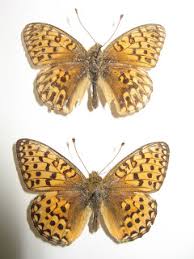
This may date back to my schoolboy capture of an extremely unusual form of the Dark Green Fritillary, a lovely butterfly which has even made it to a Mongolian stamp. I noticed straight away the distinctive keymarks on its lower topwings and, still more, the shining segments of silver on the underwings. Sure enough, it was definitely different - so much so that at one time in the 19th century, it was reclassified as a separate species called the Queen of England Fritillary in guides such as the one shown below:


It was identified for me by the learned and very kindly head of natural history at Leeds City Museum, John Armitage, who initially assumed that it was a foreign butterfly which I must have found on holiday. It was indeed a holiday capture, but on Goonhilly Down in Cornwall (in exactly the same spot where the great entomologist Prof E B Ford caught one of the few Monarch butterflies - the famous migratory American species - to be found in the UK). 


The butterfly, shown above and below with the standard Dark Green Fritillary (below in the top pic, above in the bottom one, sorry for the confusion), is known as aberration Charlotta.  It's the top specimen in the cabinet which I keep from my long-ago collecting days.