Friday, 1 November 2013

Spooky


The moth trap had some unorthodox competition last night from our Jack O'Lantern, above and below, which succeeded in attracting, not moths but trick-or-treaters, a very nice and alarmingly-disguised family from Lewes on a week's narrowboat holiday on the Oxford Canal.


I like trick-or-treating, Mischief Night, Guy Fawkes and all such customs because of the mixture of fun and genuine history and tradition involved - theology even; the temporary fling of 'evil' before the dawn of All Saints is a very venerable belief indeed.

I know some people don't like the doorbell ringing unexpectedly after dark and I sympathise; but the answer is easy: anyone up for it like us should carve and display a pumpkin. That's what brought the family to our door. They were politely choosing only houses where Hallowe'en had some recognition.


My own tradition on the night is to type 'moth' and 'pumpkin' into Google and see what transpires. Last year it was a YouTube clip of a kitten called Pumpkin batting away ineffectually at a passing moth. This year, I'm delighted to steer you to the blog of Gallivanting Rockhound, a cheerful geologist and skilled photographer in the US who also helps at a pumpkin farm whose proceeds go to needy families.

The Rockhound took this picture of a hawk moth (or sphinx moth as the Americans call them, more accurately, from the Linnean family name Sphingidae) on a large pumpkin. They needed an ID and I was (unusually...) able to supply it: the Tersa Sphinx,  Xylophanes tersa.  Many thanks to Rockhound for permission to use the pic.


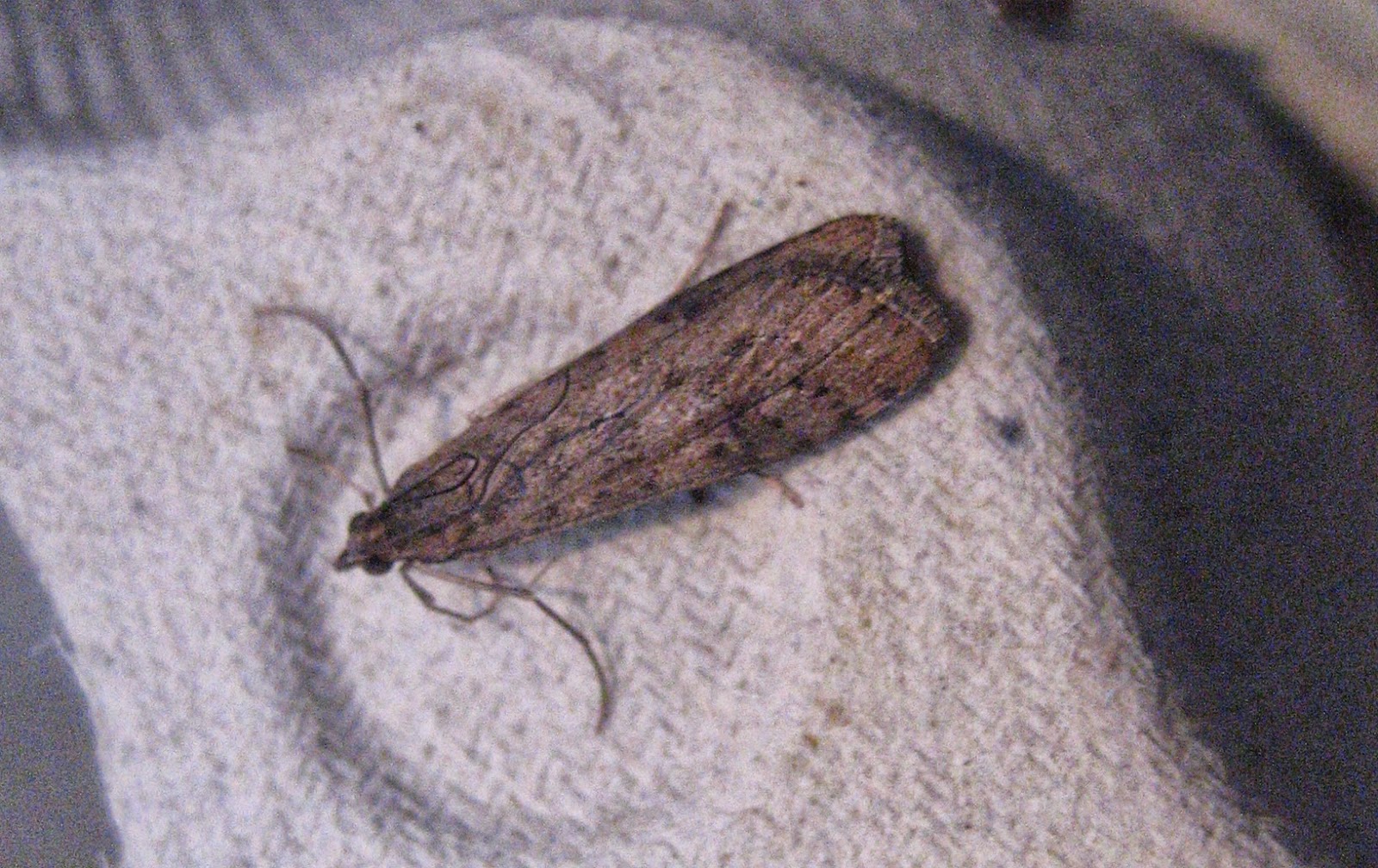
As for the trap, it survived another mild but drizzly night thanks to Mr and Mrs Robinson's illustrious rainshield and was well stocked with interesting arrivals. They included this very smart Sprawler above, one of three, and a nice T-shaped Plume micro-moth whose precise ID I hope to add later.


Then there was a lively Feathered Thorn in appropriately orange, pumpkiny glory, and some familiar - more December Moths in their fur coats, a Black Rustic with its glinting gold kidney marks, an Angle Shades and plenty of November Moths.


Finally, immigrants are in the news with the revelation that the Government's curious 'Go Home' vans with their warning notices to illegal stayers apparently persuaded only 11 people to leave the UK during their summer stint. In exchange, the trap last night welcomed three specimens of our sturdiest immigrant moth, the Dark Sword-grass. Among its many interesting features is an inability over whether to fold its wings this way (left over right):


Or that (right over left):


Thursday, 31 October 2013

Furry fellow


We've had the first frost of autumn, plenty of wet and damp and the pleasanter distraction of a weekend in Paris. So when I lit the lamp last night, there'd been an interval of nearly a week and my hopes were high.


They were realised. Two new species for my trapping in Oxfordshire came to call, both very handsome. The furry fellow at the top is the December Moth, a much grander insect than the Jane Eyre-alike November Moth. It belies its name by flying as early as October in the south of the UK. This one has just got here in time to be an October moth.


Next comes the Grey Shoulder-knot. I used to get the December Moth regularly in Leeds but this one - common in the south - is new to me. Isn't it a delight (as is my latest eggbox which tells me all about the hens' owner, one Kitty Campbell).


Finally, the Angle Shades is so photogenic that I can't resist a picture of the one which snuggled down in the trap last night. Other arrivals included a Silver Y, plenty of Red-green Carpets, a Feathered Thorn, several Large yellow Underwings, Red-line and Yellow-line Quakers and a Beaded Chestnut.


Hooray, we are back on the road.


Monday, 28 October 2013

Interlude Parisien; plus a dead but useful moth


Quelle vue de notre fenetre, alors!  It doesn't actually lean. That was me.

The moths have been left undisturbed for three full nights, the last of which saw us at the outer tip of St Jude's Day's reasonably great storm. Luckily this left no trace here beyond a larger number of leaves tumbling than usual and the trap would probably have survived intact, had I put it out.

City of romance
- so what's the
story here?
So it hasn't been the weather behind my long weekend. Non! C'etait a cose de notre premiere visite a Paris avec l'Eurostar. We hooked up with our pals Sarah and Greg Meredith, she the painter extraordinaire who kindly comments here from time to time, and Greg a master of intricate law and wit.

Il n'y a pas de moths a Paris; indeed, even when I Googled 'moth' and 'Paris' in advance, the best I came up with was a Tripadvisor blast at a restaurant where a moth had been found in the salad (a five star recommendation so far as I am concerned. Appropriately, the notion of us eating a moth was stood on its head at the Bateau Mouche station where the floating quay has this spooky sculpture of butterflies finishing off a tasty skull.


Back home, amid the swirls of wind and rain, the ace interior moth-spotter Penny discovered this Copper Underwing sadly dead beside a windowsill potted plant. Sadly for the moth, but happily for me, because it allowed a chance to see if it was a straightforward Copper Underwing or the slightly less common but almost identical Svensson's Copper Underwing.


As with similar 'doubles' such as the Common and Lesser Common Rustic and the Marbled and Dark Marbled Carpet, incontrovertible distinction usually means doing queasy things like anaesthetising the moth with ether or half-freezing it in the fridge and then checking out tricky detail such as claspers for holding on to female moths during sex. A dead moth conveniently allows us to avoid such measures, although rigor mortis can make wing pattern checks a challenge.


One of the differences between the two Copper Underwing species is the patterning on the underside of the underwing - again, usually very difficult to suss on a live moth because these two are among the jumpiest of all the UK species. Here's the pattern on my ex-moth, below, and Richard Lewington's paintings of the two different wing patterns from the Moth Bible.


Here's Svensson, first


And then, below, the standard Copper Underwing followed by a closer look at the real thing on my moth. My exciting orangey red arrow shows the black mark which establishes that this is not a Svensson's.  Now to await any dissenting Commentor, but I hope that I'm right.


Friday, 25 October 2013

Water off a moth's back


The UK Met Office is going through one of its pre-emptive phases, a common phenomenon since Michael Fish and the Great Hurricane Fiasco of 1987.   Its warnings of extreme conditions on Sunday/Monday have been taken up with enthusiasm in the media, notably my mother-in-law's Daily Express which loves weather stories (as I do myself).


Last night's bulletins included warnings of storm outriders in our area, but I am so complacent about the effectiveness of Mr & Mrs Robinson's rain shield that I put the trap out anyway. I'm glad I did because reasonably heavy rain at around dawn duly descended - and provided striking proof of the fact that moths can truck on through such conditions.


The first one featured - ID shortly (Update: I think it's a Dark Swordgrass, an interesting, entirely immigrant moth which may well be muttering about English weather) - was sitting right on top of the rain shield and you can enjoy its raindrops, which stayed put when I transferred it on to an eggbox fragment for pic two - note lively antennae and general air of wanting to get off. The Feathered Thorn in the third picture (one of eight altogether) was on the outside of the canopy, along with the November moth shown below. None were affected by the wet; all three flew off after a little coaxing back to wakefulness.


As with sheep, whose lanolin led to a vast cosmetics byproduct from the sewage works in Bradford during the city's textile heyday, the insects are protected by waterproofing. They can get bashed into submission by direct hits from large raindrops, especially if accompanied by wind. But these are seldom knockout blows. They pick themselves up and dust themselves down and start over, American style (see you soon, Sarah & Greg...).


It was more comfy inside the trap, admittedly, where this Silver Y was joined by about 30 other moths

Thursday, 24 October 2013

All of a codpiece


Good to hear the BBC's dome-headed arts guru Will Gompertz using a moth metaphor this morning on Radio 4's today - "The arts world is drawn to money like moths to a flame", he said, accurately. By chance, I also came across the final paragraph of Wuthering Heights this week while reading John Buchan's memoir Memory Hold The Door which itself concludes by quoting Emily Bronte's famous words:

I lingered round them, under that benign sky; watched the moths fluttering among the heath, and hare-bells; listened to the soft wind breathing through the grass; and wondered how anyone could ever imagine unquiet slumbers, for the sleepers in that quiet earth.

I put moths in red, not Emily.

One of these days I must attempt an encyclopaedia of references to moths in global culture, but for now here are last night's visitors to the trap. We are in a season of Red-green Carpets, lovely little moths the size of my thumbnail, whose forest colours of greens and russet would have appealed to Robin Hood.


They often rest in the curious manner of my second photograph, with their tails held high in the air - a position suggestive of codpieces and other ways of emphasising that particular part of the body. Given the prime purpose of their existence - to reproduce - I am sure that there is an element in this habit of signalling to the opposite sex. It occurs with much bigger moths such as the Poplar Hawk and there is a common variant among micro-moths of the entire body slanting up at an angle.


I must get on with other things, so here's a glimpse of other overnighters: a Beaded Chestnut, above, followed below by an Autumnal (I think) and a November Moth (I'm sure), a nice little grey and a ditto brown which await my faltering ID skills - Update: I'm going for a couple of Quakers: a Yellow-line and a rather faded Red-line - and finally a curious mini-caddisy type creature which was little more than the size of a pencil tip.


Wednesday, 23 October 2013

Dryza Bone


The trap has survived a filthy night in remarkably good and dry shape, thanks to the practical nature of Mrs W (and the oft-mentioned design talents of its inventors, Mr and Mrs Robinson. Even so, I wasn't expecting many inhabitants, if any, following the heavy rain and actual storms which have drifted lazily northwards over us for the last twelve hours.


So it was a pleasant surprise to find this impressively large Wainscot which is indeed a Large Wainscot, a name deserved by a moth which on a first brief glance is big enough to be mistaken for the pale, buttery form of the Large Yellow Underwing. I was keen to see as much of it as possible and after a flash of its darkly-striped abdomen, I teased it to wakefulness from its initial slumbers (left) to get the fuller picture at the top of this post.


Otherwise there was little on the guest list apart from a male Feathered Thorn, a Green-brindled Crescent and various Chestnut-y things; but it was worth letting the light burn, as in this excellent Moody and Sankey hymn which you can sing along to by clicking the link. I always like the metaphor of the Cleveland ferry. If you get carried away, you can check out the Johnny Cash version here though it comes with a major sentimentality alert.


The dryness of the trap also tells an interesting tale about the efficiency of trees in keeping us and wildlife dry, a question I ponder on wild nights. I had put the lamp on the vegetable patch but when thunder and lightning erupted at around 8pm, I turned it off and was going to abandon ship. That was when Penny said: 'Why not move it to under the walnut tree?' which is what I did. I should have thought of it myself because once, when I was doing the Coast to Coast Walk, I was caught in torrential rain and sought shelter in a fir tree plantation. I stayed as dry as a bone.


My pencil scale, incidentally, is appropriately entomological although I've no idea where we got it from. It says Pentech and then has little squiggly drawings of assorted insects,. In the penultimate pic, you can make out a ladybird under the Large Wainscot's lower body and tail.


Tuesday, 22 October 2013

Cannibal caterpillars


After yesterday's shocking complacency, I think I can genuinely say that last night's moth traffic was boring, unless the micro below is something unexpected and rare. I think myself that it is a Rush Veneer, a moth not blessed with any particular distinction but welcome nonetheless.


Why the cannibal cartoon at the top then? Well, inspired by yesterday's Sprawler revelations, I paid a rare visit to my caterpillar Bible and read that this species' catties are 'strongl cannibalistic, especially when young.' There is no aspect of behaviour in the natural world that should cause any surprise, but this habit is relatively rare among UK moths. Just as well; but no wonder the Sprawler I featured looks rather full of himself, or perhaps more literally, full of his close relations.


Here's another of last night's visitors to end with, below: another male Feathered Thorn, slightly different from the one featured three posts ago in that he lacks the metallic dot towards the end of the forewing. It rained a lot last night but the current very mild spell of weather seems to be turning dry, so here's hoping for tonight.