Saturday, 11 August 2012

Rollercoaster

The Mother of Pearl moth is a restless creature in my experience, usually the first to flutter away when I lift the lid from the trap. For this reason, I don't think I have ever featured it close-up in approaching five years, although it may appear in the background to past pictures of other species.

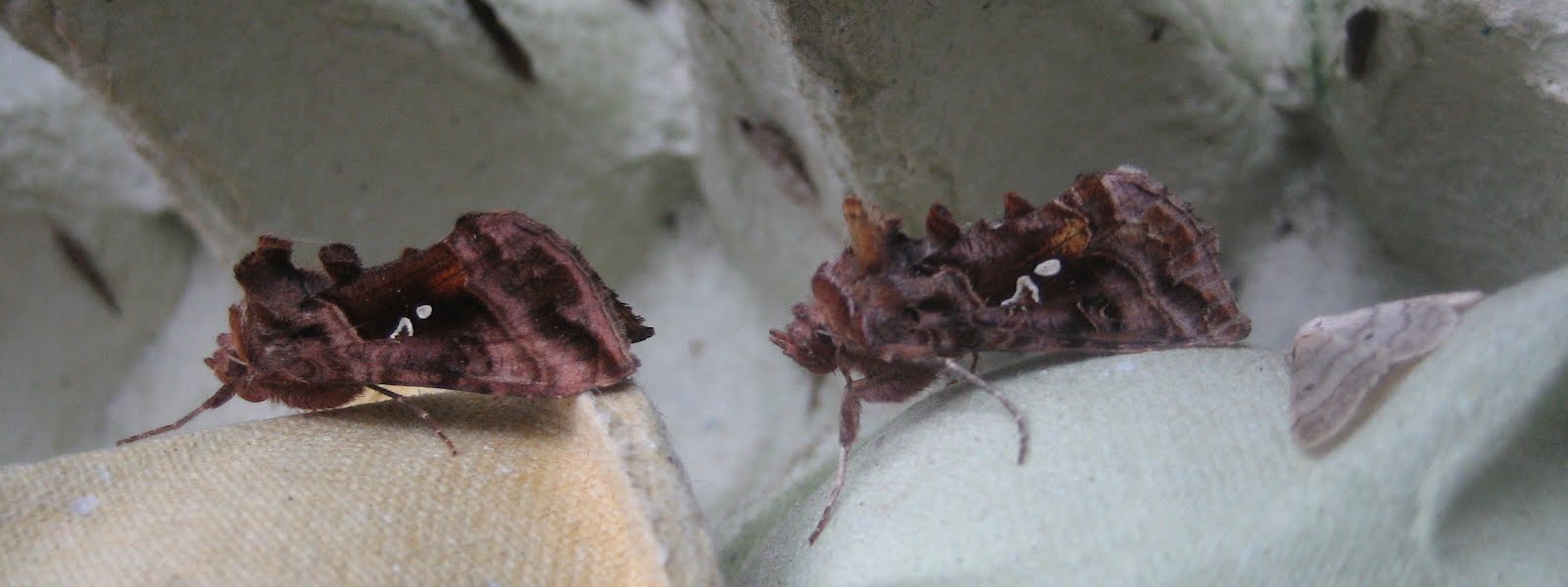
You can see why it is a pleasure to welcome it. The iridescence on its wings is distinctive among UK moths with a spectrum which seems fleetingly to include all the colours of the rainbow as you study it from different angles. For classification reasons about which I am hazy, the moth is a micro although far larger than most of the others and indeed than many macros, including the one next to it (some sort of Carpet?) in the picture below.


It also has a fascinating caterpillar which is one of very few creatures in the world to use rolling as a means of locomotion or to be more precise escape. I can't show you a picture for copyright reasons but there's an extremely good one on the Photoscience library here. Here also is a scientific description culled from another fascinating website called AskNature which catalogues natural phenomena which may be useful to engineers and inventors:

The mother-of-pearl caterpillar, however, can step on the accelerator. If it meets a predator, it anchors its rear to the ground, recoils rapidly, and then rolls away backward like a bright-green tire. Mouth to tail, it completes around half a dozen revolutions during its escape. By turning into a wheel, the caterpillar moves some 40 times faster than its normal walking pace. (Downer 2002:22) 

These are common moths whose caterpillars make a nest in rolled-up nettle leaves - also a familiar sight - so I will be out next breeding season with my camera.


Update: the sky over the M1 in Derbyshire last night, on our way back from Oxfordshire, reminded me of the Mother of Pearl. I hope the comparison survives a photo taken through the window as Penny batted along at 70mph.

Friday, 10 August 2012

Go on, jump!

I mustn't go on about the Olympics too much but they don't come to London very often - ie once in my lifetime. So here's a tribute to today's competitors in the diving, including Team GB's own Tom Daley who carries a heavy burden of expectations on his young shoulders.


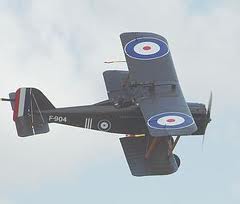
I love these T-shaped micros. I think it's because they bring back the world of craft knives, balsa wood and the size or 'dope' which we used as boys on kit aircraft wings. Kiel Kraft, wasn't it? This little creature resembles the finished product; or indeed the real-life SE5A which my grandad flew in the Royal Flying Corps.


My late and very dear Aunty Anne wrote a memoir of his love affair with my granny and his wartime flying, crash and capture. It's called Dear Girl, I escaped, and can be tracked down online, eg. here. Thanks to Wikipedia for the 'plane picture.

Thursday, 9 August 2012

A wing and a prayer

Needless to say, this is an awful year for butterflies which must be reading Genesis for advice on making arks. But the current much better weather has tempted some out, notably a beautifully fresh Small Tortoiseshell which was on our buddleia yesterday.


Few butterflies live long in their adult state and that has sadly been true of this Green-veined White whose relic I found yesterday. Can it stand as a symbol for those Olympians who tripped and fell and failed to win the glory for which they had hoped and trained for so long?


I mustn't overdo my parallels with the Games, but since they live just down the road, I must dedicate a moth to those triathlon marvels, the Brownlee brothers. The cop-out would be a brown moth and the choice of candidates for that position is infinite in the UK. Instead, here is a Lesser Swallow Prominent which arrived last night. Its whole appearance seems to me to speak of dash and speed.

Wednesday, 8 August 2012

All of a flutter


More bird news this morning - two magpies inspecting the trap. Beautiful but somehow ruthless-seeming birds. I have childhood recollections of being told how they attack smaller birds' nests.

Still, Nature is cruel; and two magpies mean joy, which there duly was: a wave of the Waves whose delicate grace is a delight at this time of the year. As those familiar with my errors may expect, I am not very good at telling them apart, but let's have a go. First, here is a picture of the two main types which frequent the trap at this time of year, especially when I put it near trees.


On the left is a Riband Wave with the clearly-defined band which accounts for its name. On the right, with a thicker and more jagged line crossing the wings like a seismometer graph...well now, what is this? I thought initially that it was a Cream or Lesser Cream Wave, but they are uncommon. It doesn't look quite like a Smoky Wave or Common Wave. It could be another Riband, as variation in moths is frequent. Help! 

To aid the inquiry, here are some definite Ribands from last night, photographed first from above, with a beetle-type friend, and then from below.


Meanwhile, here is a Common Wave


and, I am pretty sure, a Common White Wave


and one of the tiddlers in the family, half the size of those above, a Small Fan-footed Wave 


and the hopelessly-misnamed Single-dotted Wave with its many dots


and thus back to a closer view of another specimen of the one which puzzles me 


Expertise much appreciated, as always. At least I've tried...


Tuesday, 7 August 2012

Breakfast delayed

Apologies for the blurry, snatched photos in this sequence, but I had to act quickly to record an interesting sight.


I left the trap in a quiet and little-frequented spot last night and this morning I saw a robin sitting ominously on the edge of the bowl. With its self-important stance and little red tummy thrust out, it had all the air of a diner in a gentleman's club wondering why his poached eggs were taking so long. Here it is again, with added visual aid to compensate for terrible blur.


Like such a diner, it didn't seem to have the inclination to find a tasty and varied breakfast right under its nose. Here are the three potential courses: a Riband Wave and Canary Moth for starters; the robin was perched right above the Canary and inches from the Wave. Then a Swallowtail moth for mains and a Common Footman and tortrix micro for pud.


Was the robin finicky in its tastes? They prefer worms but wouldn't turn their beak down at a moth, I think. Update: check out interesting comment on this.

Had it already dined? Unlikely; there are seldom more than half-a-dozen moths on the outside of the trap. 

Had it just arrived? Too much of a coincidence and it was 6.30am and had been light for ages. Update: but I realise I had only just turned off the light (see comments again).

Or was it simply not hungry? I doubt it. Birds seem to me to feed all the time.

Perhaps it couldn't see, smell or sense them? Mmm, maybe we're getting warm. 

Were they saved by keeping completely still? That would be my best bet. 

Views and theories from the learned would be very welcome.

Monday, 6 August 2012

In the pink

The eagle-eyed may have noticed a sliver of pink, like a leaf, at the bottom of yesterday's photo of the Olympic Chairman, aka Poplar Hawk. It caught my eye too, because the Barred Red - which is what it was - is an intriguing moth.


It is entirely pink for a start, which is unique. But it also has a rare pale green version which looks extremely like the much more common Light Emerald. The standard pink Barred Red also has many of the features of the LE, although the little triangular point at the bottom of the hindwing is less pronounced. I'm sure that, like those pairs of photographs in Private Eye, they must be related.


Here they both are, the Barred Red closer-up with some of its sleepy companions, and below that, a Light Emerald which came to the trap last week. This is the high season for these gentle, fluttery moths with slender bodies and large wings. I plan a Laura Ashley fashion parade tomorrow of some of the others, the various dainty, white- and cream-coloured Waves.

Sunday, 5 August 2012

Golden Jess - Olympic moths 3

Gold medals shower on Team GB - Yorkshire alone is seventh in the medal table - and golden moths have duly arrived here in Leeds. First of all, my tribute to the lovely, sporting and Sheffield-born-and-dwelling Jessica Ennis: an appropriately heart-shaped Acleris forsskaleana.


The other gleam of gold in the trap came from this Cypress Tip micro below, which is standing in for the other five Team GB gold medallists on Super Saturday. It is meeting some of its fans, one of them with amazingly long black-and-white antennae (click on the pick to enlarge).


And finally, here is the chairman of the Olympic Committee getting ready to award the medals - our good old Poplar Hawk moth, largest of the species which visit me. They've been around since mid-June. Well done, Olympians! And more awaits us today.

Saturday, 4 August 2012

The silver arrow - Olympic moths 2

Behold the second in my Olympic series: a silver (well, silver-ish) moth with a definite 'Higher, faster, better etc' gleam in its pallid green eye. Click on the pic to see that eye more closely.


This is the micro Catoptria falsella whose engaging habits include burrowing (as a caterpillar) deep into moss on the roofs of buildings and munching away at the said moss until it is time to pupate.


The Penny Wainwright Pencil Scale shows how small it is; but this other silver contender is even smaller as you can see. I am puzzling over a number of possibilities for its identity as per usual. Is it one of the Phyllonorycters? Or another tiny beast whose Linnean second name would please children; nanana? To emphasise its tiny-ness, here it is again, exchanging gossip with a Common Footman, a pretty small macro moth itself.

Update: many thanks to wise and welcome commentator Robert Homan who has nailed it as Phyllonorycter geniculella which isn't in my Micro-moth Bible. I must find out why later on, but it is too sunny now. The moth was named as long ago as 1874 by someone called Ragonot. I couldn't find out more about them on a quick Googling, but I did discover that there is a woman bodybuilder in Washington called Brenda Ragonot.


Finally here is a pug from the trap which I am also tracking down. I include it because it looks as I would do, should I be foolish enough to enter an Olympic race of any kind.

Update: pug my foot. Once again, Wainwright blunders. As Stewart, another wise and welcome commentor, suggests, this is another micro and it is in the Bible. It's Eudonia mercurella and like the silver star at the top, its caterpillar lives deep in moss and munches its surroundings.

Friday, 3 August 2012

Going for gold: Olympic moths 1

Britain has suddenly hauled itself up the Olympic Games medal table - though 'hauled' is a rather crude word for the wonderfully smooth rowing of our women's pair. The science of rowing fascinates me as an occasional sculler; watch as the boats pause, indeed almost slip back slightly, before each surge forward as the oars dip and pull. Any designer who could crack this hiccough would win every medal going.


Anyway, I will try to feature moths appropriate to each grade of medal between now and Monday, although I will be lucky if the trap provides me with such ideal candidates as the Silvery Arches or the Goldwing. This morning, though, this Burnished Brass was dozing away and it will do nicely for bronze. I'm posting two pictures to show how another interesting department of science - focus - affects even micro-mode digital photographs of a creature as small as a moth.  The first is better focused on the BB's head and tufty hairstyle; the second on its glowing wing. Perhaps you can make another technical breakthrough by merging them on Photoshop.


You can click on the pics to make them exquisitely, or frighteningly, bigger.

Thursday, 2 August 2012

Multum in parvo

I come from England's biggest county which has just celebrated Yorkshire Day, but I concede that the best motto belongs to midget Rutland, way over at the bottom of the scale. Multum in parvo, a lot in a little, applies again and again in the world of moths.


Look at this one above, the Marbled Beauty, which is not a lot bigger than the end of my thumb (an average grown-up man's thumb) and yet displays such an intricate pattern of softly toned colours. It flew in last night and took its place unassumingly among the various Rustics and Quakers, assembled like a party at an English village in George Eliot's day.


Three others caught my eye because of their similar shape, a fan with the sinister overtones of those Vulcan V-bombers which used to swoop over the A1 in Lincolnshire.  They even have their own take on RAF camouflage; not surprisingly, because camouflage artists have always gone to the natural world for inspiration. Above, a Snout (check out that 'nose'!) and a Fan-foot and below, mmmm, an Umm...(Update: a Phoenix?) I will go back to bed with Penny and my tea and check it out.

Wednesday, 1 August 2012

Hum drum


I should by rights have a golden moth today, with the UK in ecstasies over our first Olympic gold medal. Tomorrow, maybe. For now, I can offer you only a trio of humdrum moths of the Lesser/Common Rustic and Quaker variety. Goodness, the hideous pink of the background paving stone is more colourful than they are.


Still, not so fast. Once you start to dwell on their wing tones and patterns, you start to see hidden beauty, and that is often more satisfying than the in-your-face variety offered by flashy butterflies. As in the world of moths, so in that of we humans, maybe? I will leave you to ponder that thought while I try to identify these three (Bright-line Brown Eye, Common (Lesser Common) Rustic, Common Quaker?) before one of my much more able commentors kindly saves me the trouble.

Tuesday, 31 July 2012

I've got mail!

We've been away for the weekend and turned the computer off in our absence. Luckily maybe, because look who's been examining our email.


It isn't a terribly exciting guest (perusal of the micro guide continues - see Update below), but our encounter says something about photography, computers and moths. Above is the visitor taken close-up on micro-mode without flash. Below, behold it with the flash turned on.


It had moved by then to examine another icon, of a photograph of my mother-in-law. I think you can just make out her name, Dilys, on the icon label in the gloomy background to the left of the moth. Update: it's a Brown House Moth, info courtesy of my wise and very helpful commentor Ray who, alarmingly for the UK's tourism industry, is familiar with them in B&Bs. I say 'alarmingly' because these are among the few moths whose genuinely bad habits cast a shadow over the whole and almost entirely blameless moth world. They eat books, cashmere sweaters, socks...

Friday, 27 July 2012

Let the games (and Leeds Met's bats) flourish!


Rather a cluttered post today. First, all hail to the Olympics which have prompted all manner of ingenuity in the retail trade. Here is a special Team GB rose which my mother-in-law Dilys got for me yesterday at the supermarket.

I had to add a moth but didn't want to trap last night, to give the poor things a break after a long run. So I scoured the grass round the spot where I'd placed the light the night before. This Scalloped Oak was still drowsy enough to pose, and I guess that it could be taken to represent British pluck - Hearts of Oak and all that.  Good luck guys!

Next, I'm due to make some remarks at Leeds Met today, one of our two ace universities here, so I Googled 'Leeds Met' and 'moth' and to my delight discovered:


But where do moths fit into the plan?  Eeek!  They are included as food for bats.


Finally, back to the Olympics and a couple of recent pics from the eggboxes which seem to show victory - the two Golden Ys - and disaster - the crashlanded Swallowtail Moth.  As Kipling put it:


If you can meet with Triumph and Disaster
And treat those two impostors just the same...


You'll be a moth, my son

Thursday, 26 July 2012

Carrying a torch for tiny stars

I would be a poor scientist because novelty is the main excitement that I draw from my moths. Nothing gets my heart beating faster than the sight of something different or unusual among the eggboxes. A Darwin or a Newton would buckle down instead to counting how many Yellow Underwings there are and ultimately draw important conclusions from that. Alas, not me.


So here is my morsel of joy for today: although it isn't uncommon, I haven't seen a Bramble-shoot Moth  in the trap before. Thanks to the Penny Wainwright Pencil Scale (using a special London Olympics pencil), you can see that it's a micro. I don't think I'm ever going to go overboard about these little creatures because they are very little; but close-up, their patterns are lovely. You can click on the pic to make it bigger.


Here's another: Acleris forsskaleana with its lovely golden patterning, perching outside the trap but not inclined to flit away. its caterpillars spin little homes in rolled leaves of maple trees, of which we have a couple. We also have millions of brambles, so I take it that these two fellow-residents are happy.

Tuesday, 24 July 2012

Where the Bee (Hawk) sucks...

Forgive me one last visit to France but I had forgotten this lucky picture of a Bee Hawk moth outside our bedroom window in Tarn. Given the number of blurred shots I have taken of the very similar but more common Hummingbird Hawk, it is something of a miracle that everything fell into focus this time.

I would quite like to have a proboscis, to whip out and then reel back in with the best of the nibbles at social functions. Moths and butterflies use them greedily and sometimes appear to enter a sort of trance when sipping nectar, especially on honey-scented trusses of buddleia flowers. Here's another avid French feeder, a Large Skipper, which allowed me close enough to portray his (or her) eager tongue. All quite human, really.